
Feather's relocation index (2026)
Why we created a relocation index for British residents
In 2025, an estimated 253,500 British citizens left the United Kingdom.
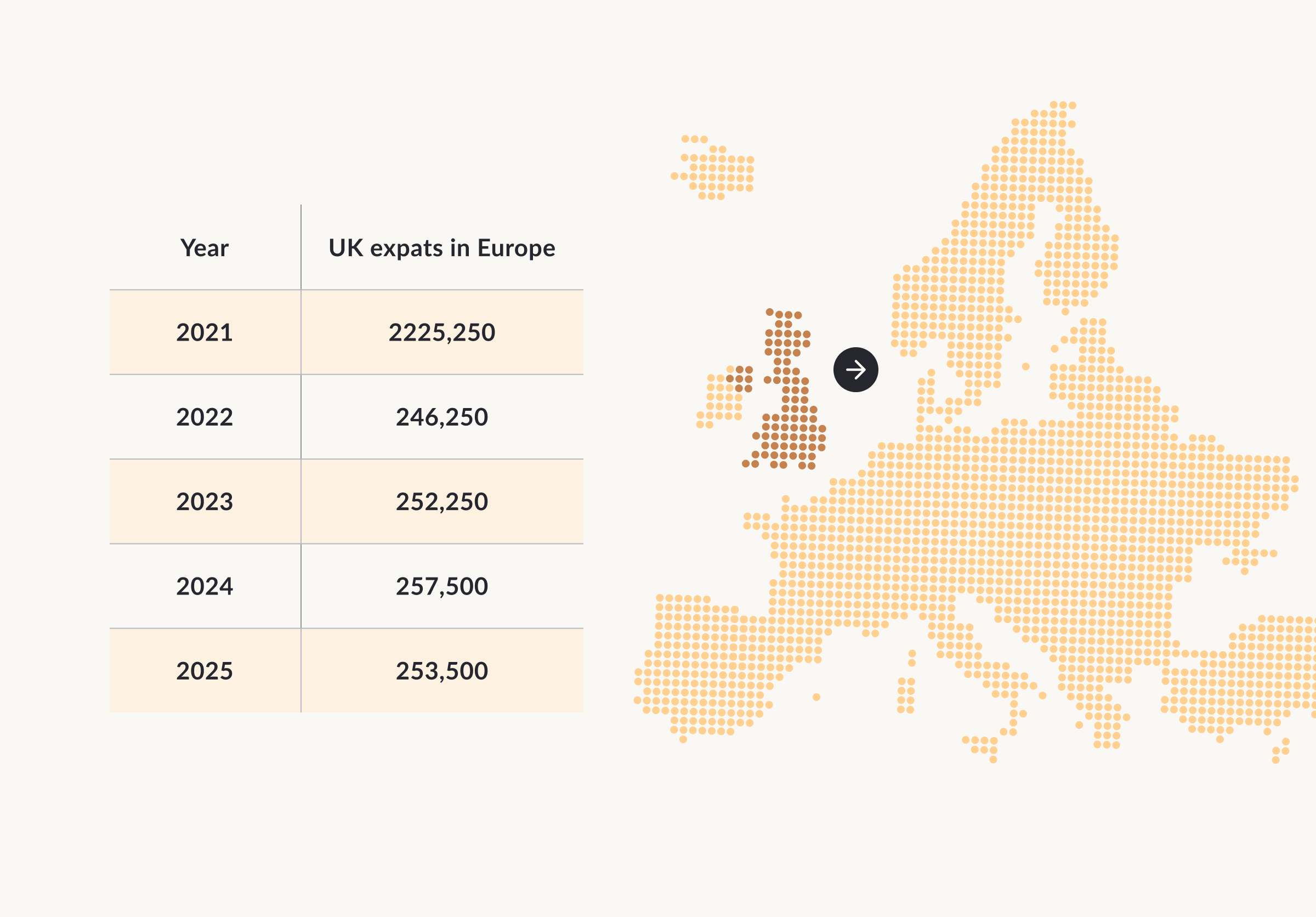
The reasons aren't hard to understand:
- Wages are stagnating.
- Public services are under long-term pressure.
- And for younger professionals and families, the idea of owning a home, or even renting comfortably, often feels more realistic somewhere else.
At the same time, more people are looking at European countries and cities and seeing a better overall equation:
- Walkable streets.
- Efficient public transport.
- Cleaner environments.
- Lower relative costs.
- A stronger emphasis on work-life balance.
Yet, moving to Europe isn't as straightforward as it used to be.
Brexit removed visa-free relocation for UK citizens, adding real friction to what was once a simple process.
And with only 1 in 5 Britons speaking another language fluently, navigating foreign-language bureaucracy is a genuine obstacle.
This is the gap traditional guides don't address: Most comparisons focus on the cost of living, but that captures only one piece of the puzzle. Post-Brexit, the feasibility of relocating matters just as much as affordability…
- How difficult is securing a visa?
- How long does the process take?
- How easy is it to actually settle once you arrive?
That's why we created the 2026 Feather Relocation Index.
We wanted to reframe the question from "Where can I afford to live?" to something more useful: "Where can I realistically relocate?"
What the index measures
To rank European cities and countries by ease of relocation, we built a multi-factor framework that considers both administrative friction and lifestyle factors.
The index assesses four factors:
- Openness to immigration
- Economic opportunity
- Ease of opening a business
- Administrative complexity
For each factor, we examined several sub-indicators and weighted them based on their real-world impact. This approach lets us capture a broader range of variables that affect how realistic relocation to a given place is.
For a detailed breakdown of our methodology, data sources, and scoring calculations, see our Index Methodology and Scoring document, which contains the full scoring criteria we applied to each sub-indicator.
Openness to immigration
Countries and cities that are more welcoming to newcomers tend to be easier to relocate to.
A high score here signals a city is likely to have a larger community of expats and English speakers, which makes integration smoother. A lower score suggests the opposite.
Here’s how we measured it:
English proficiency.
A country's level of English proficiency affects how easily you can communicate with colleagues, officials, and navigate daily life.
With nearly 80% of Britons being monolingual, this is often decisive.
We measured this using the EF English Proficiency Index. Here’s how each of the countries performed on that index:
| Country | English proficiency score |
|---|---|
| Netherlands | 636 |
| Sweden | 608 |
| Denmark | 603 |
| Germany | 598 |
| EU average | 583.26 |
| Spain | 538 |
| Italy | 528 |
| France | 524 |
Foreign-born population share.
Cities with more foreign-born residents tend to be more welcoming to newcomers.
This metric captures something harder to quantify: how “at home” a city feels to new arrivals.
Larger expat communities can bridge language and cultural gaps, especially during your first few months. They're also a source of support for navigating the everyday: shopping, booking appointments, and making friends.
We used Eurostat data to calculate what percentage of each city's residents were born outside the country. The table below shows the results for each city:
| City | Immigrants as % of population |
|---|---|
| Amsterdam | 34.06% |
| Paris | 18.92% |
| Berlin | 15.17% |
| Milan | 13.52% |
| Copenhagen | 12.60% |
| Barcelona | 9.83% |
| Rome | 9.15% |
| Madrid | 9.12% |
| Lyon | 6.91% |
| Stockholm | 4.54% |
| Munich | 3.79% |
| Frankfurt | 2.41% |
Residence permits per 1,000 people.
This indicates how willing a country is to welcome people seeking long-term relocation.
A higher rate of permits issued suggests greater openness to immigration. Post-Brexit, most Britons will need a long-term visa or residence permit to relocate, so a country that issues more of these is a feasible option.
We calculated this using 2024 Eurostat data, and you can find how many residence permits each country gave out in the table below.
| Country | Residence permits granted per 1000 persons |
|---|---|
| Spain | 11.55 |
| Denmark | 7.9 |
| EU average | 7.79 |
| Netherlands | 7.15 |
| Germany | 6.53 |
| Sweden | 6.33 |
| Italy | 5.87 |
| France | 5 |
Economic opportunity
Knowing whether you can maintain a comparable standard of living once should also be part of the equation.
This is where salary comparisons can be misleading.
Most European cities have lower average salaries than London (which boasts an average salary of £3,615.84, after tax). But the number on your payslip doesn’t matter: it's what that salary can actually buy you that does.
Maintaining or improving your relative standard of living makes a city feasible, and it makes the considerable hassle of relocating worth it.
Here’s how we measured it:
Purchasing power relative to London.
To compare salaries fairly across cities, we adjusted salaries for local purchasing power. A lower wage can deliver a higher standard of living, depending on how far your money goes.
Cities scoring higher than London on this metric mean you can expect a comparable or better quality of life, even if your nominal salary drops.
We calculated this using data from Numbeo.com.
Cost of living relative to salary.
We looked at the average cost of living for a single person in each city as a percentage of the local average salary, then compared that ratio to London.
A lower percentage means you'll spend less of your income on daily essentials (leaving more for saving or spending as you choose).
This data also comes from Numbeo.com.
Rent costs.
Rent is typically the largest monthly expense for most people, and it's a major driver of cost-of-living concerns in the UK.
We compared the average cost of a one-bedroom apartment in each city to London's average (£2,370.00), using Numbeo.com data.
Cities with lower relative rents will be particularly attractive if housing costs are pushing you to consider a move.
| City | Average salary | Average salary adjusted for Purchasing power (Compared to London) | Average cost of living per single person per month (excl. rent) | Average 1 bedroom rental cost |
|---|---|---|---|---|
| Frankfurt | €3,936.00 | €5,387.30 | €1,078.40 | €1,188.92 |
| Copenhagen | €4,081.58 | €4,779.20 | €1,168.80 | €1,515.99 |
| Munich | €3,731.96 | €4,726.80 | €1,046.10 | €1,356.12 |
| Berlin | €3,159.75 | €4,565.30 | €994.30 | €1,053.20 |
| Amsterdam | €4,164.20 | €4,551.00 | €1,156.50 | €1,970.32 |
| Stockholm | €3,094.72 | €4,165.80 | €1,100.80 | €1,145.15 |
| Lyon | €2,627.33 | €4,158.20 | €1,003.60 | €689.56 |
| Paris | €3,253.02 | €4,078.20 | €1,045.80 | €1,232.42 |
| Madrid | €2,253.03 | €3,610.50 | €805.40 | €1,156.03 |
| Barcelona | €1,942.26 | €3,132.70 | €793.20 | €1,217.45 |
| Rome | €1,908.78 | €2,996.50 | €891.20 | €1,036.51 |
| Milan | €2,065.33 | €2,753.20 | €994.20 | €1,255.53 |
Job availability.
Your ability to afford life in a new city depends on finding work.
To measure this, we calculated the number of open jobs per 1,000 residents in each city.
This lets us compare opportunities across cities with vastly different populations and economies.
Cities with more open positions per capita offer better prospects for Britons seeking employment as part of their relocation.
To gather job data, we used LinkedIn alongside country-specific job boards: StepStone for Germany, Pôle Emploi for France, InfoJobs for Spain, Indeed Italy for Italy, Indeed Denmark for Denmark, Werk.nl for the Netherlands, and the Swedish Public Employment Service for Sweden. We averaged the results across both sources, then divided by each city's population using the latest available Eurostat data.
Here’s how many open jobs we found per 1000 residents in each city.
| City | Number of jobs per 1000 residents |
|---|---|
| Amsterdam | 42 |
| Frankfurt | 39.5 |
| Munich | 36 |
| Berlin | 33 |
| Copenhagen | 31.5 |
| Stockholm | 29 |
| Madrid | 27.5 |
| Paris | 26 |
| Barcelona | 24.5 |
| Milan | 23 |
| Lyon | 21 |
| Rome | 18.5 |
Ease of opening a business
If you're an entrepreneur, relocating means you'll need to register your business with local authorities. For freelancers and the self-employed, opening a locally-registered business can be the most consistent visa route.
How complicated the process is and how long it takes can make or break your decision to move to a particular city.
Countries with simpler, faster, or cheaper registration processes are naturally more feasible for business owners. A higher score on this factor means a country offers more streamlined pathways to getting your business up and running.
We measured it by looking at:
- How difficult it is to register a business entity as a foreigner
- How long the registration process typically takes
- And whether you can complete it digitally.
To gather this data, we surveyed relocation experts and immigration lawyers working across each of the countries in our index. Their responses were scored and averaged by country.
Administrative complexity
Finally, we looked at the general administrative friction involved in relocating to each country. A more challenging process means more obstacles to navigate (and you'll need to decide whether it's worth the effort).
A higher score here means less complexity for British residents and fewer hurdles to clear.
We measured it through:
Pre-arrival bank account access.
Having a bank account is essential for receiving money and paying bills.
Countries scored higher if you can open a long-term savings or investment account before you physically relocate. For British emigrants, being able to sort this out early removes a major administrative obstacle from the process.
We gathered this information from expat forums on Reddit and official government websites.
Mandatory insurance requirements.
We looked at the types of statutory insurance each country requires and whether you can secure them before moving.
Countries with fewer mandatory insurances (and the option to arrange them in advance) scored higher.
Fewer requirements mean fewer challenges to navigate before you meet the legal obligations of your new home.
This data came from government sources and Feather’s team of insurance experts.
Visa processing times, requirements and costs
The visa you're eligible for, the administrative steps involved, costs, and the overall difficulty of the process all contribute to how feasible it is to move to a particular country,
To measure ease of relocation, we surveyed relocation experts and immigration lawyers across each country in our index to assess the difficulty and complexity involved. Countries with faster times, fewer requirements and lower costs scored higher.
Fewer requirements mean fewer challenges to secure a permit to relocate to your chosen home.
Specifically, we looked at:
- How difficult the process is to secure a relocation visa or residency permit.
- How long the visa process typically takes.
- The average cost of obtaining a residence permit.
- And the difficulty of securing a Social Security number and a tax ID.
How we ranked the countries and cities
We gave each county a score out of 100 based on its performance across country-specific measures like the number of long-term visas granted and the overall visa process. A higher score indicates an easier, more realistic path to relocation.
For city-specific rankings, we gave each city a score out of 100. 75 points came from how well its country performed in the rankings, with another 25 coming from city-level factors like cost of living and its expat population.
Best cities for UK nationals to move to in Europe
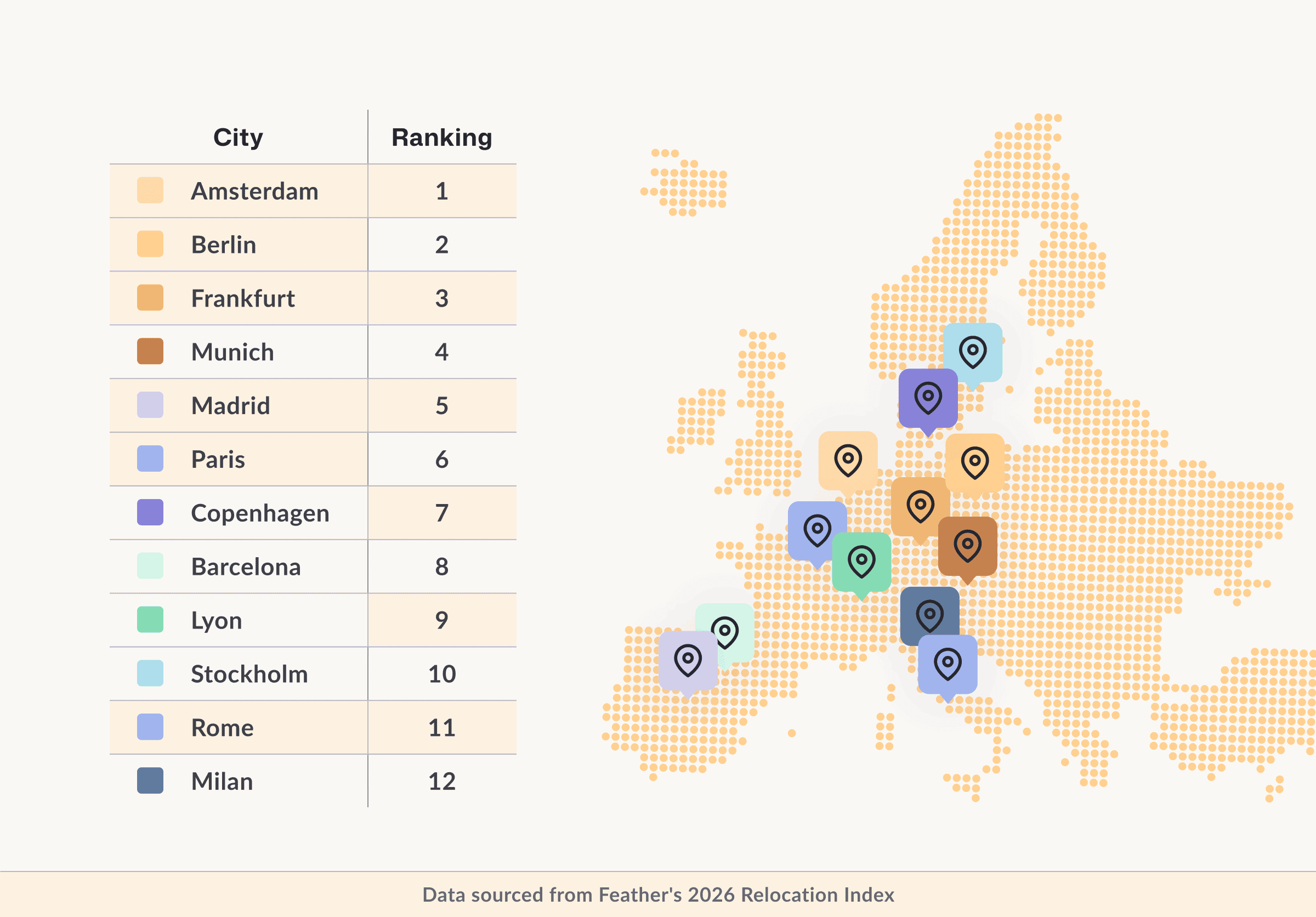
| Rank | City | Total |
|---|---|---|
| 1 | Amsterdam | 78 |
| 2 | Berlin | 73 |
| 3 | Frankfurt | 72 |
| 4 | Munich | 70 |
| 5 | Madrid | 66 |
| 6 | Paris | 65 |
| 7 | Copenhagen | 63 |
| 8 (tie) | Barcelona | 62 |
| 8 (tie) | Lyon | 62 |
| 10 | Stockholm | 58 |
| 11 (tie) | Rome | 49 |
| 11 (tie) | Milan | 49 |
#1 Amsterdam (78/100)
The Dutch capital takes the title of the best city for UK nationals to move to in Europe with a score of 78.
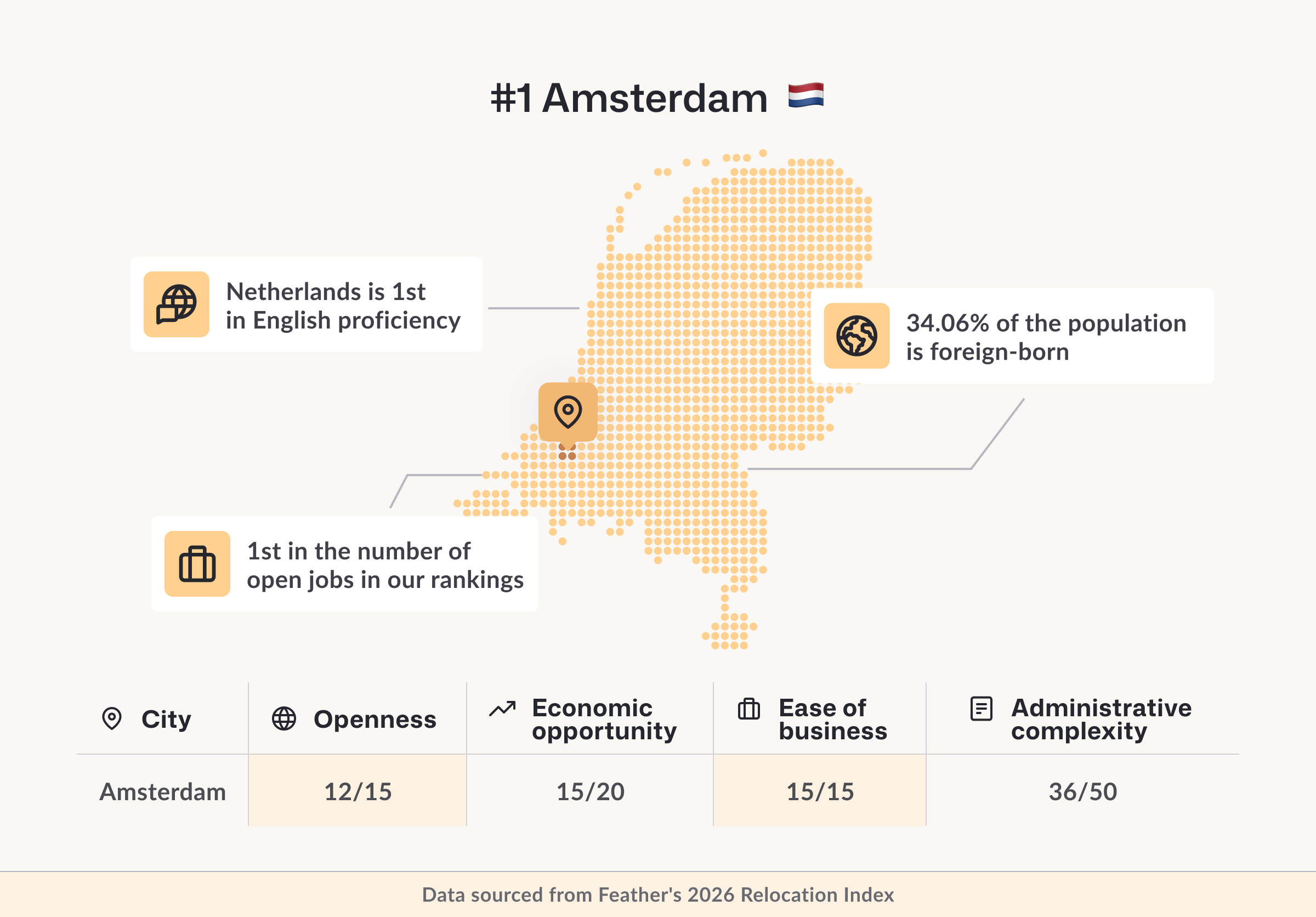
The city benefits from the Netherlands’ remote-friendly business registration requirements, high degree of English proficiency, and overall transparent visa process. What truly gives Amsterdam its edge are its expat population and earning potential.
Amsterdam has the largest expat population among cities in the index. Approximately, 34% of the city's residents were born outside of the country. This makes it a great option if you’re looking for a community to help you navigate your first few months in a new city.
It also offers a high average salary of €4,164 per month, and one of the continent’s strongest job markets with roughly 42 open roles per 1000 residents, or 8 more than London’s 34.
What this means for you
Taken together, these factors make Amsterdam a great choice whether you’re an entrepreneur or an employee.
However, the city does have a higher cost of living than most of the other cities in the list. In Amsterdam, renting an average 1 bedroom apartment takes up nearly half of your salary. This can make it a less desirable option if cost of living concerns are your primary reason for
Alternative destinations
If you’re looking for a more cost-effective destination that still offers a strong job market and large expat community, then consider Berlin.
Frankfurt is another great choice if you’re looking for a city with high earning potential and a strong job market, but don’t need as big an expat community.
#2 Berlin (73/100)
The German capital is the second best city for UK nationals to move to in Europe, with a score of 73 out of 100.
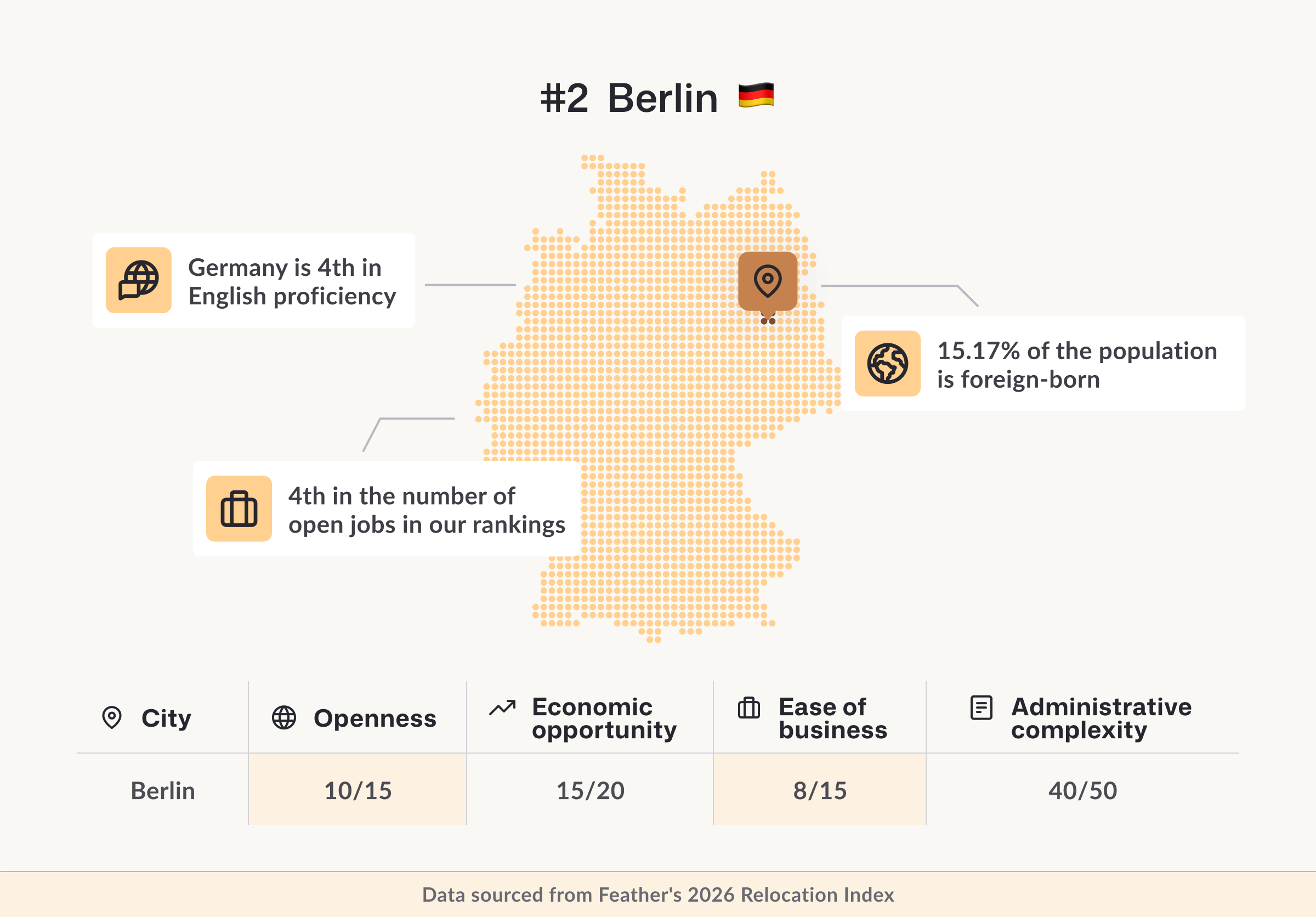
Like Amsterdam and the Netherlands, it benefits from Germany's reliable visa pathways, particularly for employees, and a high degree of English proficiency.
Berlin offers a large expat community with 15.15% of its residents having been born outside of the country, and a robust job market with 33 open jobs per 1000 residents.
Its average salary of €3,158.75 is also one of the highest in the index. However, it’s able to go much farther due to Berlin’s lower cost of living.
What this means for you
Berlin is one of the most feasible options if cost of living is a major reason for relocating, as the city offers a good degree of affordability. The city’s strong job market is great news if you’re looking for a job that allows you to benefit from the country’s visa pathways.
It also has a large expat community who can help you navigate the transition to living in a new country.
Alternative destinations
If a large expat community is less important to you, and you’re looking for a city with higher earning potential, then Frankfurt is a good alternative. Its average salary is one of the highest in Europe, and its job market is only beaten by Amsterdam.
#3 Frankfurt (72/100)
Frankfurt narrowly trails Berlin and claims third place among the best European cities for UK nationals to move to. Like Berlin, it benefits from Germany's high degree of English proficiency and a reliable visa pathway, particularly if you're an employee.
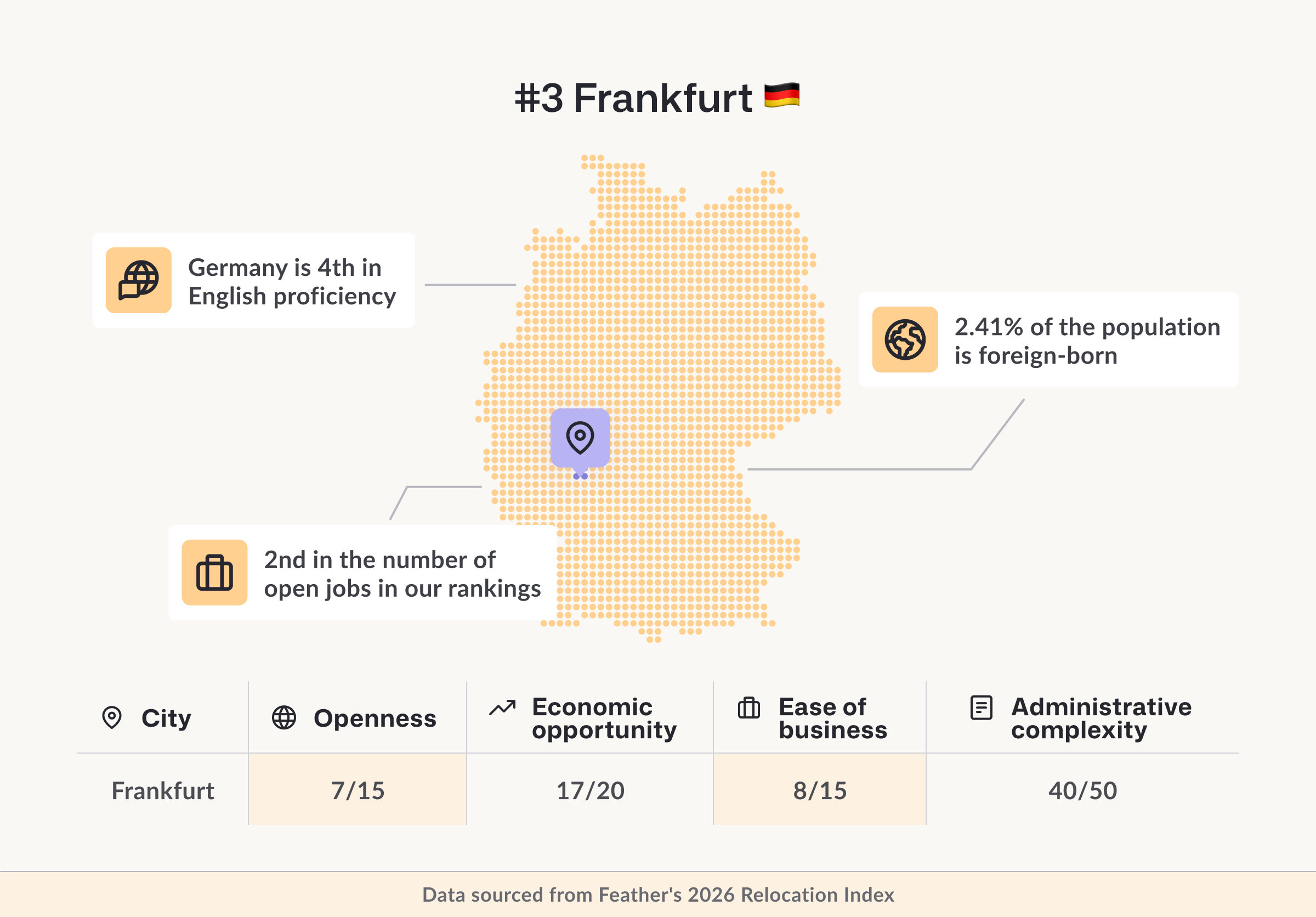
What separates the cities in terms of feasibility comes down to your personal situation and priorities. Frankfurt has the second strongest job market with an average of 39.5 open roles per 1,000 residents.
It also has one of the highest average salaries in Europe at €3,936 per month. This is only beaten by Amsterdam and Copenhagen.
What this means for you
Frankfurt’s strong job market and high average salaries make it a better option than Berlin if you’re looking for a higher earning potential with a comparable standard of living.
However, it does have a significantly smaller expat population, with just 2.4% of its residents having been born outside of Germany. That would make Berlin the better choice if your priority is to have a community that can help you adjust to life in a new country.
Alternative destinations
If you don’t mind trading off a small expat community for higher earning potential, Munich is a good alternative to Frankfurt. The Bavarian capital also scores high for average salaries, has a healthy job market, and a comparable standard of living.
Worst cities for UK nationals to move to in Europe
#7 Stockholm (58/100)
Sweden’s capital city is the third worst city for UK nationals to move to in Europe with a score of 58 out of 100.
Contributing to this is the city’s relatively small expert population, with just 4.54% of its residents being born outside of the country. This hurts its overall openness to immigration score, despite the country’s high rate of English proficiency.
Despite having a high average salary of €3,094, Stockholm’s relative cost of living and its average rent prices make it a less affordable option. The city’s job market is weaker than those of the German cities and Amsterdam, with 29 open jobs per 1000 residents.
What this means for you
Stockholm remains a good option if affordability is not a major reason for wanting to relocate. However, its smaller job market can make it harder to find a job in the city and makes it less feasible if you require one to kickstart your relocation process.
The city’s expat population can make it challenging to navigate moving to the city, even though English proficiency won’t be as big of a concern as it might be in places like Barcelona or Madrid.
#8 (tie) Rome (49/100)
Rome ties with Milan as the worst city for UK nationals to move to in Europe. The Italian capital earned a score of 49 out of 100.
The city’s performance is hampered by Italy having more cumbersome visa pathways, harder processes for registering a business as a foreigner, and the country’s low levels of English proficiency.
Rome also struggles with a much smaller expert population, with fewer than 10% of the city's residents born outside of the country.
It also has one of the smallest job markets with its average of 18.5 open jobs per 1000 residents, the lowest among cities in the list.
What this means for you
If you don't speak Italian or are moving primarily to escape high living costs, Rome presents significant challenges. In particular, its expat community may not be big enough to compensate for the country’s low levels of English proficiency.
Additionally, its smaller job market and the country’s low number of residence permits can make it hard to justify the application process if you don’t meet all of the requirements.
#8 (tie) Milan (49/100)
Like Rome, Milan’s score is affected by many of Italy’s country-level factors. That sees it tie for last place in the rankings.
Italy’s second largest city does have an expat population comparable with that of Berlin, but it’s not clear if that’s enough to make up for the country's overall level of English proficiency.
The city also has the third lowest average salaries at €2,065.33, and the lowest purchasing power relative to London. It also has one of the highest relative costs of living, and higher rent prices than both Berlin and Frankfurt.
What this means for you
If you work in a lucrative industry or a highly skilled role, this can offset some of these affordability challenges. Milan’s larger job market can make it more feasible than Rome, especially if securing full-time employment is part of your relocation plan.
However for most Britons relocating for affordability, the city is hard to justify.
Best countries for UK nationals to move to in Europe
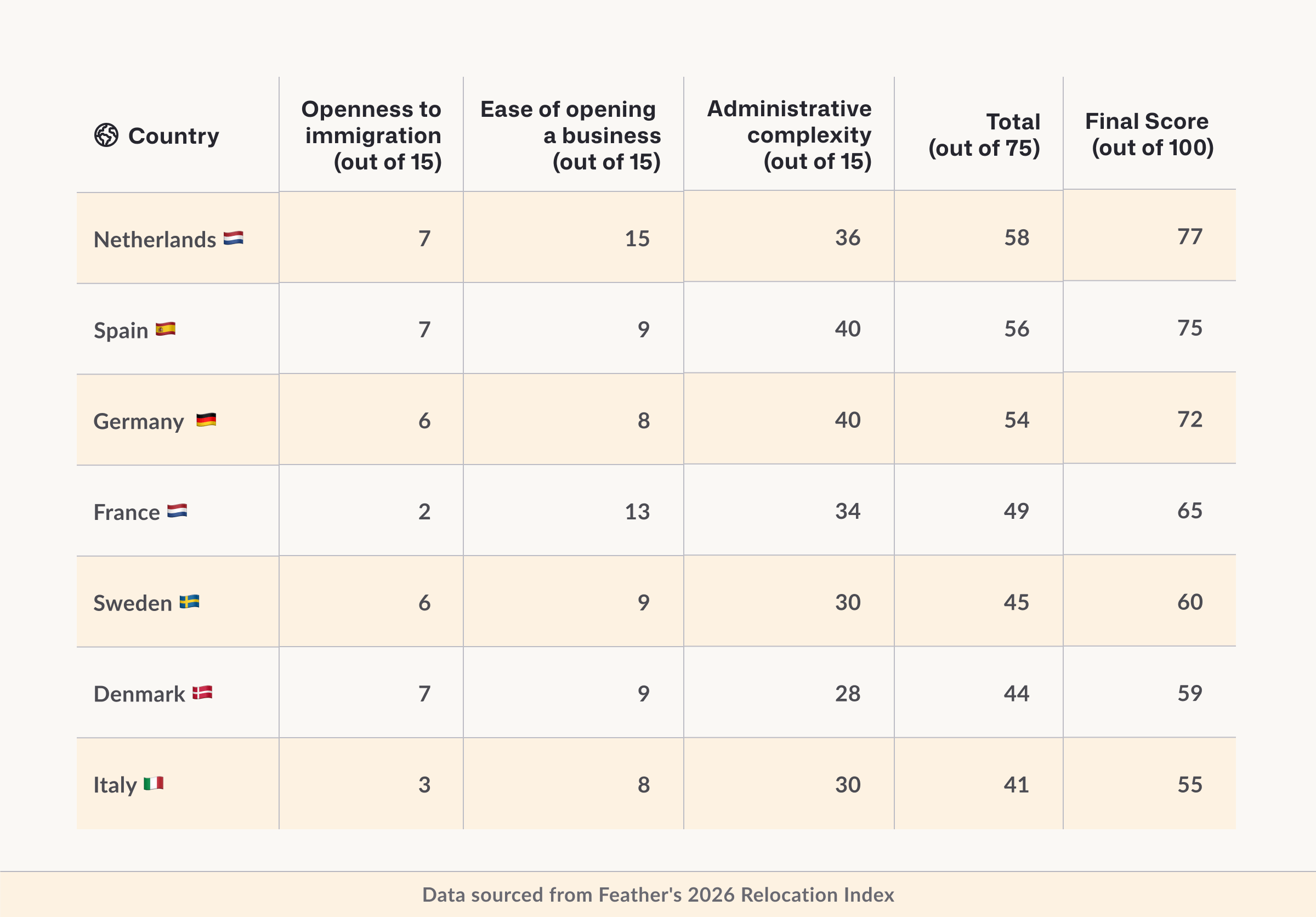
| Rank | Country | Score |
|---|---|---|
| #1 | Netherlands | 77 |
| #1 | Spain | 75 |
| #3 | Germany | 72 |
| #4 | France | 65 |
| #5 | Sweden | 60 |
| #6 | Denmark | 59 |
| #7 | Italy | 55 |
#1 Netherlands (77/100)
The Netherlands is the best country for UK residents looking to relocate. The country benefits from one of Europe's highest levels of English proficiency, 98 points above the European Union’s average.
The country scores a perfect score for the ease of opening a business, having a fast and simple process for foreigners who want to register a business. A fully digital visa application process and a relocation process minimally affected by language fluency contribute to the country’s high score and top spot in the index.
What this means for you
If you're looking for a country with a high degree of English fluency and an entrepreneur-friendly environment, the Netherlands is hard to beat.
The country’s capital, Amsterdam, has a strong job market, making it a good fit for employees who need to secure a role before relocating.
However, the country gives out slightly fewer residence permits than the EU as a whole, which can make relocating there harder if you don’t meet all of the requirements.
Alternative destinations
Germany is a close second if you’re looking for a country with good English proficiency and reliable visa pathways but need a more affordable cost of living.
If English proficiency isn’t a critical requirement, Spain and France are two other countries offering faster, more streamlined processes for entrepreneurs and freelancers looking to register a business.
#2 Spain (75/100)
Narrowly trailing the Netherlands as the best country for UK residents looking to relocate is Spain. The country gives out 11.55 residence permits per 1000 persons, well above the EU average of 7.79.
Spain also ties with Germany for the best administrative complexity score. Both countries earned a score of 40 of 50 on this indicator, indicating a lower friction experience for people relocating there.
In particular, Spain allows for opening a local account before moving there, has a low number, a low number of mandatory insurances, and a fully digital application process.
However, Spain has a lower level of English proficiency than the EU average, which can make relocating more challenging if you only speak English.
What this means for you
All together, these factors make Spain a great option if you’re looking for a reliable, low friction relocation process. The country’s high rate of residence permits also raises the probability of successfully relocating.
Despite this, the country’s lower levels of English proficiency can undermine the feasibility of relocating if you don’t know some Spanish.
Alternative destinations
In these cases, Germany or the Netherlands would be a more feasible choice given both countries reliable visa pathways and levels of English proficiency.
#3 Germany (72/100)
Rounding out the top 3 best countries for UK nationals to move to in Europe is Germany. The European Union’s most populous country and largest economy earned a score of 72 points.
Alongside Spain, Germany offers the most reliable visa pathways, particularly for relocating employees. It also has some of the continent’s lowest visa and residency application fees and shortest wait times, as well as a high degree of English proficiency.
What this means for you
Germany is one of the most feasible relocation options if you’re trying to balance language, reliable visa processes and overall costs.
It’s also one of the best options in Europe if you’re relocating as part of a job, due to its strong job market and a visa system that’s geared towards employees.
Germany does issue fewer long-term residency permits than Spain, and remote business formation can be slightly more complex.
If you're an entrepreneur, you may face a few extra hurdles, like the high cost of health insurance, compared to some southern European options.
Alternative destinations
The Netherlands is Germany’s closest continental rival for UK residents who need to balance language requirements with the visa process. However, the Netherlands is the best option for entrepreneurs due to its easier remote business formation.
Worst countries for UK nationals to move to in Europe
#5 Sweden (60/100)
The third worst country for UK presidents to move to in Europe is Sweden with a score of 60 out of 100.
Sweden has a high degree of English proficiency with a score of 608, nearly 70 points higher than the EU average. The country also allows you to acquire all of the mandatory insurances before relocating.
However, it doesn’t earn a higher place in the rankings due to its more expensive visa application fee, estimated 20 week waiting time for residence permits after submitting an application, and the challenging process to register a business as a foreigner. Swedish cities also have a high relative cost of living, compared to other countries in the ranking.
What this means for you
Sweden remains a viable option if you require a country with a high degree of English proficiency and you're willing to navigate a slightly more cumbersome visa and relocation application process.
However, Sweden has a comparably higher cost of living than other European cities whose countries also offer an easier visa process.
#6 Denmark (59/100)
Denmark narrowly trails Sweden as the second worst country for UK residents to move, scoring 59 out of 100.
The country scores highly for an English proficiency score of 603. It also gives out slightly more residency permits than the EU as a whole with 7.9 granted per 1000 people.
However, its overall score is brought down by its higher administrative complexity and more challenging process for registering a business. Denmark doesn’t allow potential residents to open a local account or acquire any of its mandatory insurances before moving there.
It also has a more expensive residency application fee ranging between £800 to £1,100.
What this means for you
Similar to Sweden, Denmark is a feasible option if you’re prioritising countries with a high degree of English proficiency and are willing to navigate a slightly more cumbersome visa and relocation application process.
#7 Italy (55/100)
Italy takes the title of the worst country for UK residents to move to in Europe. It’s score of 55 out of 100 is affected by an English proficiency score and number of residency permits that are considerably below the EU average.
Only France grants fewer residency permits per 1000 people than Italy’s 5.5. The country’s residency application fee can also exceed €500 and language fluency can affect your success in getting a tax ID or social security number.
The country also has a challenging process for registering a business as a foreigner, and only offers a partially digital process for doing so.
What this means for you
If you don't speak Italian or meet all of its relocation requirements, Italy presents significant challenges. In particular, its cities have smaller job markets which can make it especially challenging if you need to secure employment to kickstart your relocation process.
What the Index means for UK movers
Choosing where to relocate is about more than lifestyle and affordability. It's about friction and the feasibility of securing the necessary paperwork and permits.
Since Brexit, administrative complexity and inconsistent visa pathways play as significant a role as cost of living and job market factors in determining what's actually realistic.
This index highlights how your personal circumstances and employment setup affect where you can feasibly move.
The Netherlands has a clear edge
The Netherlands offers a combination of predictable relocation pathways, a high degree of English proficiency, and an entrepreneur-friendly environment. Together, the factors give the country an edge over its closest competitors and makes it the most feasible choice for many Britons.
That's also reflected in Amsterdam topping the list of the best cities for UK residents to relocate to, due to the city’s large expat population, strong job market, and high average salaries.
Spain offers an alternative for business owners
After the Netherlands, Spain offers the strongest environment for entrepreneurs. Madrid, and to a slightly lesser extent, Barcelona, combine digitalised processes, fewer mandatory insurances, and more attainable business setup pathways for entrepreneurs who are willing to negotiate the country’s language gaps.
German cities offer realistic options for employees looking for both earning power and affordability
While the Netherlands and Spain have an advantage for entrepreneurs, Germany offers some of the most competitive options for employees who want to balance earning potential and affordability. The country’s visa application system is geared towards relocating employees and Berlin, Frankfurt and Munich all have strong job markets.
The three cities all have high average salaries, and a lower relative cost of living compared to London and Amsterdam. Berlin in particular has some of the most affordable rent among major cities.
We hope this index helps you understand not just where you might want to live, but how much time, energy, and administrative stamina you'll need to get there.
A note on individual circumstances
Everyone's situation is unique. Visa pathways, documentation requirements, timelines, and administrative processes can vary depending on your profession, income, family circumstances, the nationality of your partners or dependents, health insurance needs, and the specific region or municipality you're relocating to.
Even within the same country, local authorities may interpret requirements differently or operate with varying levels of digitalisation and efficiency.
While we've worked with relocation experts to build a comprehensive dataset, it doesn't account for all individual variables.
We encourage you to speak directly with qualified immigration lawyers, relocation consultants, or official government offices to assess your specific eligibility, required documents, and potential costs.
Acknowledgments
This index wouldn't have been possible without the expertise and generosity of the people who contributed their time and knowledge.
Special thanks to Josh Nel, who led the research behind this project.
We're also grateful to the immigration lawyers and relocation experts who shared their on-the-ground insights across each country in our index:
- Adam Law (Immigration lawyer, Sweden)
- sorted.berlin (Relocation coaching, Germany)
- Visaguard (Immigration law, Germany)
- Your Spanish Visa (Immigration law, Spain)
- Moviinn (Relocation and immigration, Spain)
- Avv. Raffaella Lauricella – Immigration Lawyer, Rome and Milan, Italy (Immigration law, Italy)
- relokate (Relocation software solutions, Germany)
- Lexidy (Immigration law, Italy)
- Italy Law Firms (Attorney Michele Ambrogio, Italy)
- Get In Expat (Relocation services)
- Gibbesch Consulting (Relocation consulting)
- AZ Legal (Immigration law, Netherlands)
- Visaguiden (Legal consulting, Denmark)
Their expertise helped ensure the accuracy and practical relevance of our findings.
Want to dig into the data? Review our methodology and scoring.