
The future of expats: Where expats will be living in 2036
Moving abroad used to be a once-in-a-lifetime leap that only a handful of people made. Not anymore: today, only around one in ten Europeans we surveyed would rule out a life abroad.
We surveyed 2,000 people across the UK, France, Germany, and Italy to find out:
- Who's planning to move
- Where they're going
- And what's really driving the decision.
Then, we partnered with travel expert Holly Rubenstein, host of The Travel Diaries podcast, to discuss what it all means for the next decade of living abroad.
The research revealed a Europe on the move: nearly half expect to live abroad one day, the cost of living crisis is the biggest force driving them out, and the dream destinations are changing. And a new kind of mover is emerging, the "semi-pat", who won't pick one country at all.
Nearly half of Europe expects to live abroad
More than any other group surveyed, French people (57%) expect to live in a different country at some point in the future, followed by Germans (52%), Italians (49%) and Brits (48%).
And this isn't idle daydreaming. More than one in four Brits (28%) are seriously considering or actively planning a move. In Germany, one in ten people is actively planning one right now. More than nine in ten Britons (92%) say something has made them more open to leaving in recent years, the highest figure of any nation surveyed, making the UK the most restless country in the study.
Why six in ten Europeans are open to moving abroad
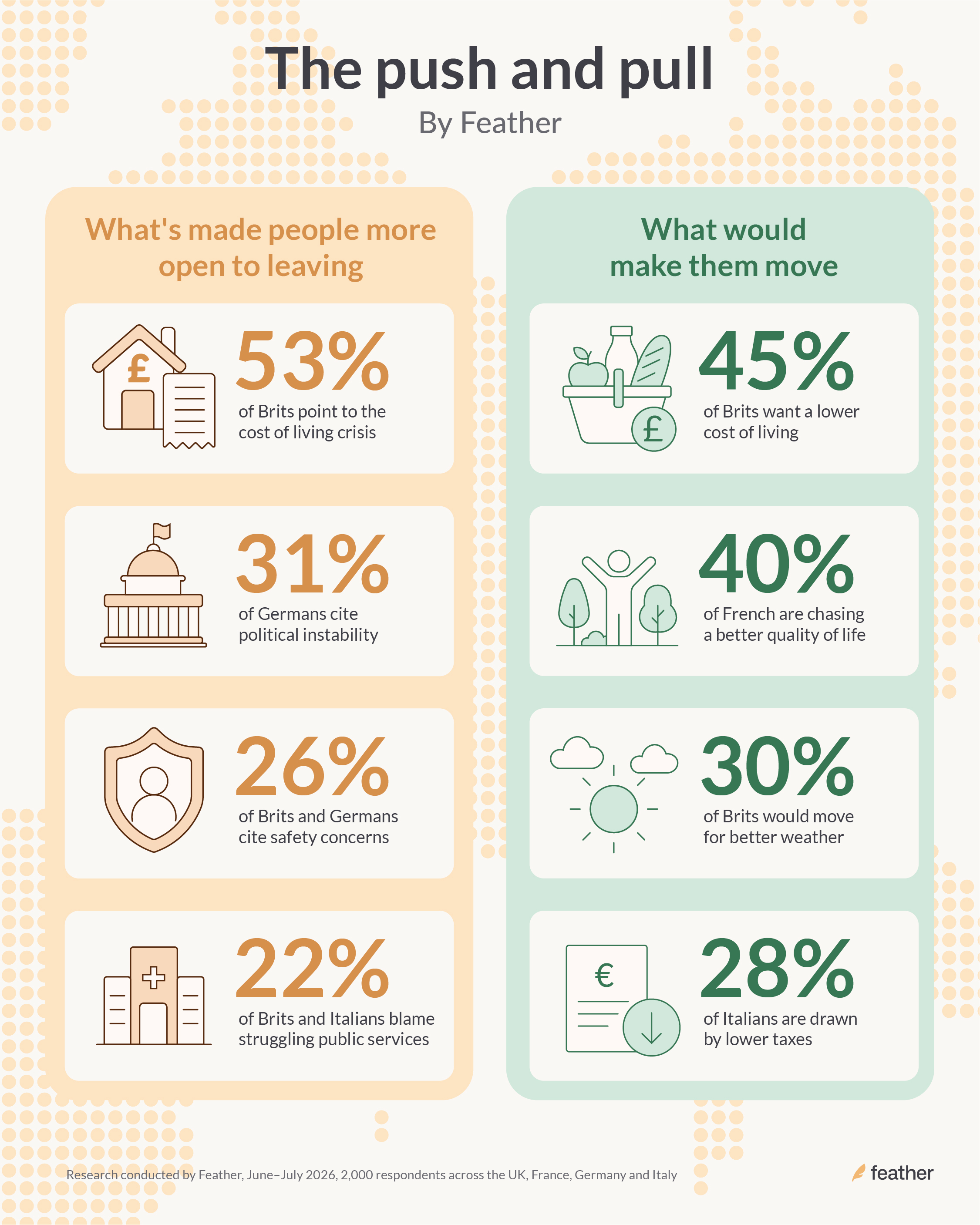
For many, the desire to leave is as much a reaction to the mood at home as the pull of somewhere new. In every country surveyed, the cost of living crisis is the single biggest factor making people more open to a life abroad, cited by 53% of Brits, 48% of the French, 43% of Germans and 32% of Italians. But each nation is chasing something different.
Brits want a cheaper, better life (45% cite lower cost of living). The French prioritize lifestyle over savings, the only country where quality of life (40%) beats cheaper living (35%). Germans weigh the two equally (34% each). Italians are pulled hardest by work, with career opportunities (20%) and work-life balance (18%) mattering more there than anywhere else.
Over the next decade, the classic sunshine-and-scenery checklist will give way to a different question: where can I build the happiest, healthiest version of my life?
— Holly Rubenstein, travel expert and host of The Travel Diaries
The rise of the semi-pat
Meet the "semi-pat": the new breed of mover who isn't emigrating for good, but living a life that flexes across two or three countries at once. It's the trend Holly believes will define the next decade of living abroad.
"The traditional expat story was: move abroad, buy a home, build a new life permanently. The emerging version is much more fluid — spend six months somewhere, work remotely, test a lifestyle, and build connections across several places. Gen Alpha will grow up with remote connection as the norm. For them, career, friendships and identity won't need to sit in just one place."
Countries are already responding, competing for location-flexible workers with digital nomad visas and streamlined residency routes.
Where everyone wants to go
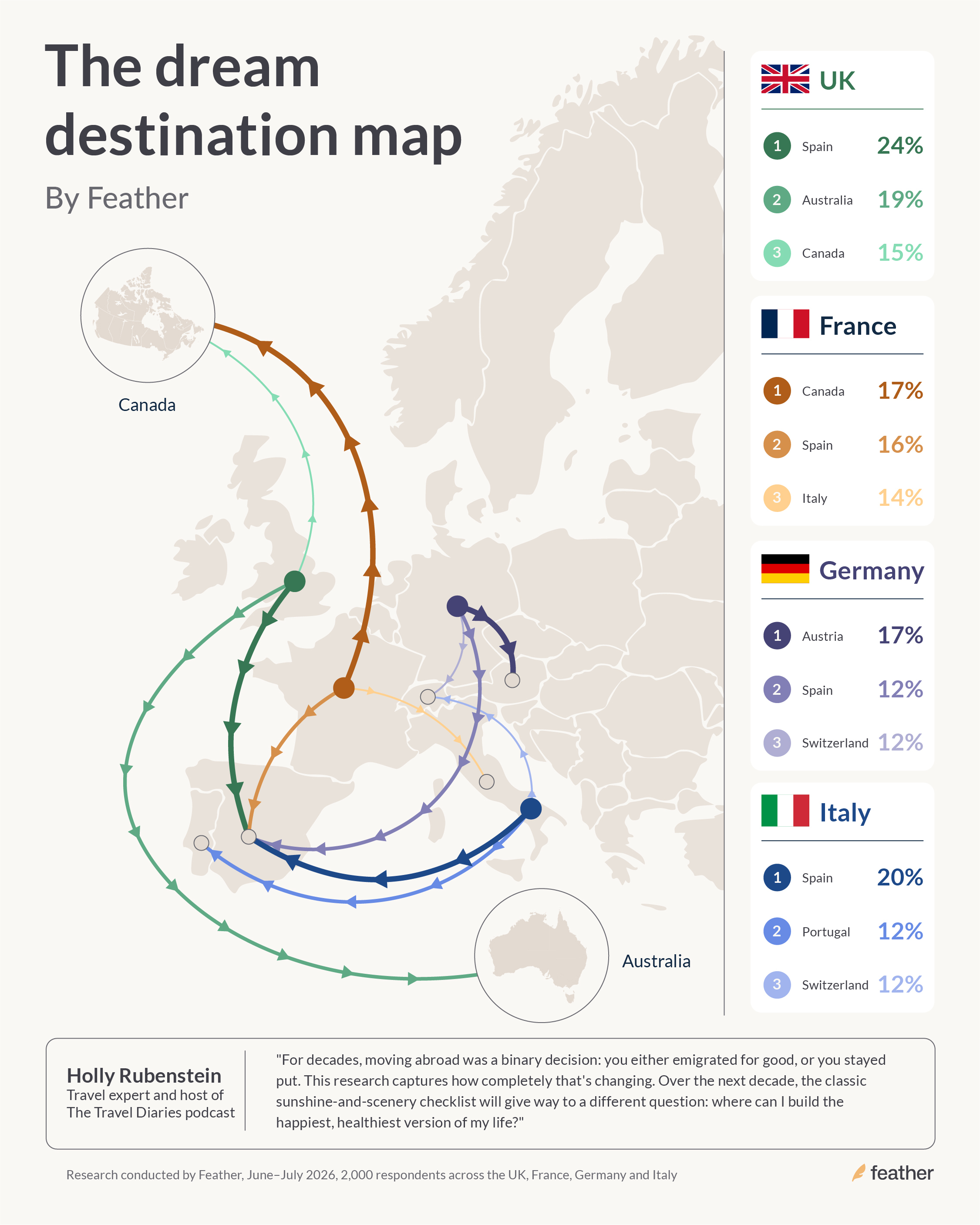
The top destination in each country:
| Country | Top choice | Runner-up | Third |
|---|---|---|---|
| UK | Spain (24%) | Austalia (19%) | Canada (15%) |
| France | Canada (17%) | Spain (16%) | Italy (14%) |
| Germany | Austria (17%) | Spain (12%) | Switzerland (12%) |
| Italy | Spain (20%) | Portugal (12%) | Switzerland (12%) |
The hotspots of the future
So where will the next generation of expats actually go? Holly's prediction: the traditional checklist is giving way to something bigger.
"The next generation of expat hotspots will be driven less by sunshine and scenery, and more by a combination of quality of life, affordability, climate resilience, healthcare, infrastructure and access to nature." Her ones to watch:
Canada, Australia and New Zealand. Their strong showing in the research doesn't surprise Holly: they represent something increasingly rare, access to the outdoors, a sense of space and a genuinely different work-life balance.
Slovenia, Montenegro and Croatia. All the natural beauty and outdoor lifestyle that draws people to the Mediterranean, with European accessibility, but without the crowds, costs or sweltering summers of the traditional hotspots.
Costa Rica. A destination that connects nature, biodiversity, sustainability and wellbeing, and home to Nicoya, one of the world's original Blue Zones, where communities live measurably longer, healthier lives.
Portugal. Already a popular destination, but it reflects exactly what future movers are looking for: lifestyle, community, safety and accessibility. Its challenge will be balancing popularity with affordability.
Is the Mediterranean dream over?
In a word: no. But it's changing.
"The traditional favorites like Spain, France and Italy aren't going anywhere — their appeal is too deeply rooted. But the future may not be people rejecting Spain or Italy. It's people choosing differently within them: northern regions, smaller cities, countryside locations where they can find community and year-round quality of life."
The pressure is concentrated in the obvious hotspots, places where rising property prices, overtourism and extreme summer heat are already changing the conversation. The question movers are starting to ask isn't "where has the best weather?" but "where can I comfortably live all year round?" The same logic applies to big cities. If you can work remotely, do you still want the expense and intensity of a major capital, or does a smaller destination offer a better everyday life?
The reality check
Whatever the destination, one thing hasn't changed: the gap between the dream and the everyday.
"When you travel somewhere, you experience the highlights. When you live somewhere, you experience the everyday version, and that's where healthcare, insurance and bureaucracy suddenly matter. The dream gets people interested, but the practical side is what makes them stay."
The destinations that win over the next decade, Holly predicts, won't just be the most beautiful. They'll be the ones that make the practical reality easiest: clear visa routes, strong healthcare, insurance that works across borders, and straightforward admin.
How Feather helps you get there
This is exactly why we built Feather. Insurance feels impossibly complicated when you're new to a country. Different systems, unfamiliar terms, paperwork in a language you might not speak yet, all during the most chaotic weeks of your life. With Feather, you can discover and sign up for the insurance you need online, in minutes, in a language you understand. Health insurance, liability, travel cover: we make the part that feels most confusing as simple as possible, so you can get on with actually settling in, wherever the next decade takes you.
About the research
We surveyed 2,000 adults across the UK, France, Germany and Italy (500 per country), exploring who's planning to move abroad, what's driving the decision, and where they want to go. Market research conducted by 3Gem from 24th June to 1st July 2026. Travel trends forecast developed in partnership with Holly Rubenstein, travel journalist and host of The Travel Diaries podcast.