
Health & healthcare in Belgium: Statistics, trends & facts (2026)
Belgium spends a lot on healthcare. In 2023, it put 10.8% of its GDP toward health, or €4,570 per person. That's 20% more than the EU average.
So what does all that spending buy? If you're living in Belgium (or thinking about a move), it's worth knowing. How healthy are people here? How well does the system work? And where are the gaps?
In this article, we'll cover:
- Who lives in Belgium, and how long they can expect to live
- How much Belgium spends on healthcare, and where the money comes from
- What the budget goes on, from hospitals to pharmaceuticals
- How healthy Belgians are, and what they're most likely to die from
- How many doctors, nurses and hospital beds the country has
- How much sick leave Belgian workers take
First, the headline numbers.
Key Belgium healthcare statistics: our top picks
- In 2018, the average Belgian took 12.3 sick days.
- 8% of Belgians rate their health as bad or very bad.
- 75% of Belgian adults say they're in good or very good health.
- 1.5% of Belgians report unmet medical needs.
- Belgium contributed 17% of total pharmaceutical R&D spending across the EU in 2023.
- 99% of Belgian residents are covered for core health services.
Belgium's population statistics
In 2025, Belgium had 11.8 million inhabitants and a population density of 385 people per square kilometer. The Brussels Capital Region is by far the most crowded, with 7,732 inhabitants per km².
The Flemish Region is home to the largest share of the population, with 6.8 million inhabitants. The Walloon Region has 3.7 million, and the Brussels Capital Region an estimated 1.2 million.
Around 88% of Belgian residents lived in urban areas in 2024, with the other 12% in rural areas.
Source: StatBel, World Bank
Population growth and migration
Belgium recorded 108,150 births in 2024. That's the lowest number since 1942, and 5,711 fewer than the 2020 to 2023 average.
Parents are also getting older. In 2024, the average age of a mother having her first child was 29.6 years, up from 27.3 years in 2000. Across all mothers, the average age was 31.2 years. For fathers and co-parents, it was 34.3 years.
Source: StatBel
Gender and age distribution
In 2025, 51% of Belgium's population were women and 49% were men.
The gap widens with age. Among people aged 65 and over, 55% were women and 45% men. Among widowed people aged 65 and over, 78% were women and 22% men. Among unmarried adults aged 18 and over, it flips: 47% were women and 53% were men.
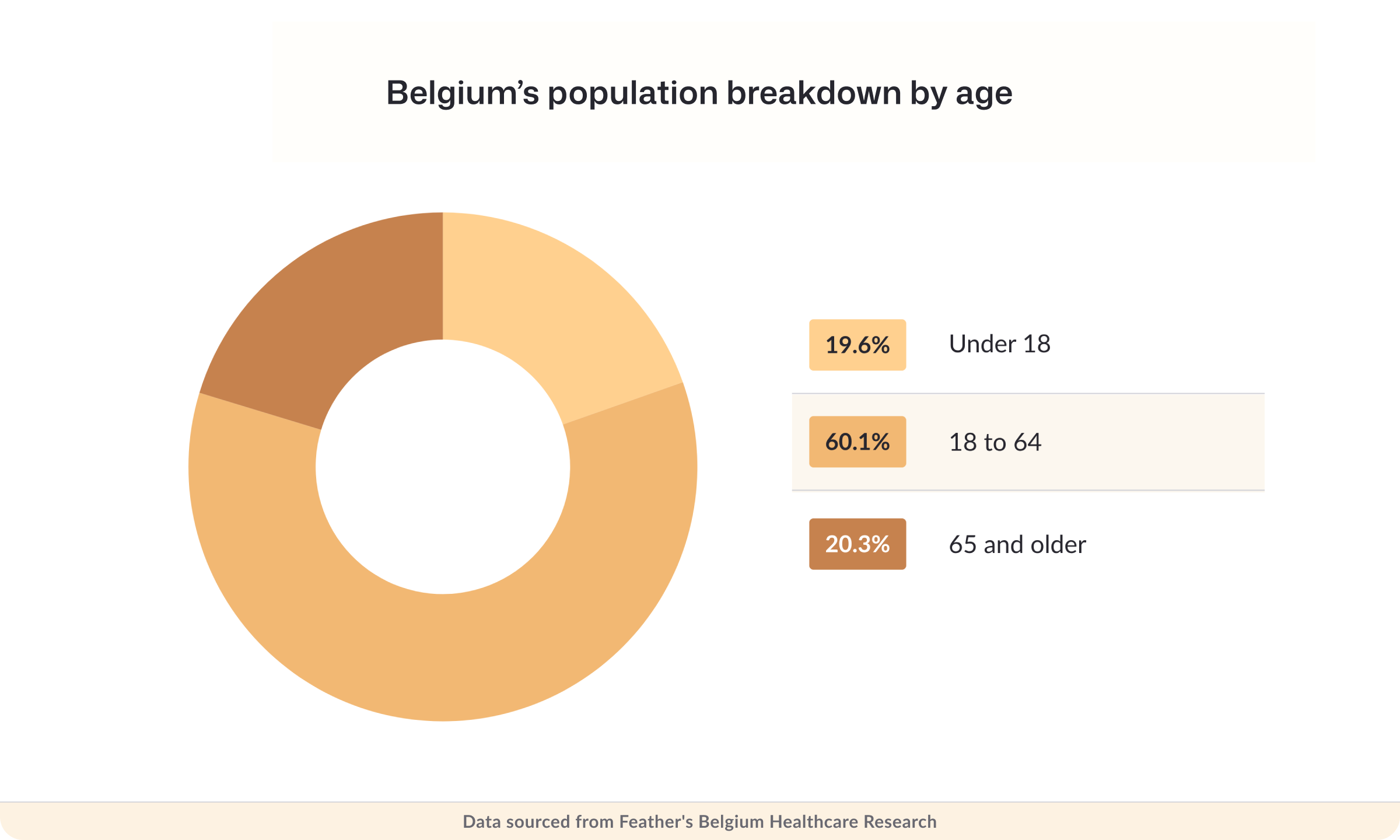
By age, 19.6% of residents were younger than 18, 60.1% were aged 18 to 64, and 20.3% were 65 or older.
Belgium also had more than 3,172 centenarians in 2025: 2,632 women and 540 men.
Source: StatBel
How many Belgian residents were born outside the country?
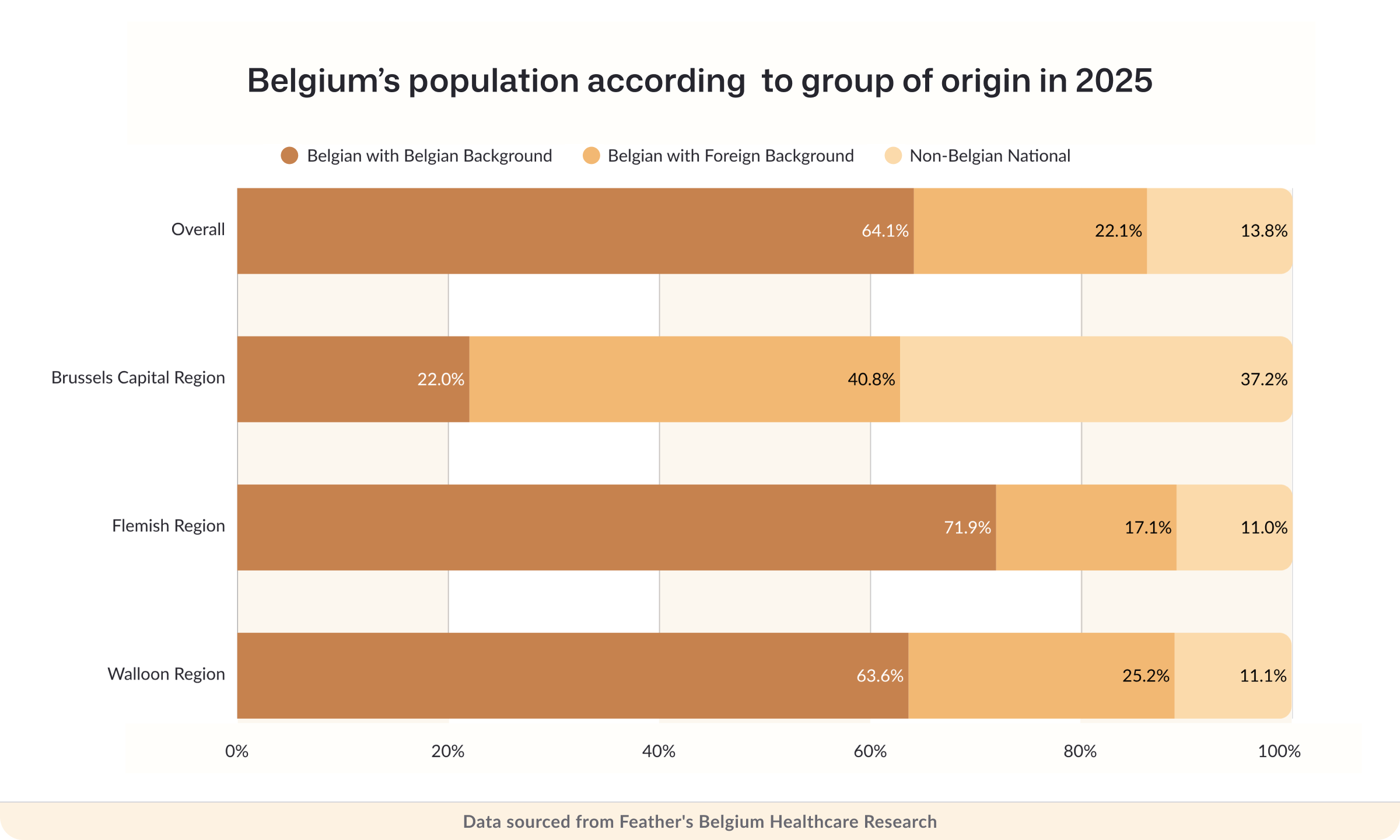
Across Belgium, 64.1% of residents are Belgian with a Belgian background, meaning at least one of their parents was a Belgian citizen. Another 22.1% are Belgian with a foreign background, and 13.8% are non-Belgian nationals.
The mix looks very different depending on where you are. In the Brussels Capital Region, 37.2% of residents were non-Belgian nationals, 40.8% were Belgian with a foreign background, and just 22% were Belgian with a Belgian background.
In the Flemish Region, 71.9% were Belgian with a Belgian background, 17.1% Belgian with a foreign background, and 11% non-Belgian nationals.
In the Walloon Region, the split was 63.6%, 25.2% and 11.1% respectively.
Source: StatBel
Life expectancy statistics in Belgium
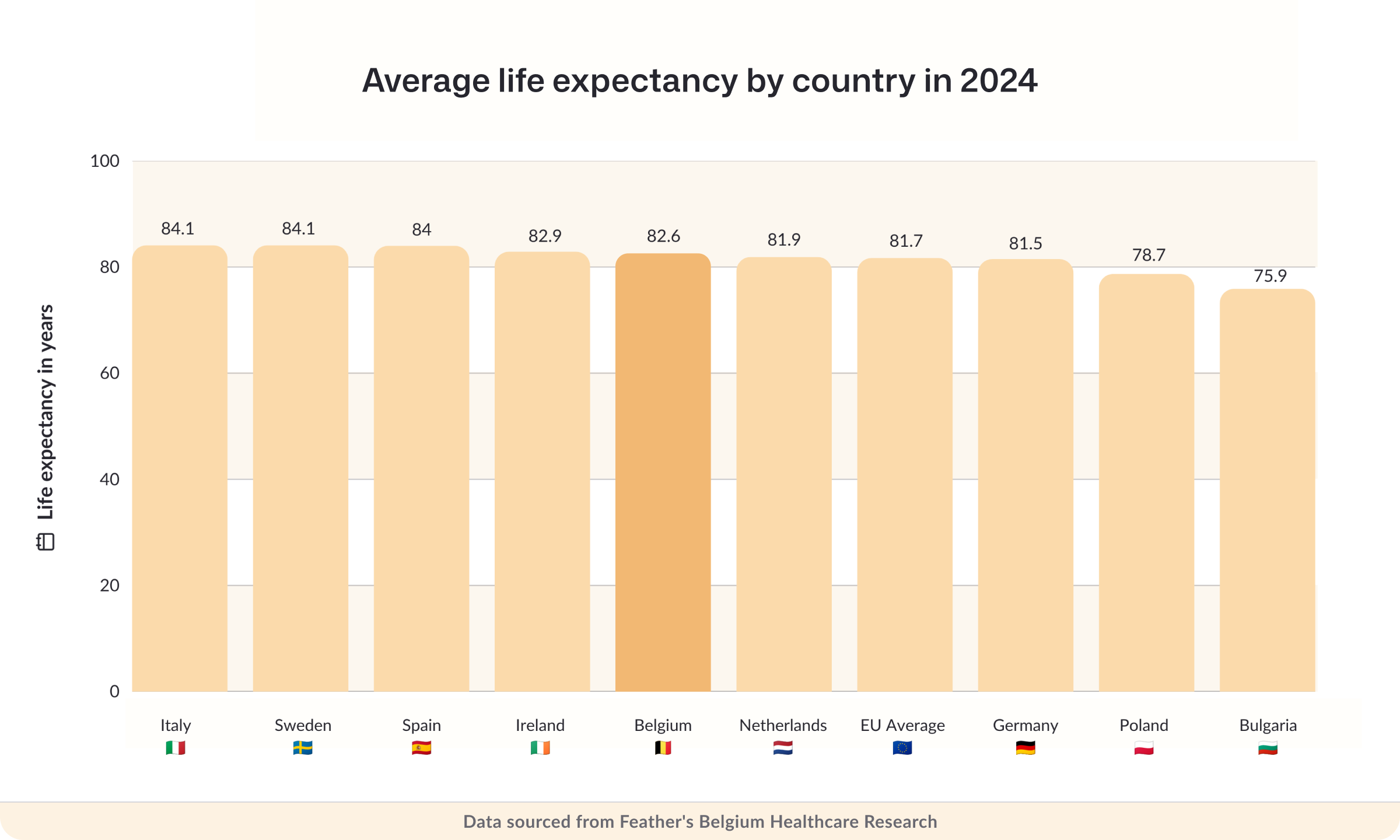
In 2024, life expectancy at birth in Belgium was 82.6 years, up by less than 0.3 years on 2023.
Women could expect to live to 84.4, and men to 80.3.
That gives Belgium the 11th highest life expectancy in the EU. It trails Italy and Sweden (84.1 years), Spain (84 years) and, narrowly, Ireland (82.9 years).
Belgium does come out ahead of the Netherlands (82.0 years), the EU average (81.9 years) and Germany (81.5 years).
Source: European Health Observatory, StatBel
How much does Belgium spend on healthcare?
In 2023, Belgium spent 10.8% of its GDP on healthcare, above the EU average of 10%.
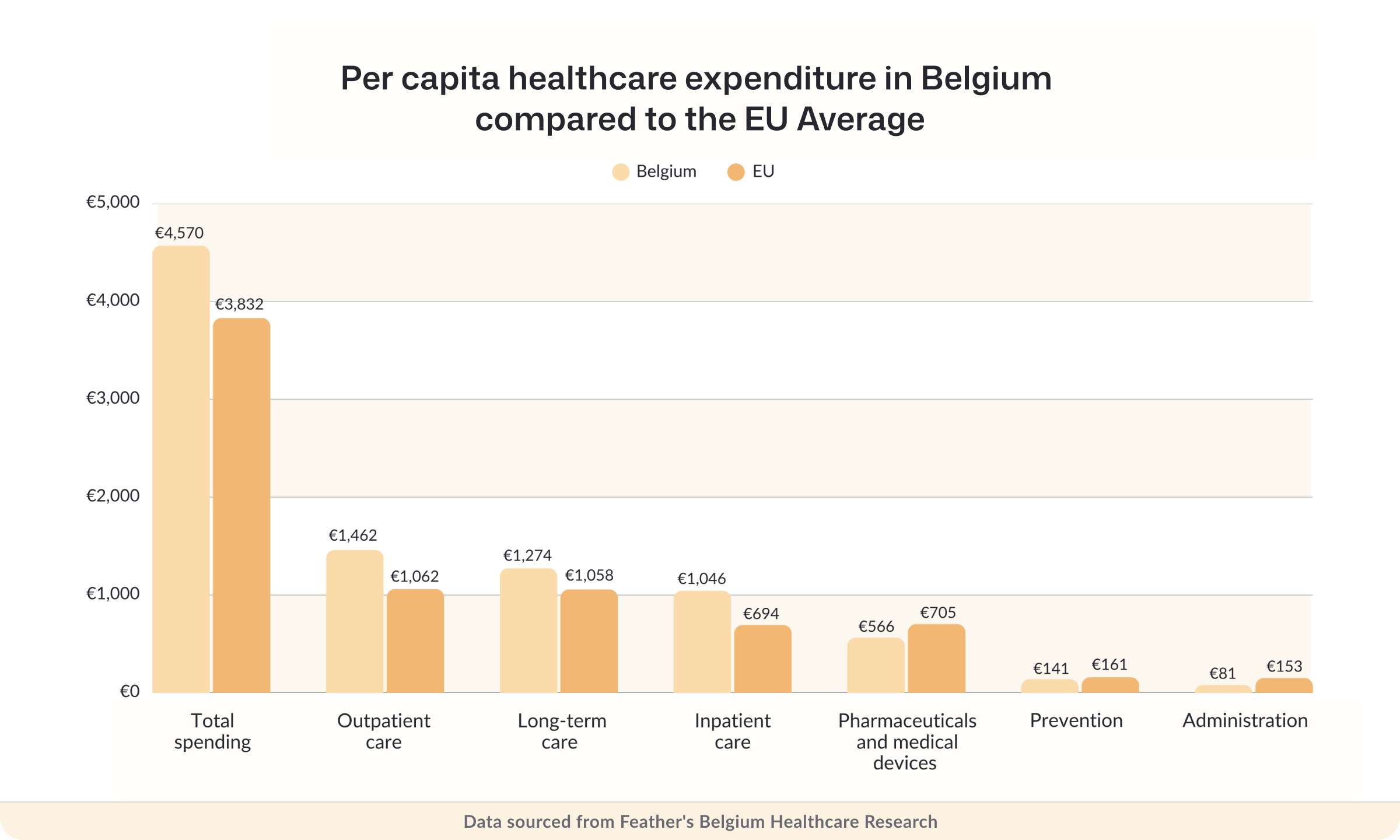
Per person, that came to €4,570, around 20% more than the EU average.
Here's how spending per person in Belgium compares to the EU average:
-
Inpatient care:
€1,462 per person in Belgium vs €1,062 EU average -
Outpatient care:
€1,274 per person in Belgium vs the EU average of €1,058 -
Long-term care:
€1,046 per person, well above the EU average of €694 -
Pharmaceuticals and medical devices:
€566 per person vs €705 across the EU
Belgium also spent €141 per person on healthcare administration and €81 per person on prevention. That prevention figure is just under half the EU average of €153.
For households, healthcare took an average of 4.8% of income in 2022, including out-of-pocket costs.
 Source: European Health Observatory
Where does Belgium spend its healthcare budget?
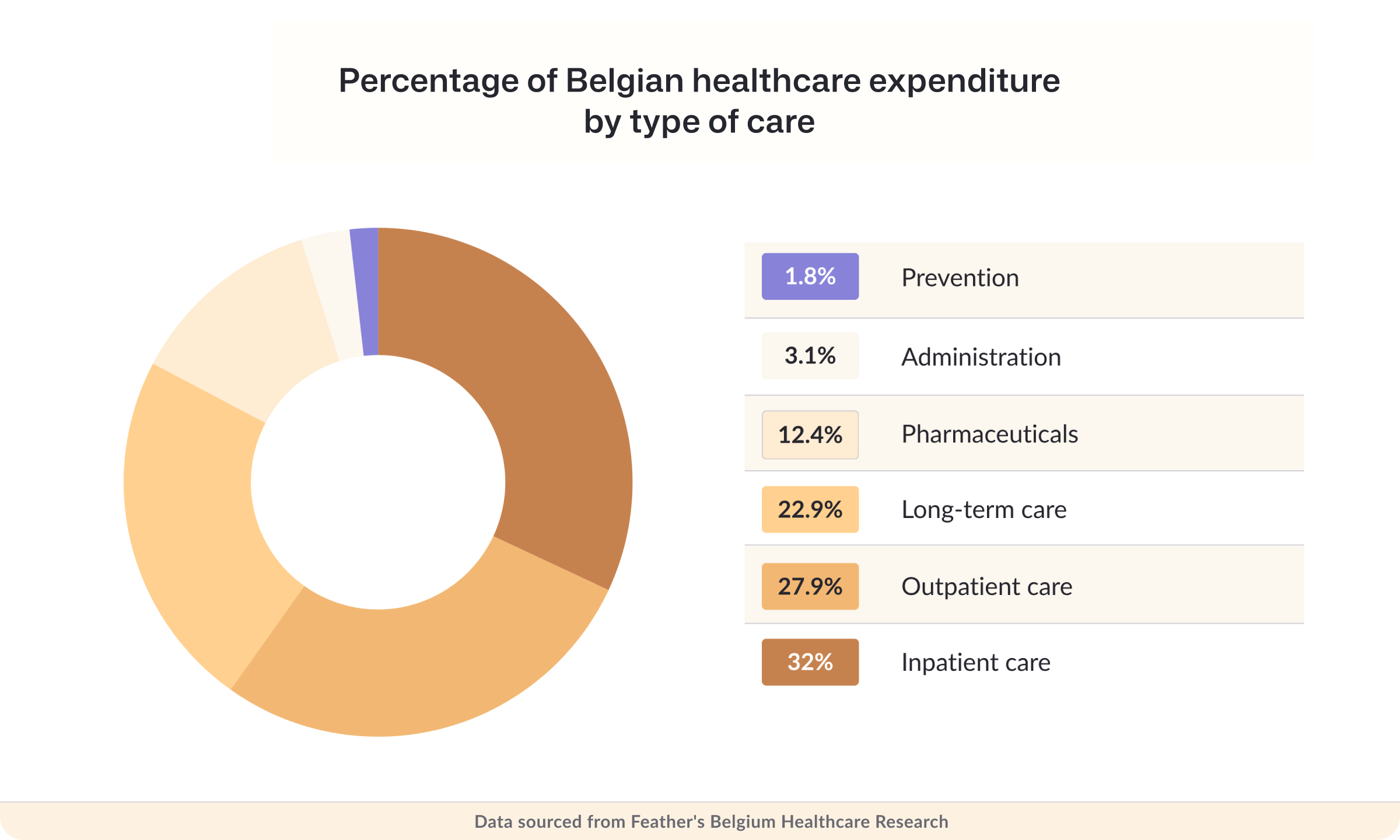
Hospitals take the biggest share. Inpatient care made up 32% of Belgian healthcare spending in 2023, followed by outpatient care at 28%.
Long-term care accounted for 23%, and pharmaceuticals and medical devices for 12%.
Prevention got less than 2% of the budget. Healthcare administration took 3.1%.
Source: European Health Observatory
How much does Belgium spend on pharmaceuticals?
In 2023, Belgium spent an average of €479 per person on retail pharmaceuticals, slightly below the EU average.
Overall, pharmaceuticals made up around 10% of Belgium's total healthcare spending.
Generic medicines are catching on, but slowly. Their share rose from 26% in 2012 to 38% in 2023, still well below the EU average of 51%.
Source: European Health Observatory
How are pharmaceuticals funded in Belgium?
Mostly by the state. Social health insurance covers 74% of pharmaceutical costs in Belgium.
Belgium is also the EU's biggest investor in pharmaceutical research per person. In 2023, the country spent €2.6 billion on pharmaceutical R&D, or €227 per person adjusted for purchasing power.
That's roughly 17% of all pharmaceutical R&D spending in the EU.
Source: European Health Observatory
Where does healthcare funding in Belgium come from?
Coverage in Belgium is close to universal. 99% of residents are covered for core health services through compulsory social health insurance.
Around 74% of healthcare funding comes from the government and compulsory insurance schemes. The other 26% comes from private sources.
That private share includes out-of-pocket spending, which makes up 22% of total healthcare spending. That's one of the higher rates in the EU, so it's worth budgeting for co-payments if you're moving here.
Source: European Health Observatory
How healthy are people in Belgium?
Pretty healthy, by their own account. 75% of Belgians say they're in good or very good health, above the EU average of 68%. Only 8.8% rate their health as poor or very poor.
Income makes a big difference, though. Among low-income Belgian men, only 61% report good health, compared to 90% of high-income men.
Belgium does well on several risk factors. 12.8% of Belgian adults smoke, compared to the EU average of 18.5%.
The average adult in Belgium drinks 7.8 liters of alcohol a year, below the EU average of 9.8 liters.
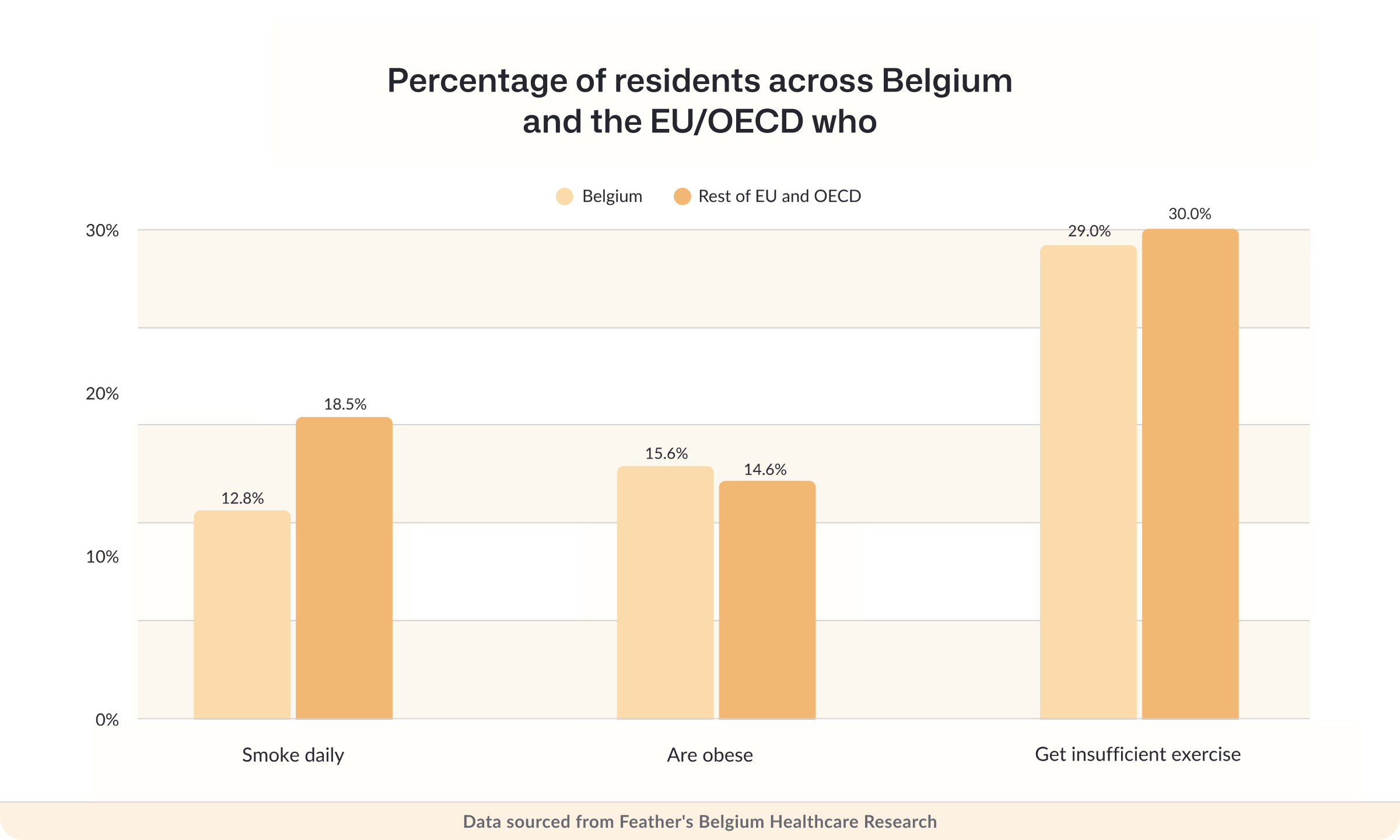
Around 15.5% of Belgian adults are obese. And 29% of adults don't get enough physical activity, slightly below the OECD average of 30%.
Source: European Health Observatory, OECD
What do preventive care and treatment access look like in Belgium?
Vaccination and screening rates are strong. Around 97% of children have had three doses of the DTP vaccine, above the OECD average of 93%.
58% of Belgian women were screened for breast cancer in 2023, above the OECD average of 55%.
Antibiotic use is on the high side. In 2024, 19 defined daily doses of antibiotics were prescribed per 1,000 people, compared to the OECD average of 16 per 1,000.
Source: OECD
How many people in Belgium have a chronic health condition?
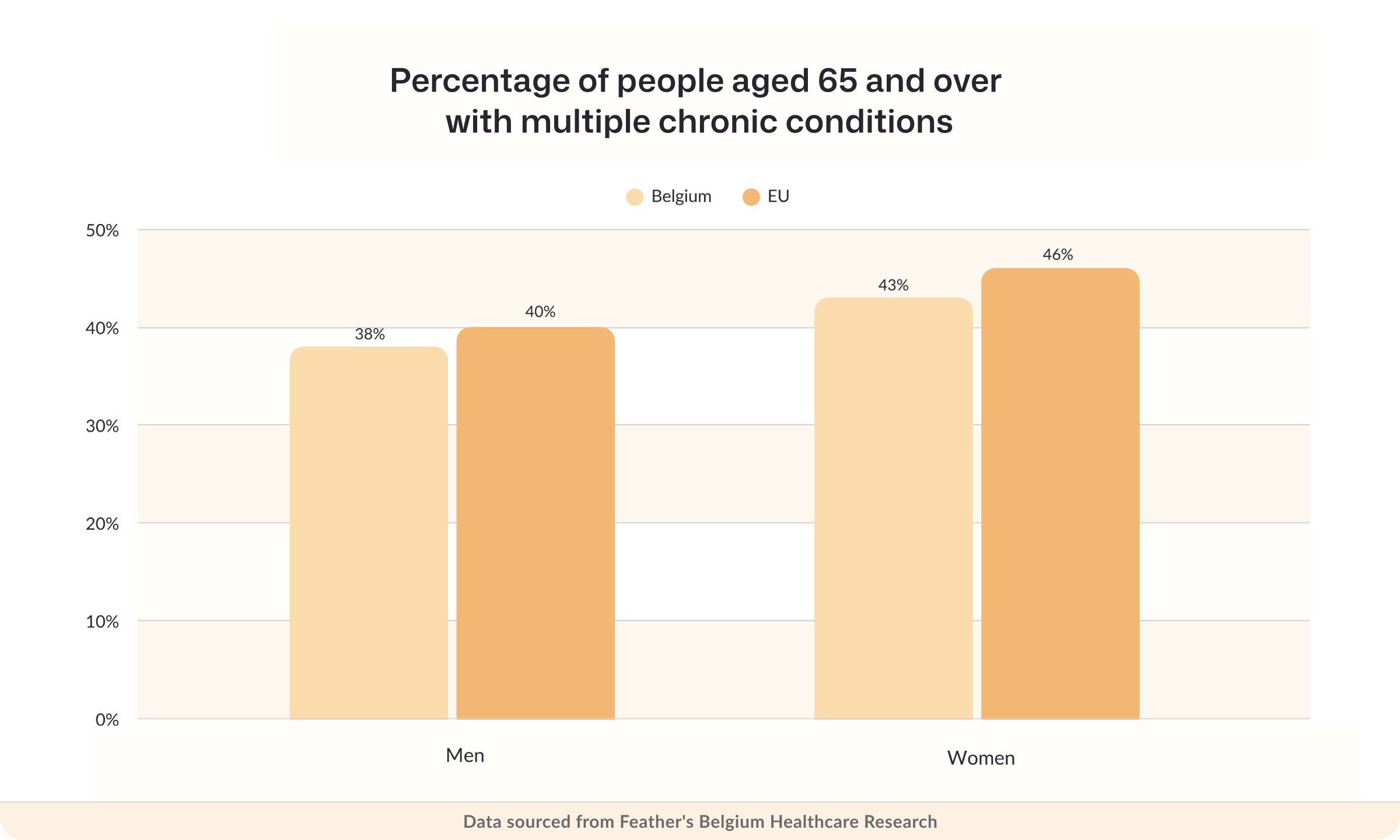
Among men over 65, 38% report having more than one chronic health condition, slightly below the EU average of 40%. For women in the same age group, it's 43%, compared to the EU average of 46%.
Source: European Health Observatory
Cause of death statistics in Belgium
In 2022, there were 116,000 deaths in Belgium, or around 9.5 deaths per 1,000 inhabitants.
For men, cancer was the leading cause of death. For women, it was cardiovascular disease.
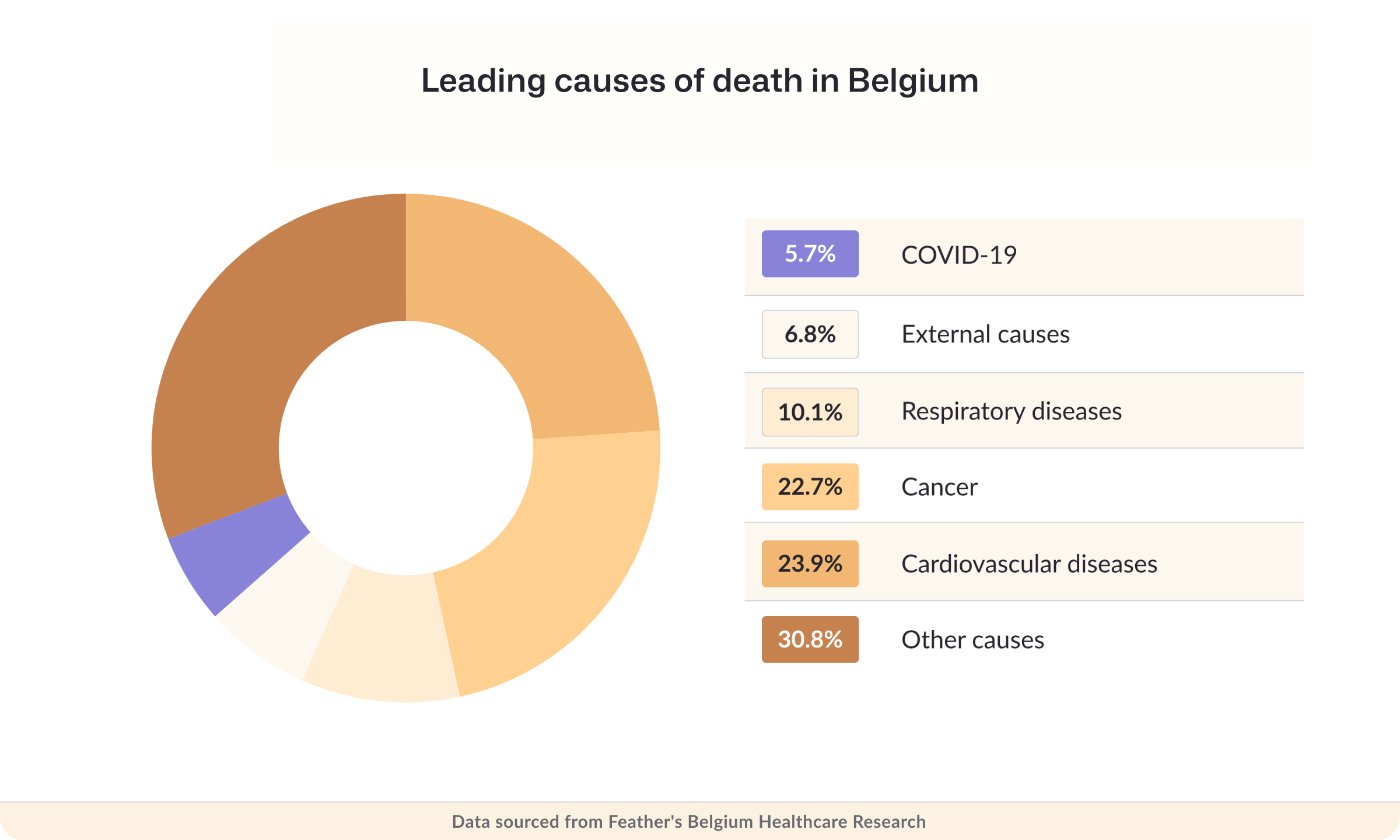
Overall, cardiovascular diseases came first, at 23.9% of deaths, followed by cancer at 22.7%.
Respiratory diseases accounted for 10.1% of deaths, and COVID-19 for 5.7%.
External causes made up 6.8% of deaths. Suicide alone accounted for 1.5%, giving Belgium a suicide rate of 14 deaths per 100,000 people.
Among cancers, lung cancer is the biggest killer, responsible for 5% of all deaths.
 Source: European Health Observatory, StatBel
How many doctors and nurses are there in Belgium?
In 2023, 646,640 people worked in Belgian health and social care. That's more than double the 302,600 people employed in the sector in 1995.
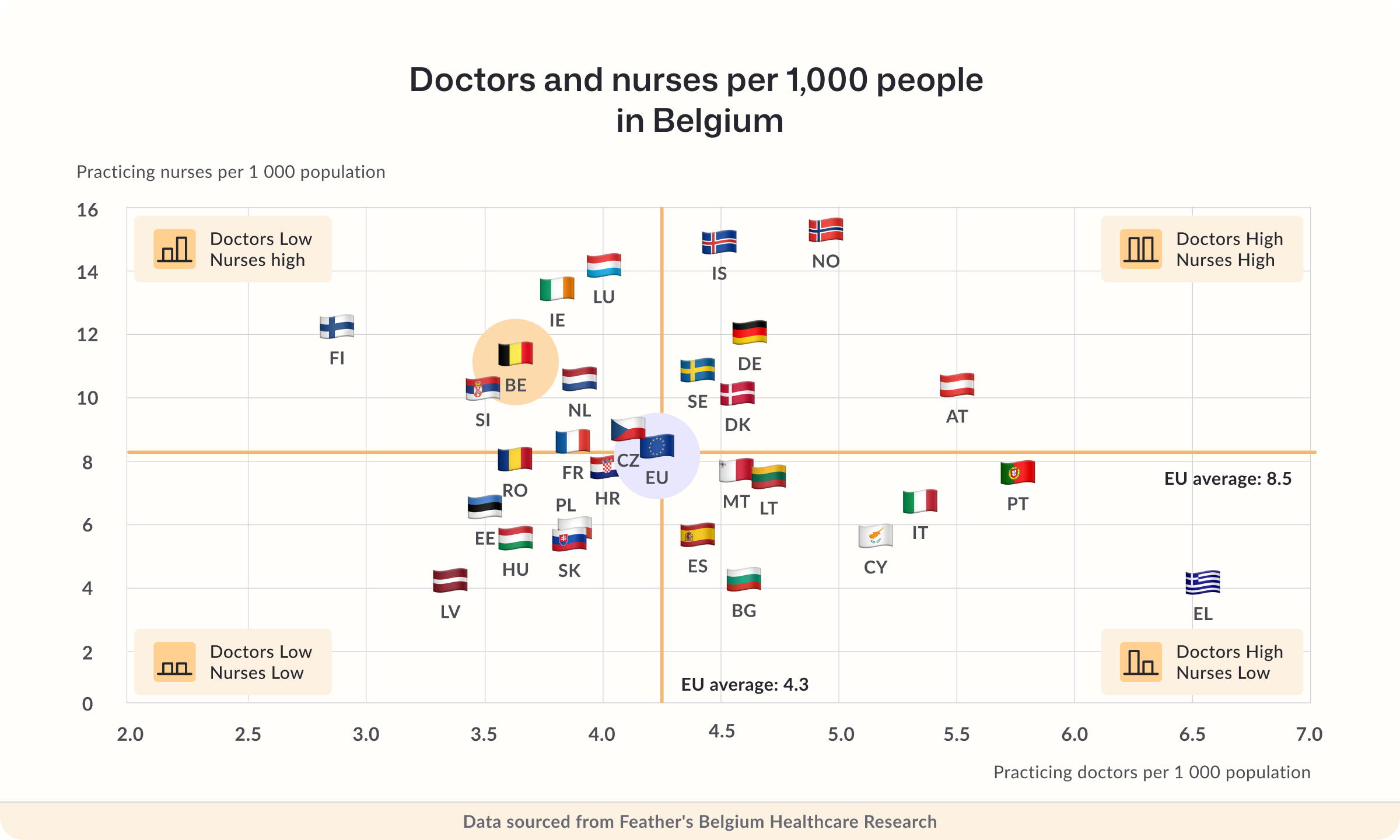
Belgium had 3.4 doctors per 1,000 people, below the EU average of 4.1 per 1,000. General practitioners make up around 34% of all doctors.
Nurses are more plentiful: 11.5 per 1,000 people in 2023, above the EU average of 8.4 per 1,000.
In absolute terms, Belgium had 223,688 licensed nurses in 2021. 214,200 of them trained in Belgium, while foreign-trained nurses made up 4.26% of the total.
Belgium also has 128 pharmacists per 100,000 people and 4.1 long-term care workers per 100 adults aged 65 and over.
On equipment, the country has 40 CT, MRI and PET scanners per million people.
Source: Statista, European Health Observatory, OECD
What percentage of the population has unmet medical needs?
Getting care in Belgium is rarely a problem. Only 1.5% of the population report unmet medical needs, below the EU average of 3.5%.
Income changes the picture. Among people at risk of poverty, unmet medical needs rise to around 5%.
Dental care is where the gaps are widest. Around 5% of the general population report unmet dental needs. Among people at risk of poverty, it's roughly 12%.
Source: European Health Observatory
How many hospital beds are there in Belgium?
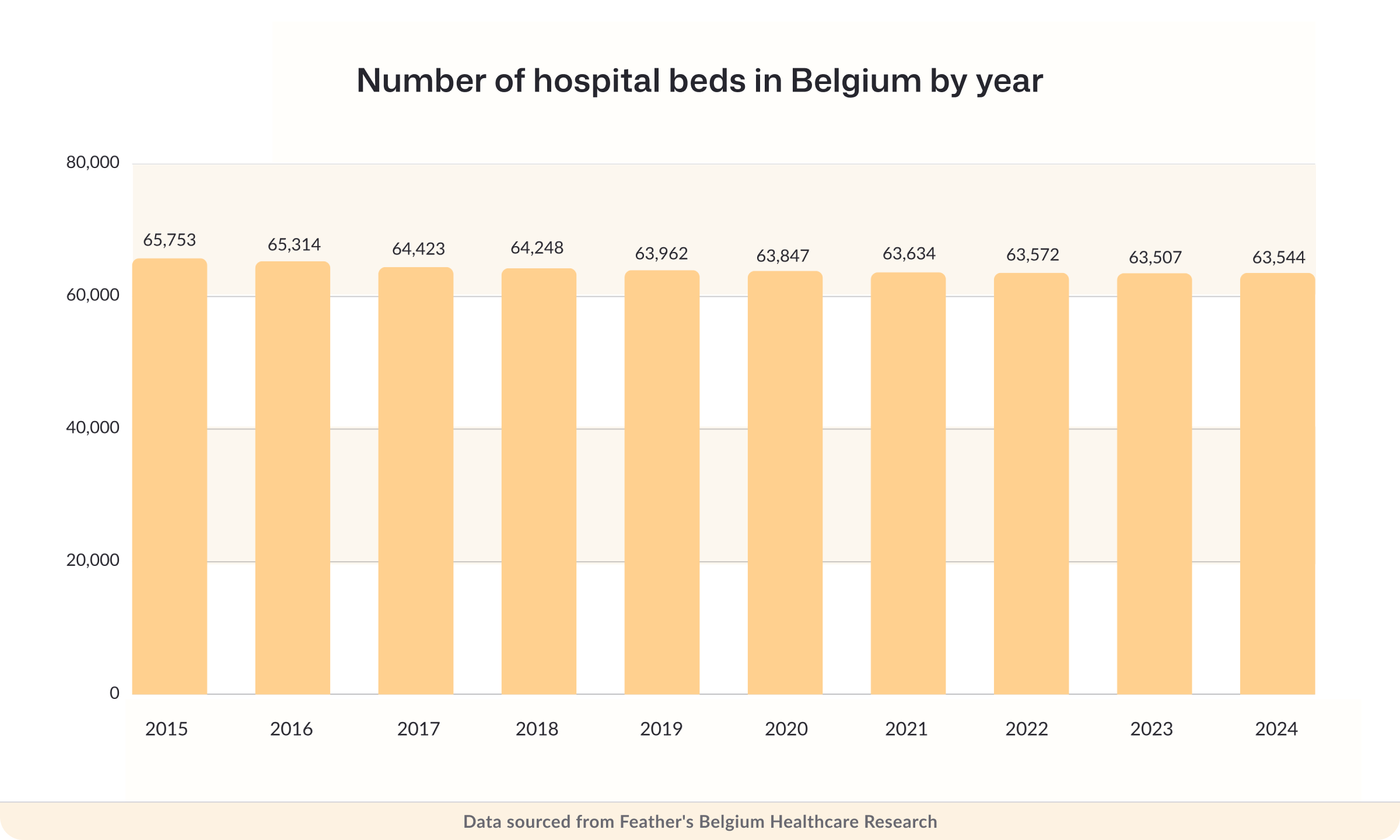
In 2024, Belgium had 63,544 hospital beds, a slight increase from 63,507 in 2023.
Look further back and the trend is downward: the country had 65,753 beds in 2015.
That works out to 5.4 hospital beds per 1,000 people, slightly above the EU average of 5.1 per 1,000.
 Source: Statista, European Health Observatory
Sick leave statistics in Belgium
In 2018, the average Belgian employee took 12.3 sick days, up from 11.1 days in 2013.
More than 50% of employees took at least one sick day in 2024. And 17.4% of Belgian workers were off sick three or more times during the year.
On average, workers had 1.36 periods of sick leave in 2024. Frequent sick leave is up 36% compared to pre-pandemic levels.
Source: Gateway, Belga News Agency


