
Health & healthcare in Thailand: Statistics, trends & facts (2026)
Thailand introduced universal health coverage in 2002. Two decades on, average life expectancy has reached 75.3 years, while health spending as a share of GDP sits at half the OECD average. That's a big return on a modest budget.
There's a catch, though. Thailand's population is aging fast, and it now has one of the highest rates of chronic illness in South-East Asia. So if you're living in Thailand, or thinking about it, how healthy are people here really? And has universal coverage bought them more healthy years?
In this article, we'll cover:
- Who lives in Thailand, and how long (and how healthily) they can expect to live
- How much Thailand spends on healthcare, and where the money comes from
- Where the budget goes, including an unusually big bet on prevention
- How healthy Thai people are, and what they're most likely to die from
- How many doctors, nurses and hospital beds the country has
First, the headline numbers.
Key Thai healthcare statistics: our top picks
- Thailand's average life expectancy in 2021 was 75.3 years, nearly 4 years above the world average of 71.4 years.
- 77.8% of Thai health spending in 2023 came from government sources.
- In 2023, Thailand spent an estimated US$326.50 per person on healthcare.
- Thailand spends less than 0.10% of its healthcare budget on long-term care, one of the lowest rates in the world.
- Thailand spends nearly 3-6x more on prevention than EU countries like Belgium and the Netherlands.
- Stroke is the leading cause of death, at 96.7 deaths per 100,000 people.
- Nearly a quarter of all Thai adults aged 30–69 are living with a chronic illness.
Thailand's population statistics
In 2023, Thailand had a population of approximately 71,702,453 people. That's expected to shrink by around 7.4%, to approximately 66,382,735, by 2050.
The country is getting older. In 2024, children aged 14 and under made up just 15.2% of the population, while the working-age population (15–64) accounted for 64.0%. The over-65 share stands at 16.1%.
Women outlive men by a clear margin. At ages 60–64, there are approximately 2.5 million women to 2.2 million men. The gap widens with age: in the 65–69 bracket it's 2.0 million women to 1.7 million men.
Among people aged 85 and over, there are approximately 700,000 women and just 400,000 men. In other words, Thai women are almost twice as likely as men to live past 85.
Source: World Health Organization
What percentage of Thailand's population lives in urban areas?
In 2024, 62% of Thailand's population lived in urban areas and 38% in rural areas. That urban share is below the average for upper-middle-income countries (70%) and slightly below the East Asian average (64%).
Source: World Bank
Life expectancy statistics in Thailand
In 2021, average life expectancy in Thailand was 75.3 years. That's above the world average of 71.4 years and well above the South-East Asian average of 68.4 years.
Thai women live a lot longer than men: 79.0 years for women compared to 71.8 years for men. That's a gender gap of 7.2 years, wider than the typical 4–5 years seen across EU countries.
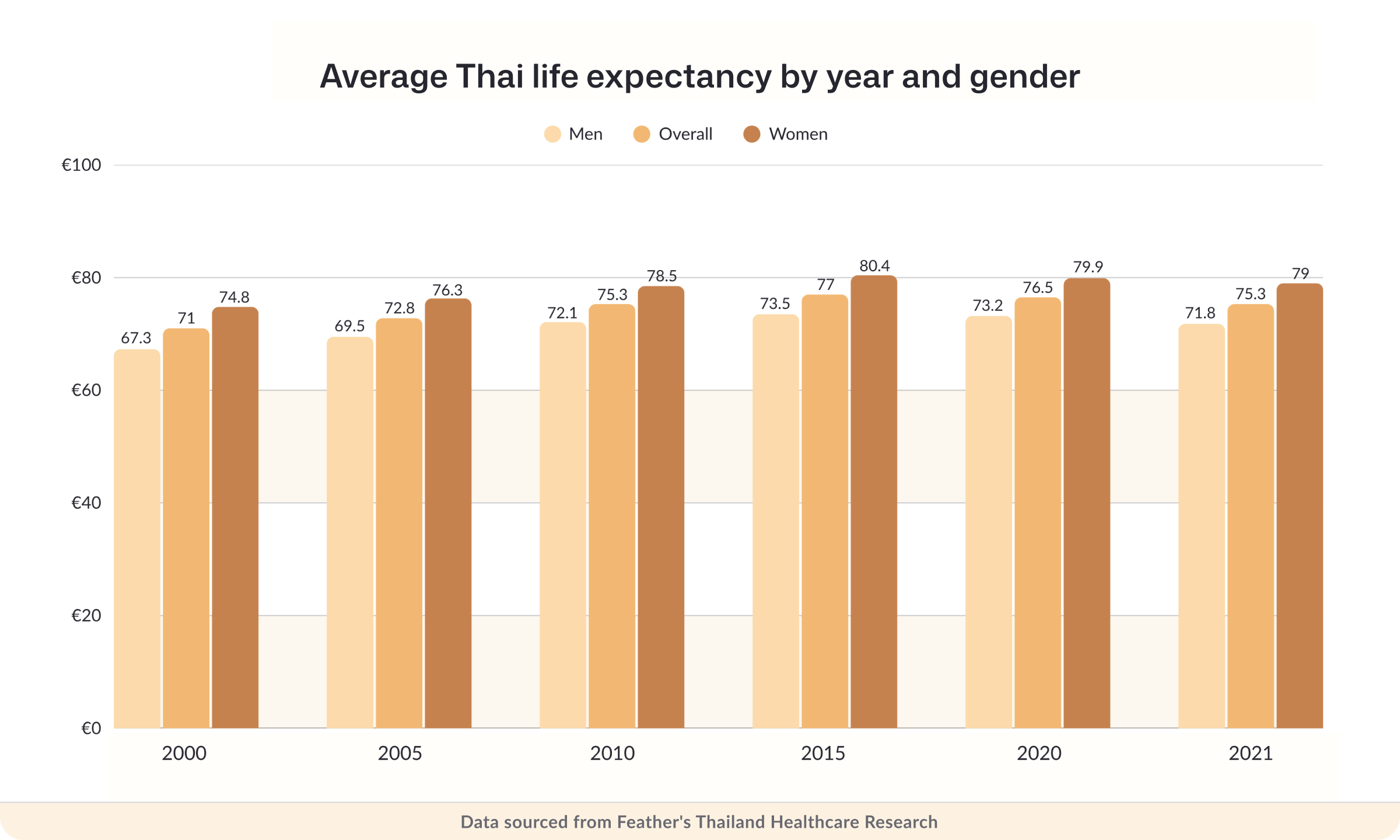
Life expectancy rose from 71.0 years in 2000 to 72.8 in 2005, 75.3 in 2010 and a peak of 77.0 in 2015. Between 2015 and 2020, it slipped back to 76.5 years.
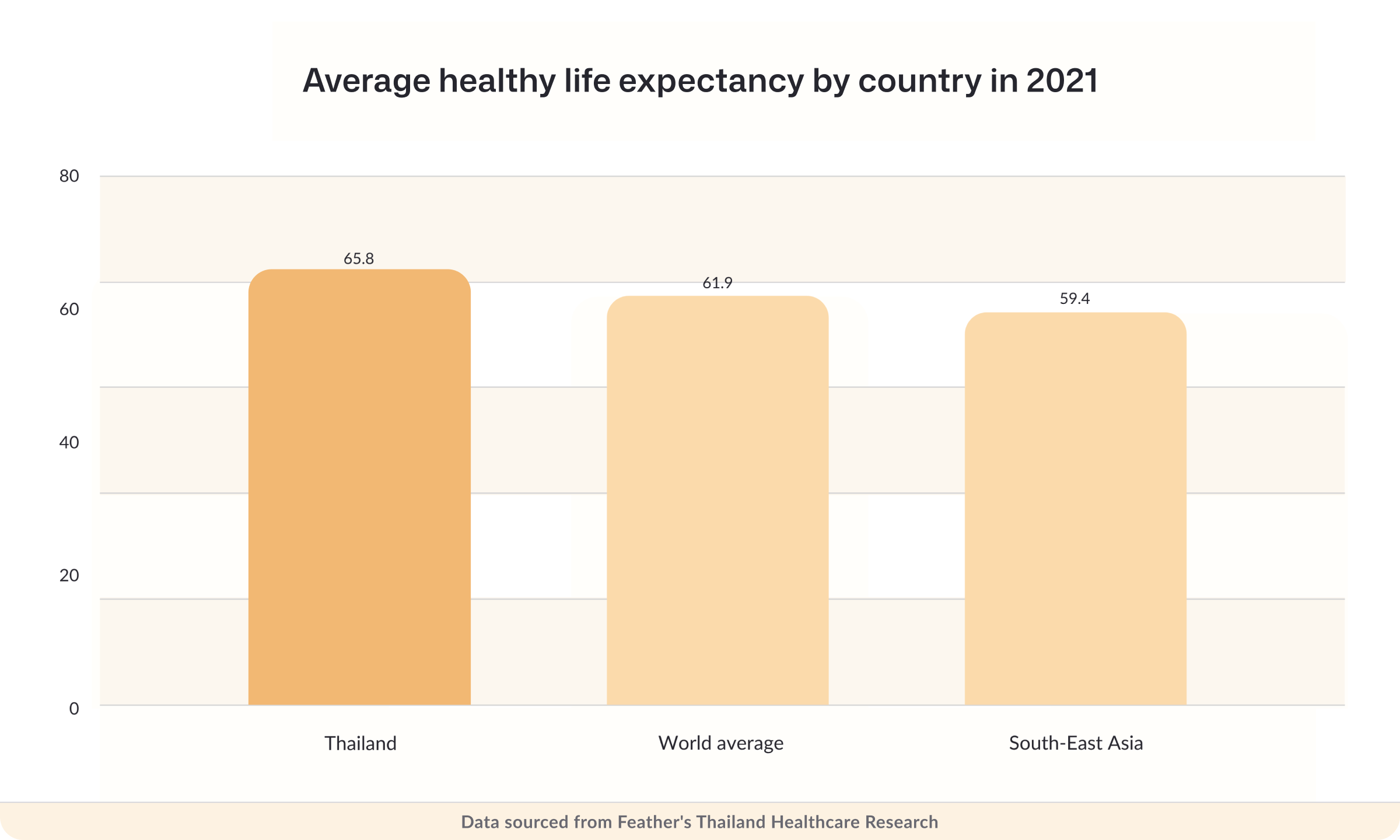
In 2021, the average Thai could expect 65.8 healthy life years at birth. That's above the world average of 61.9 years and the South-East Asian average of 59.4 years. Women fared better, with 68.1 healthy life years compared to 63.5 for men.
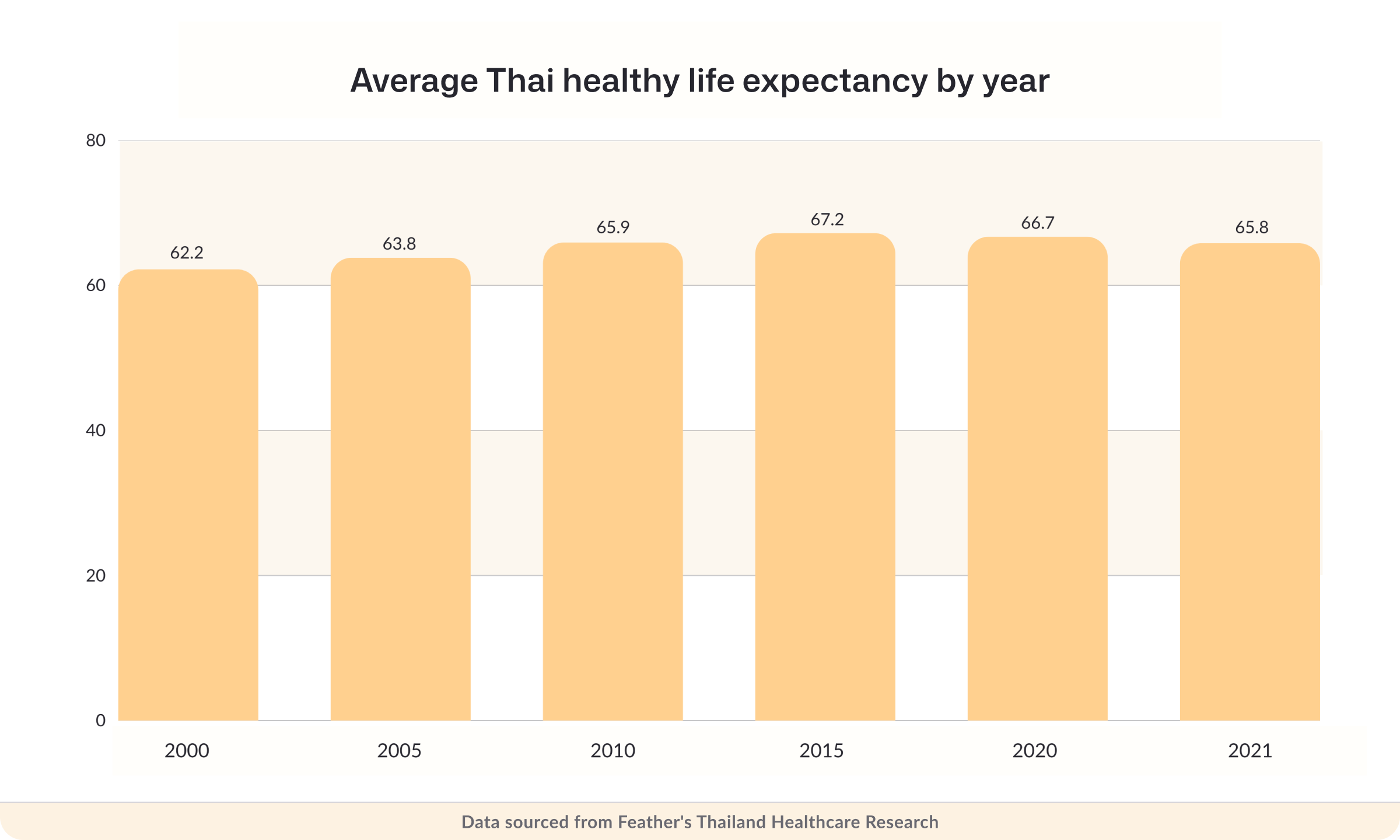
Between 2000 and 2021, healthy life expectancy at birth improved by 3.5 years, slightly below the 4.3 years gained across South-East Asia as a whole.
Source: World Health Organization
How much does Thailand spend on healthcare?
In 2023, Thailand spent an estimated US$326.50 per person on healthcare, down from US$369.98 in 2022. It's still far above the US$191.74 per person spent in 2011.
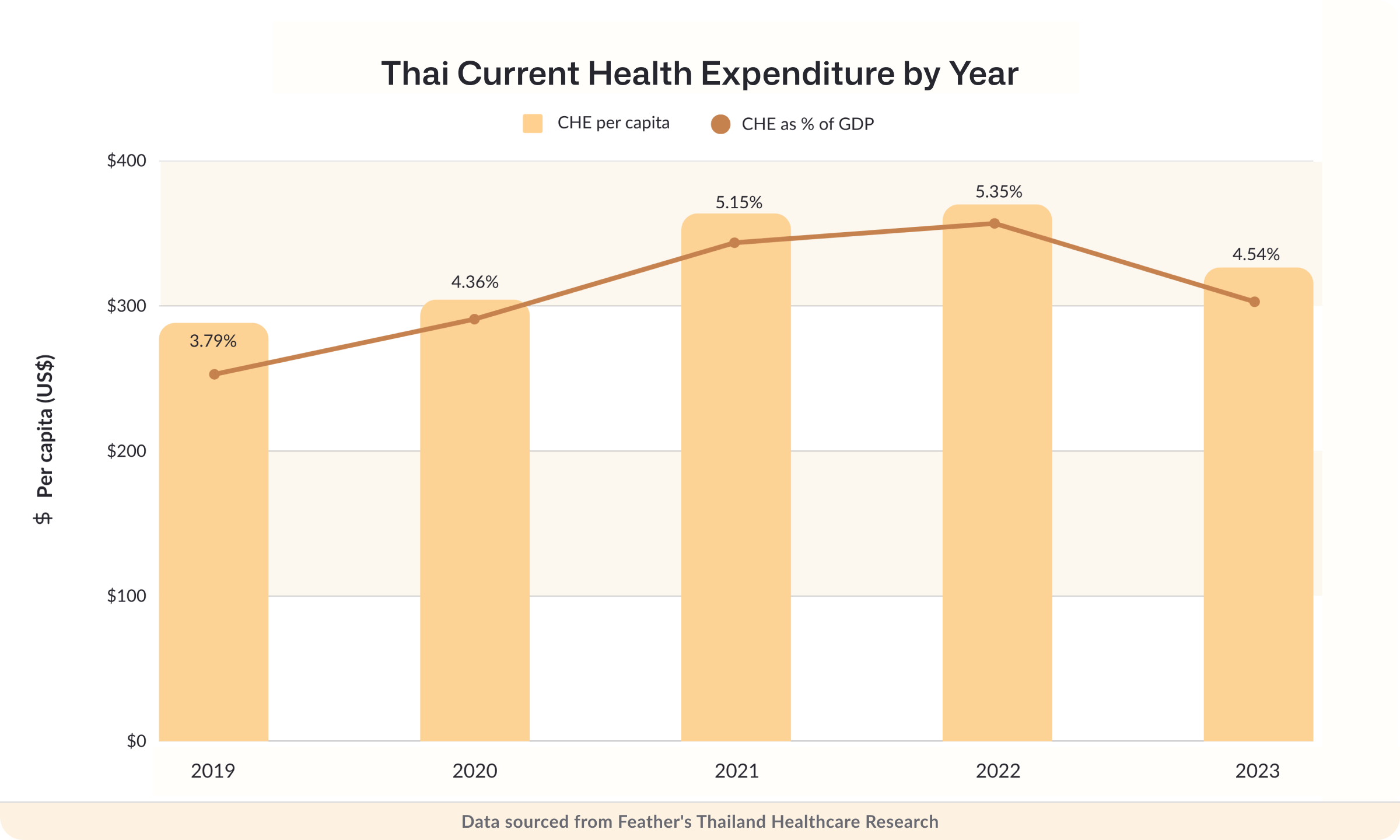
As a share of the economy, Thailand spent 5.54% of its GDP on health in 2023. That's up from 5.35% in 2022, and above the 4.36% it spent at the height of the COVID pandemic.
Even so, it's less than half the OECD average of 12.72% of GDP, and below the 6.08% average for upper-middle-income countries.
Healthcare accounted for 13.7% of general government spending in 2021, up from 12.1% in 2020.
In 2022, primary healthcare made up 58.3% of total current health spending.
Source: World Health Organization, World Bank
Where does Thailand spend its healthcare budget?
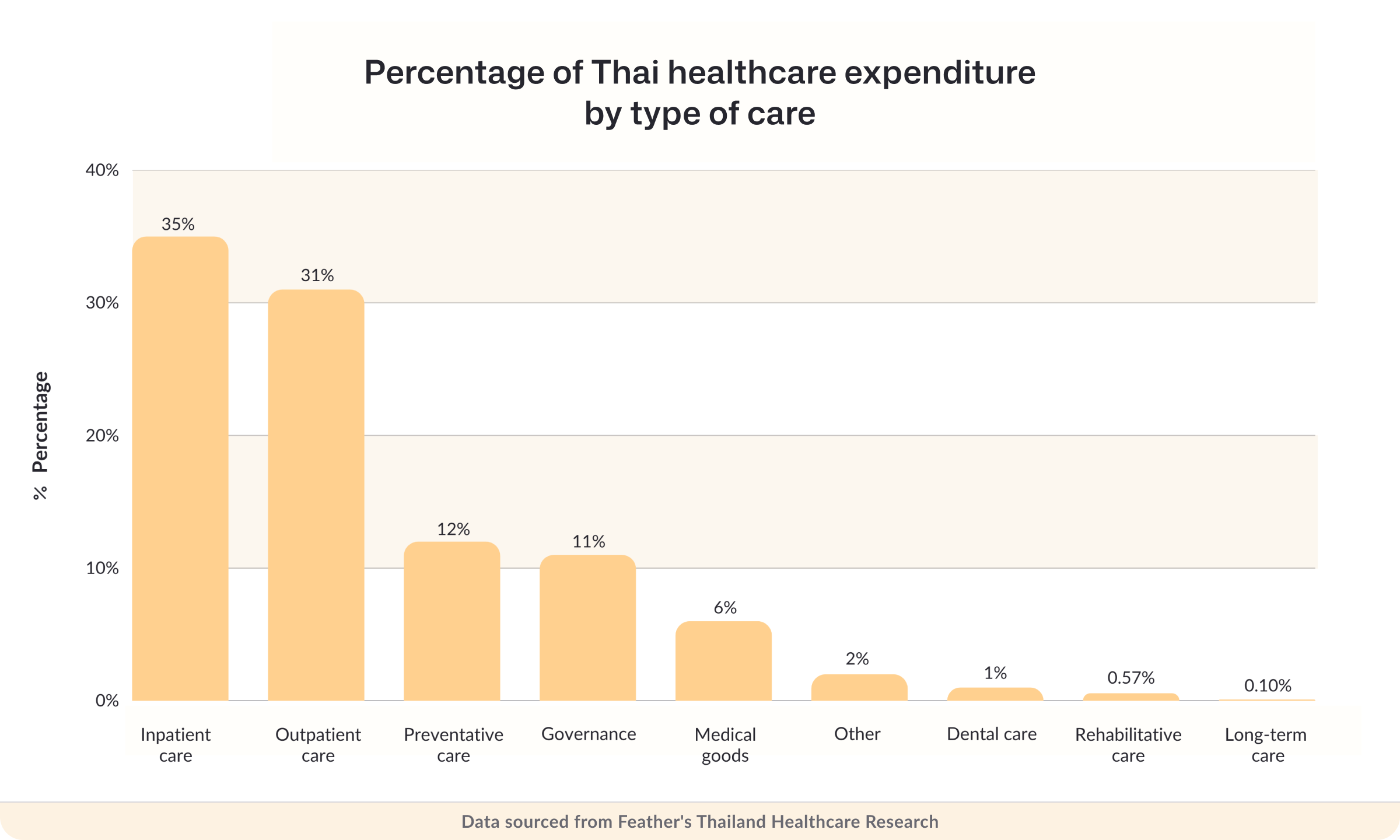
Hospitals take the biggest share. Inpatient care made up 35% of Thai healthcare spending in 2022, followed by outpatient care at 31%.
Long-term care barely registers, at less than 0.10% of spending. Compare that to Belgium (23%), Italy (10.2%) or the Netherlands (29.1%).
Prevention is where Thailand stands out. It spent 12% of its healthcare budget on prevention, far above the EU average of 2-4%.
Source: World Health Organization
Where does healthcare funding in Thailand come from?
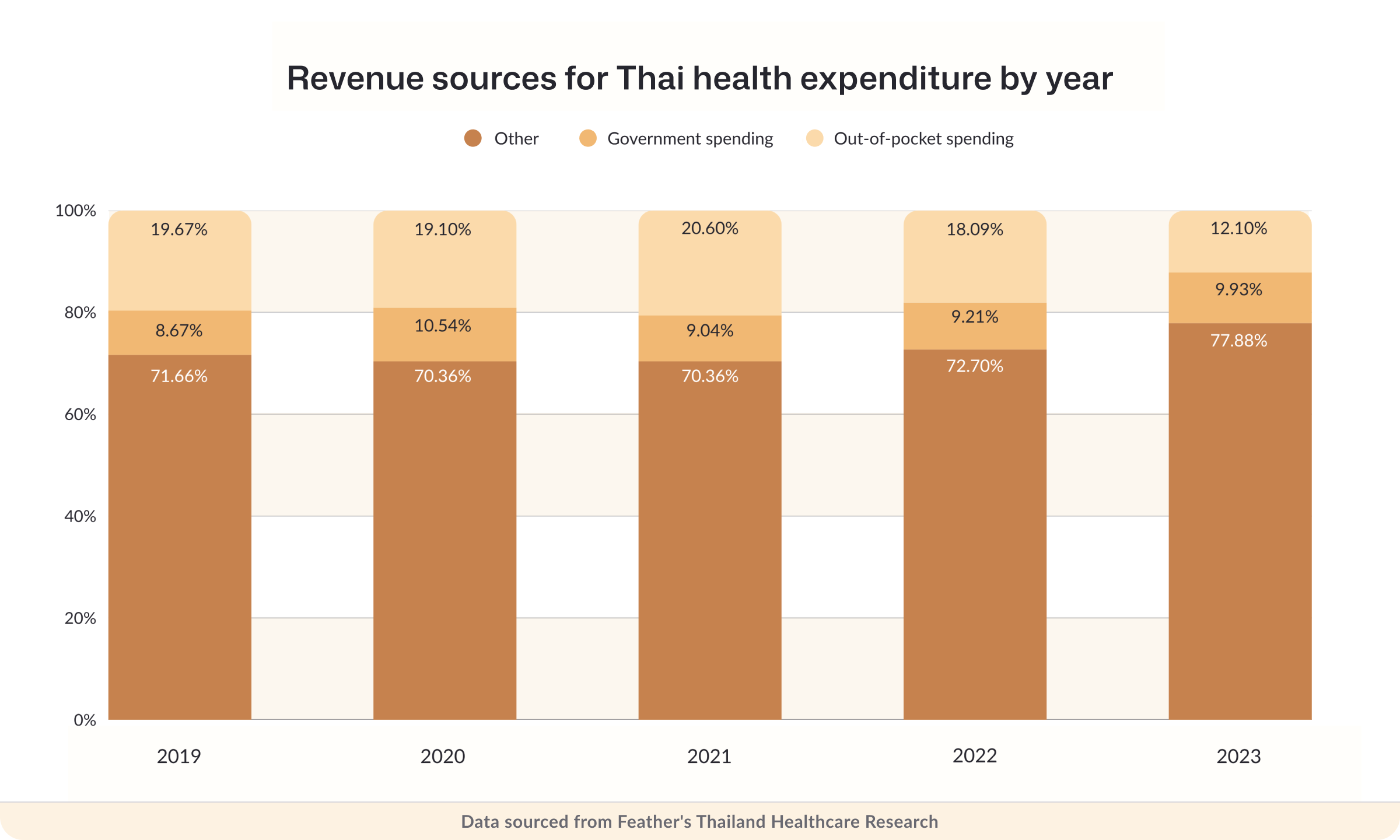
Mostly from the government. In 2023, 77.8% of all health spending came from public funding, up from 72.7% in 2022 and 70.4% in 2021.
Out-of-pocket spending made up just 9.9% of total health spending in 2023. Other sources, including voluntary insurance and external funding, covered the remaining 12.9%.
Universal coverage has made a real difference to household finances. In 2002, the year it was introduced, 20.2% of the population faced financial hardship because of out-of-pocket health costs. By 2017, that had fallen to 11.9%, a drop of more than 8 percentage points in 15 years.
Public coverage comes from three schemes: the Universal Coverage Scheme (UCS), the Social Security Scheme (SSS) and the Civil Servant Medical Benefit Scheme (CSMBS).
In 2025, the number of people covered by essential services without facing financial hardship was projected to grow by 7.3 million, compared to the 2018 baseline.
Source: World Health Organization, World Health Organization, World Health Organization
How healthy are people in Thailand?
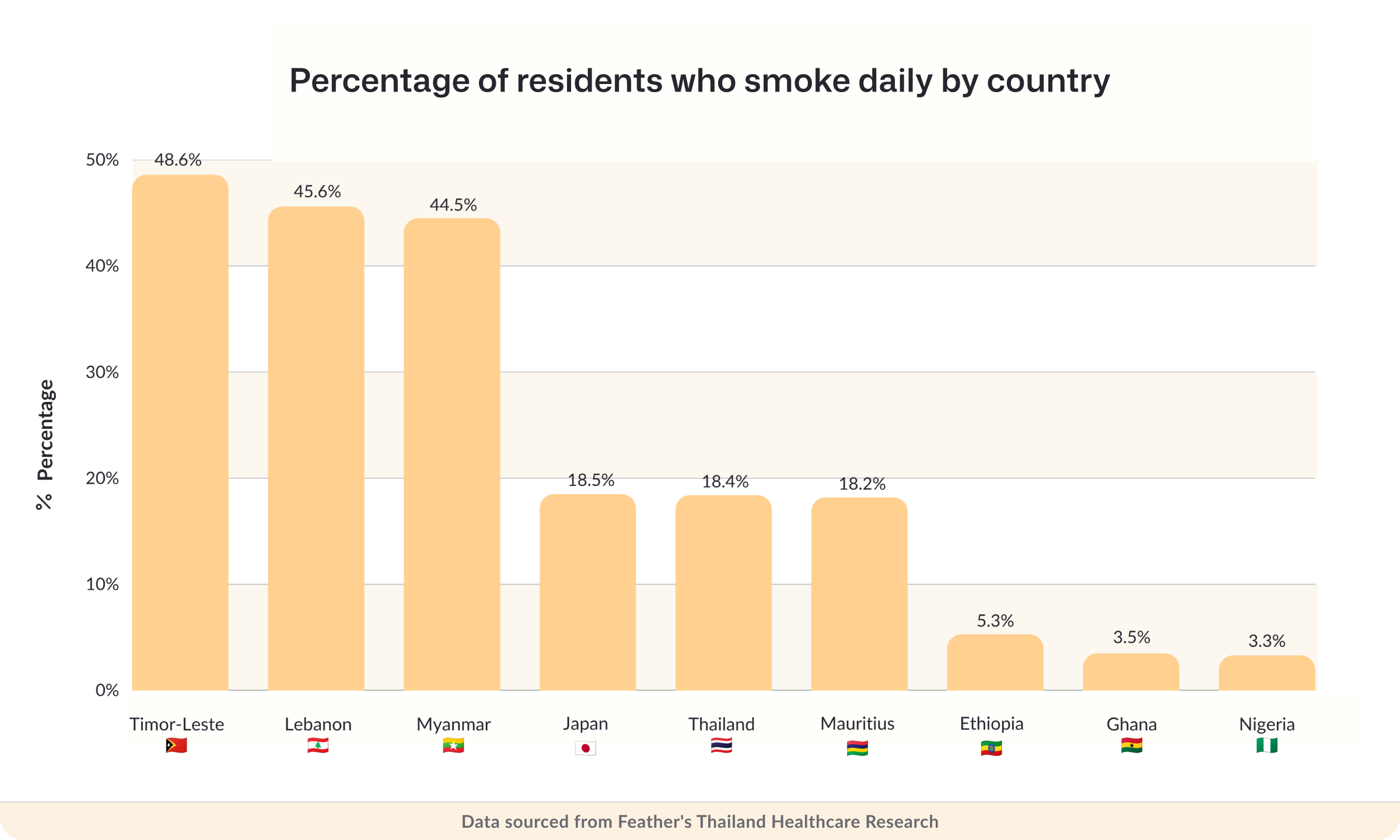
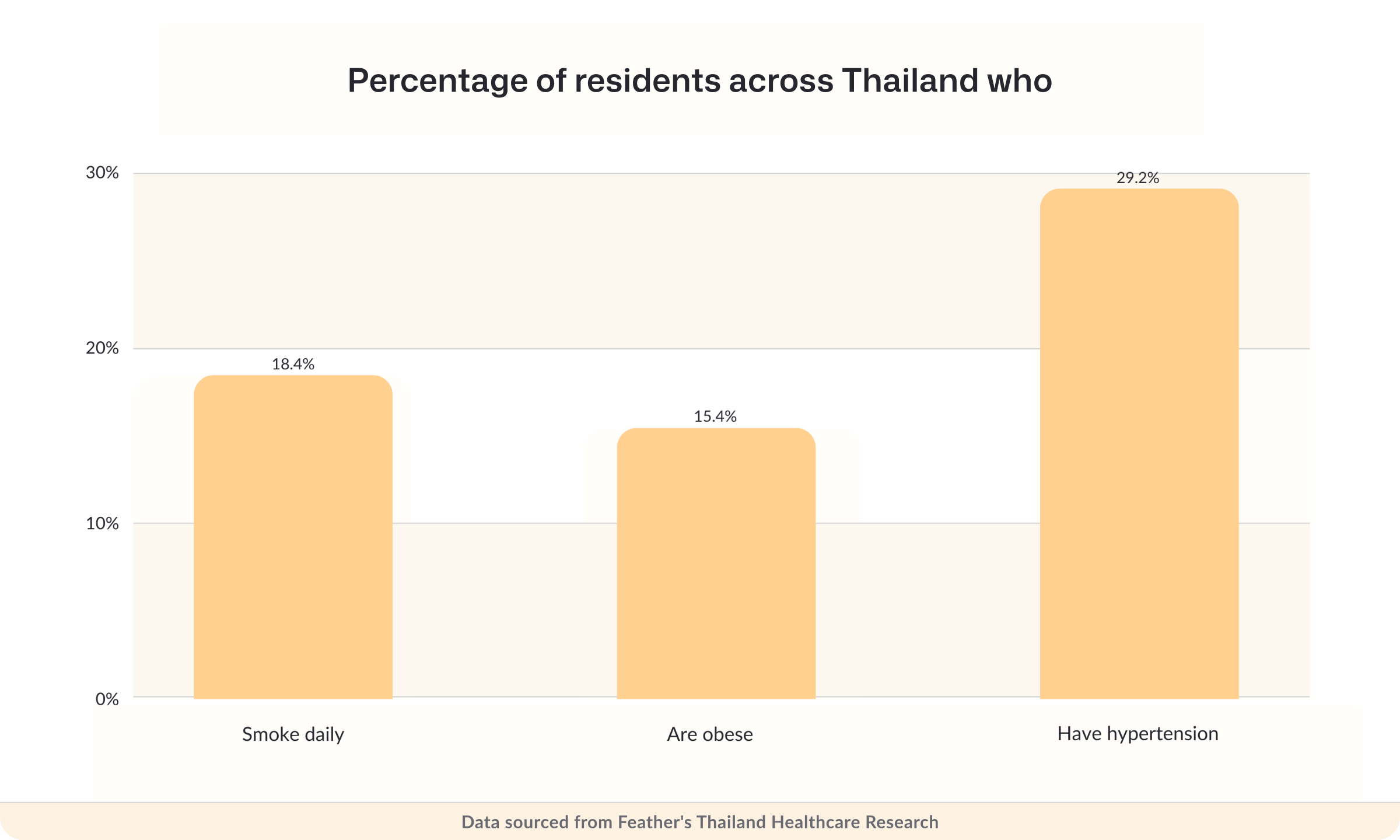
Approximately 18.4% of Thai adults smoke daily. That puts Thailand between Japan (18.5%) and Mauritius (18.2%) in the global rankings.
Alcohol consumption stood at 6.7 liters per adult per year in 2020, up 0.04 liters on 2019.
29.2% of Thai adults aged 30–79 have hypertension, a slight increase from 29% in 2018. Obesity stands at 15.4% for adults (aged 18+) and 12.3% for children and adolescents (aged 5–18).
Thailand also recorded 149 cases of tuberculosis per 100,000 people in 2023, up slightly from 148 per 100,000 in 2022.
Source: World Health Organization, World Health Organization
How many people in Thailand have a chronic health condition?
Around 75% of Thailand's elderly population (65+), approximately 7.4 million people, have at least one chronic disease. And nearly a quarter of all adults aged 30–69 are living with a chronic illness.
Diabetes is rising fast. The number of people diagnosed went from 1.99 million in 2013 to 3.17 million in 2021, an average increase of 6% a year. The International Diabetes Federation estimates 6.36 million adults were living with diabetes in Thailand in 2024, with another 2.1 million cases undiagnosed.
Mental health is a growing part of the picture too. In 2021, mental, neurological and self-harm conditions accounted for 37.2% of Thailand's total disease burden, up from 34.4% in 2000.
Source: World Health Organization, International Diabetes Federation
Cause of death statistics in Thailand
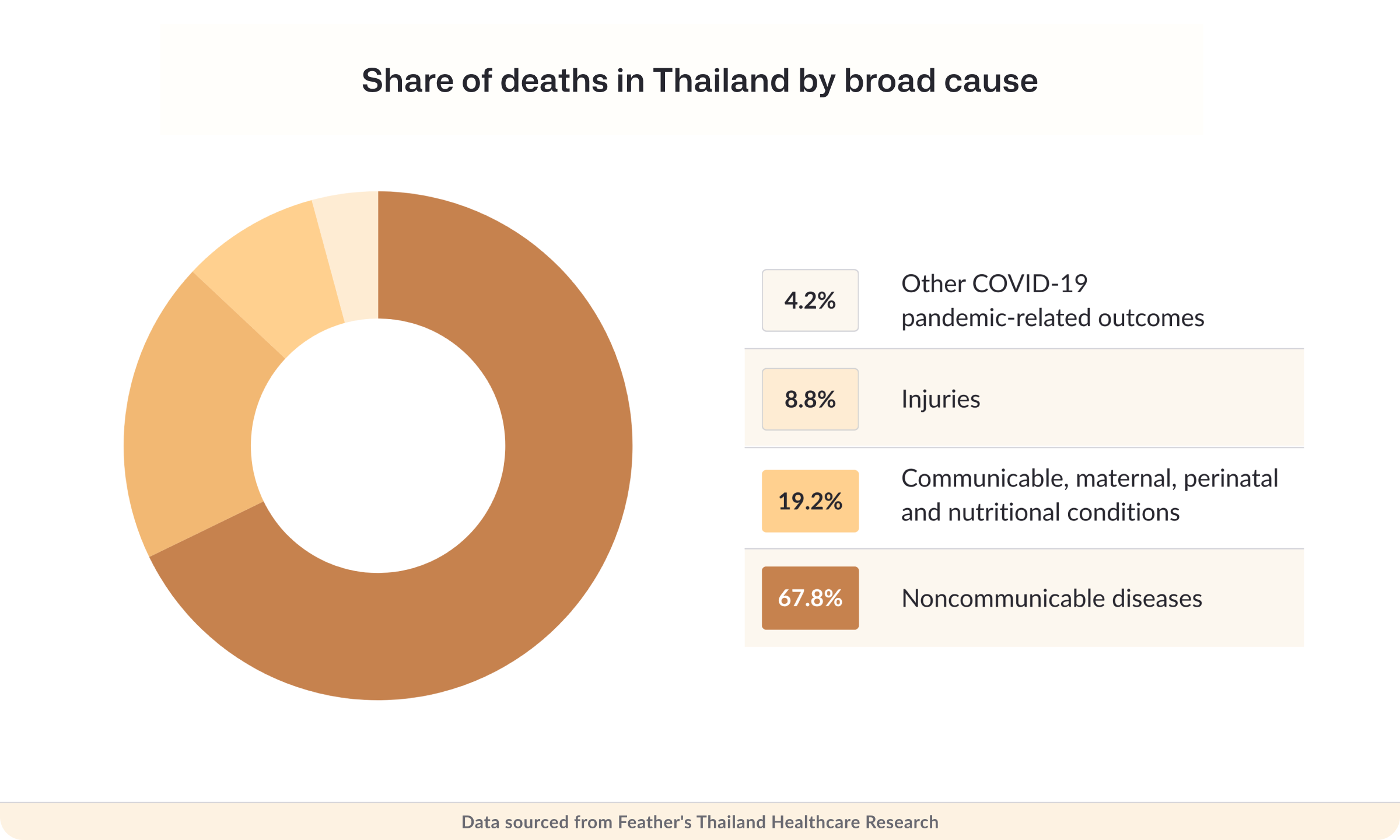
In 2021, non-communicable diseases caused 67.8% of all deaths in Thailand. Injuries accounted for 8.8%, and communicable diseases for the rest.
Here are the ten leading causes of death per 100,000 people in 2021:
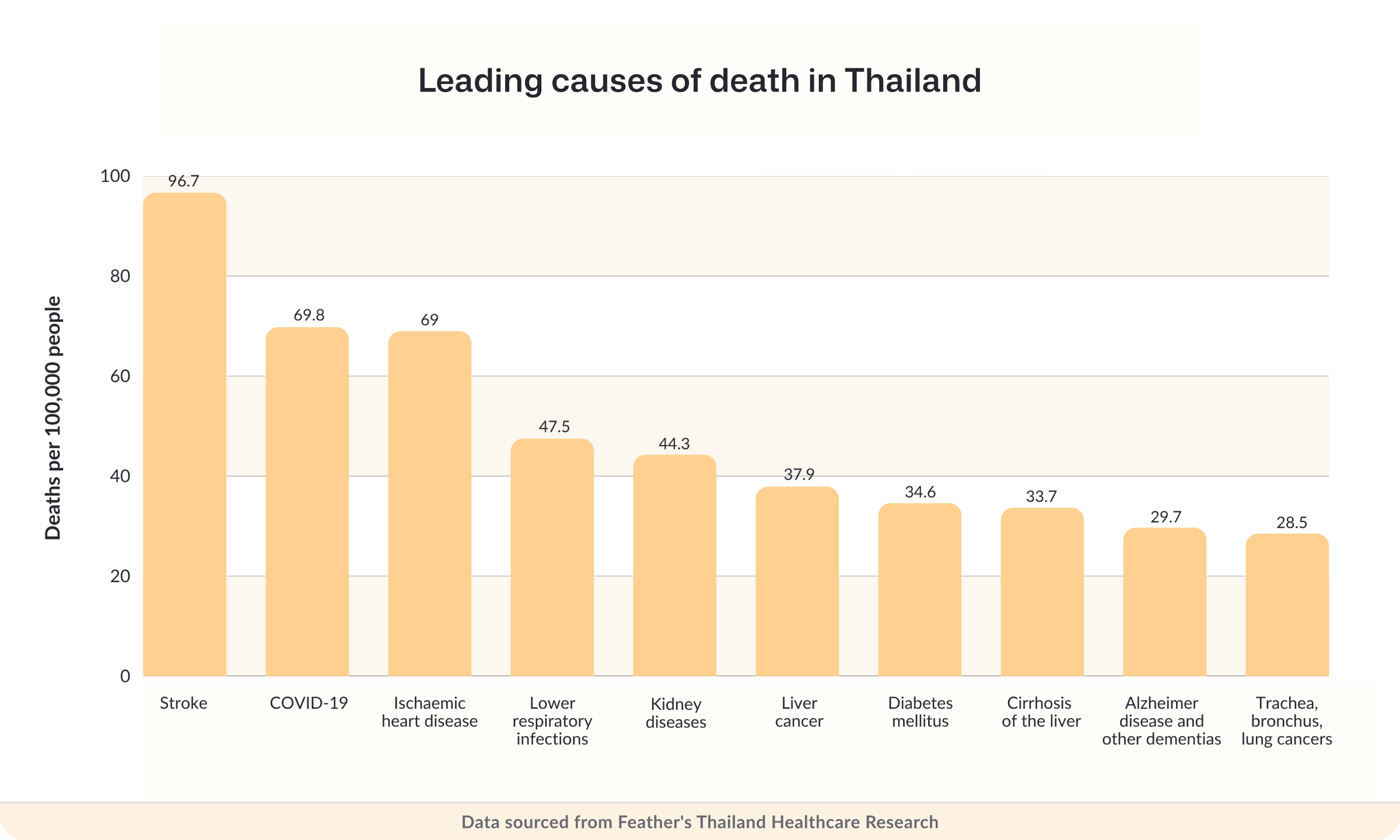
Stroke is the leading cause of death, at 96.7 deaths per 100,000. Liver cancer comes next, at 37.9 deaths per 100,000.
Roads are another major risk, with 25.4 road traffic deaths per 100,000 people in 2021. Deaths linked to air pollution stood at 46.1 per 100,000 in 2019, down 12.8 per 100,000 from 2010.
Source: World Health Organization
How many doctors and nurses are there in Thailand?
Not many, by international standards. In 2022, Thailand had 5.45 doctors per 10,000 people, or 0.54 per 1,000. That's far below the OECD average of 4.3 doctors per 1,000 people.
Thailand had roughly 1.13 dentists per 10,000 people and 2.3 pharmacists per 10,000.
Nurses fill much of the gap. In 2022, Thailand had 26.5 nurses and midwives per 10,000 people, an increase of 7.2 since 2012. That gives the country a nurse-to-doctor ratio of approximately 4.9:1.
Source: World Health Organization, OECD
How many hospital beds are there in Thailand?
Thailand has approximately 2.4 hospital beds per 1,000 people. That's below the global average of 3.3 per 1,000 and nearly half the OECD average of 4.0 per 1,000.
Diagnostic equipment is also below OECD levels. Thailand has roughly 32 CT, MRI and PET scanners per million people, compared to the OECD average of 51 per million.
Source: World Health Organization, OECD
Vaccination and cancer screening coverage in Thailand
In 2023, 92% of one-year-olds in Thailand received three doses of the DTP (diphtheria, tetanus, pertussis) vaccine, broadly in line with the OECD average of 93%.
On reproductive health, 87% of Thai women of reproductive age have their family planning needs met with modern methods. And 100% of births are attended by a skilled healthcare professional. Both are strong signs of how far primary care reaches.
Source: World Health Organization, OECD


