Health & healthcare in Switzerland: Statistics, trends & facts (2026)
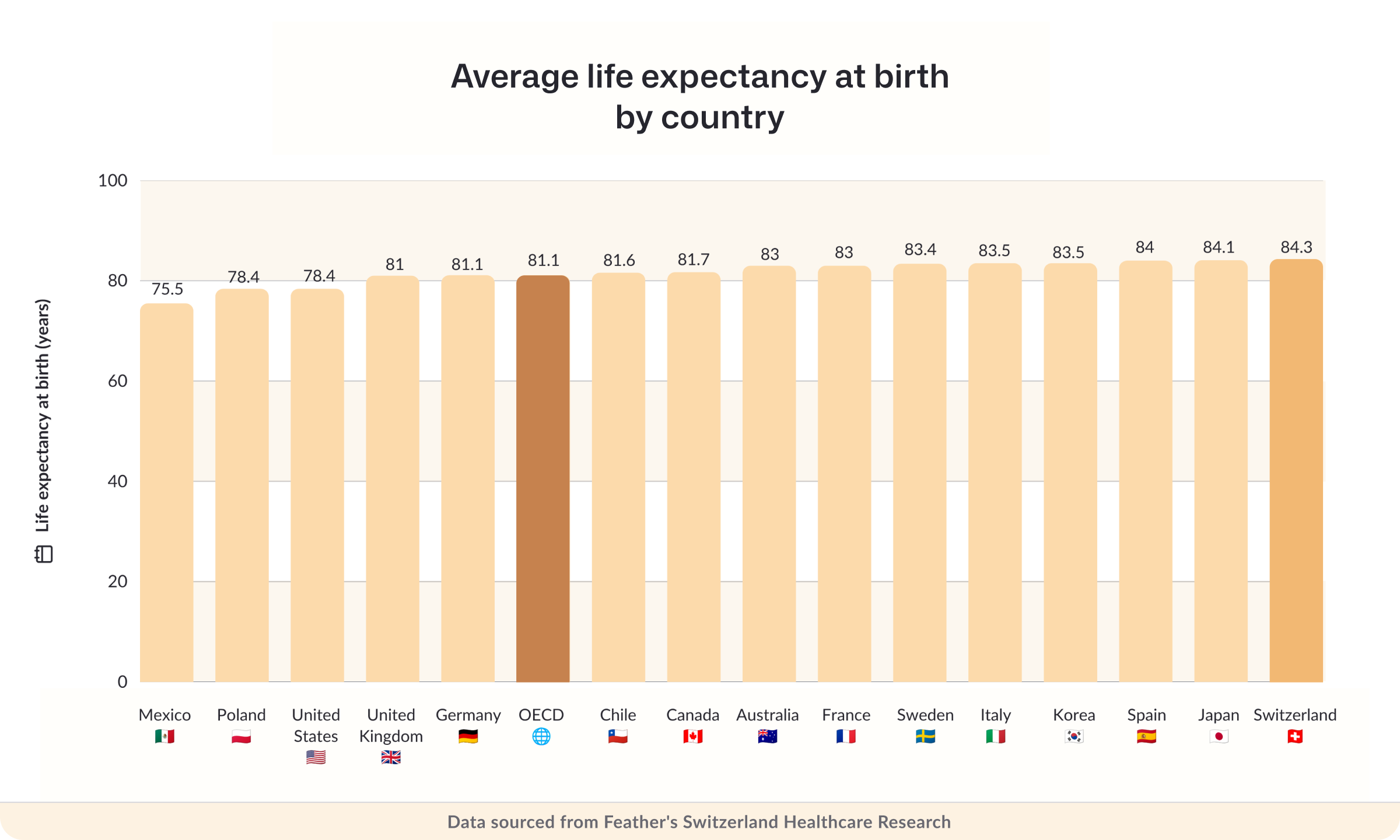
In 2025, the Swiss health system was ranked twelfth in the world, behind Belgium and ahead of Japan. In the same year, average life expectancy in Switzerland reached 84.3 years, one of the highest in the OECD.
So what's behind all that longevity? And what does it cost? If you're living in Switzerland, or about to, you'll know health insurance is compulsory and premiums aren't small. Here's where the money goes and what you get for it.
In this article, we'll cover:
- Who lives in Switzerland, and how long (and how healthily) they can expect to live
- How Swiss health insurance coverage works, and how many people add private plans
- How much Switzerland spends on healthcare, and how it's funded
- How satisfied the Swiss are with their care, and how healthy they are
- What people in Switzerland are most likely to die from
- How many doctors, nurses and hospital beds the country has
First, the headline numbers.
Key Swiss healthcare statistics: our top picks
- Switzerland's average life expectancy of 84.3 years in 2025 is the highest among OECD members.
- Switzerland has more than double the mental hospital beds per 100,000 people of the average high-income country (75.1 vs 28.6 mental health beds per 100,000 people).
- Switzerland's 53 psychiatrists per 100,000 people is 4 times the high-income country average of 13 per 100,000.
- Generic medicines make up just 25% of Switzerland's pharmaceutical market, one of the lowest shares in the OECD.
- Out-of-pocket spending is the second largest source of funding in the Swiss health system, at 21.3% of health funding.
Switzerland's population statistics
In 2025, Switzerland had a population of 9,124,288 people, up 0.8% on 2024.
By 2050, the Swiss population is projected to reach 9.3 million, an increase of 5.3% on 2023's estimate.
6.5% of the population is aged 14 and under, 71.9% are 15 to 64, and the remaining 21.6% are over 65.
72.3% of the population are Swiss nationals. The other 27.7% are foreign nationals living in the country.
The gender split is almost even: 50.3% women and 49.7% men.
Source: World Health Organization, Federal Statistical Office
Life expectancy statistics in Switzerland
In 2025, average life expectancy at birth in Switzerland was 84.3 years, 3.2 years above the OECD average. That puts it just ahead of Japan (84.1 years) and Spain (84 years).
Between 2000 and 2021, life expectancy in Switzerland rose by 3.61 years, from 79.7 years to 83.3 years. Across Europe, it rose by 3.89 years over the same period.
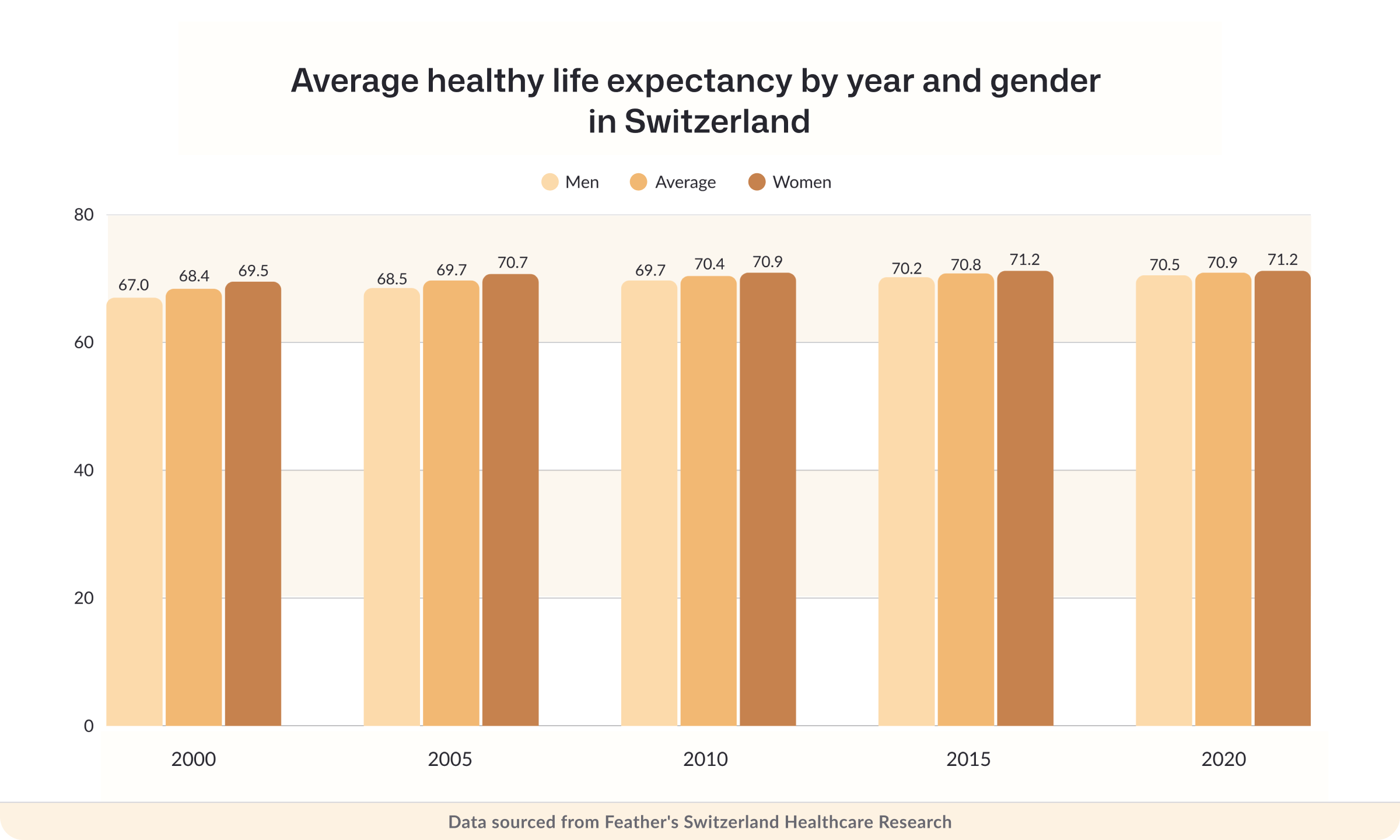
In 2021, the average Swiss resident could expect 71.1 healthy life years, an increase of 2.8 years since 2000.
That's above both the global average of 61.9 healthy life years and the European average of 66.
The gap between men and women is tiny. In 2020, just 0.7 years separated them: men could expect 70.5 healthy life years, and women 71.2.
Source: OECD, World Health Organization
How many people in Switzerland have health insurance?
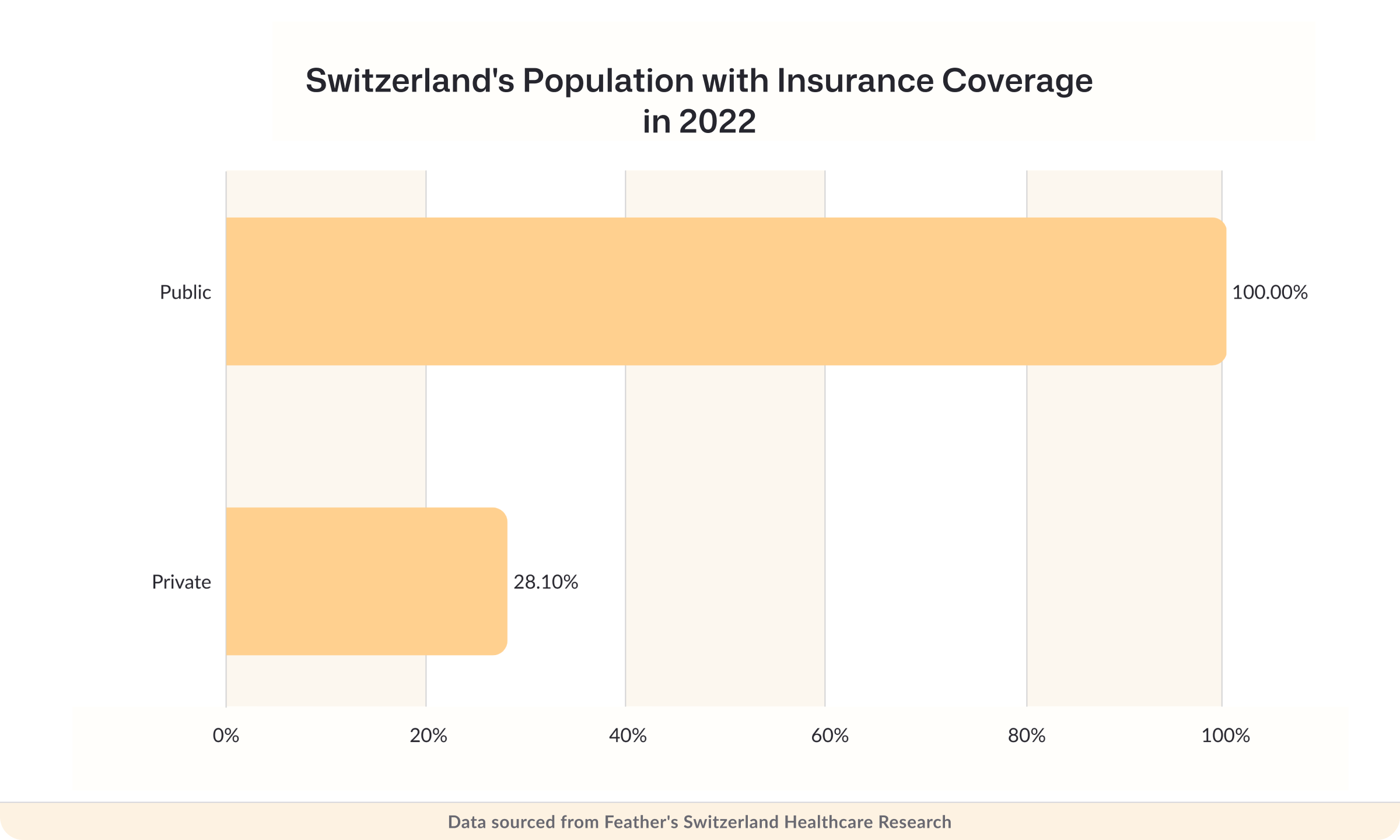
Everyone. Switzerland has universal healthcare because 100% of the population is covered for a core set of health services through public health insurance. The OECD average is 98%.
In 2022, an extra 28.1% of Swiss residents also had private health insurance.
These private plans typically cover what the public system doesn't: dental care, alternative medicine, private or semi-private hospital rooms, and care received abroad.
Source: Commonwealth Fund, OECD
How much does Switzerland spend on healthcare?
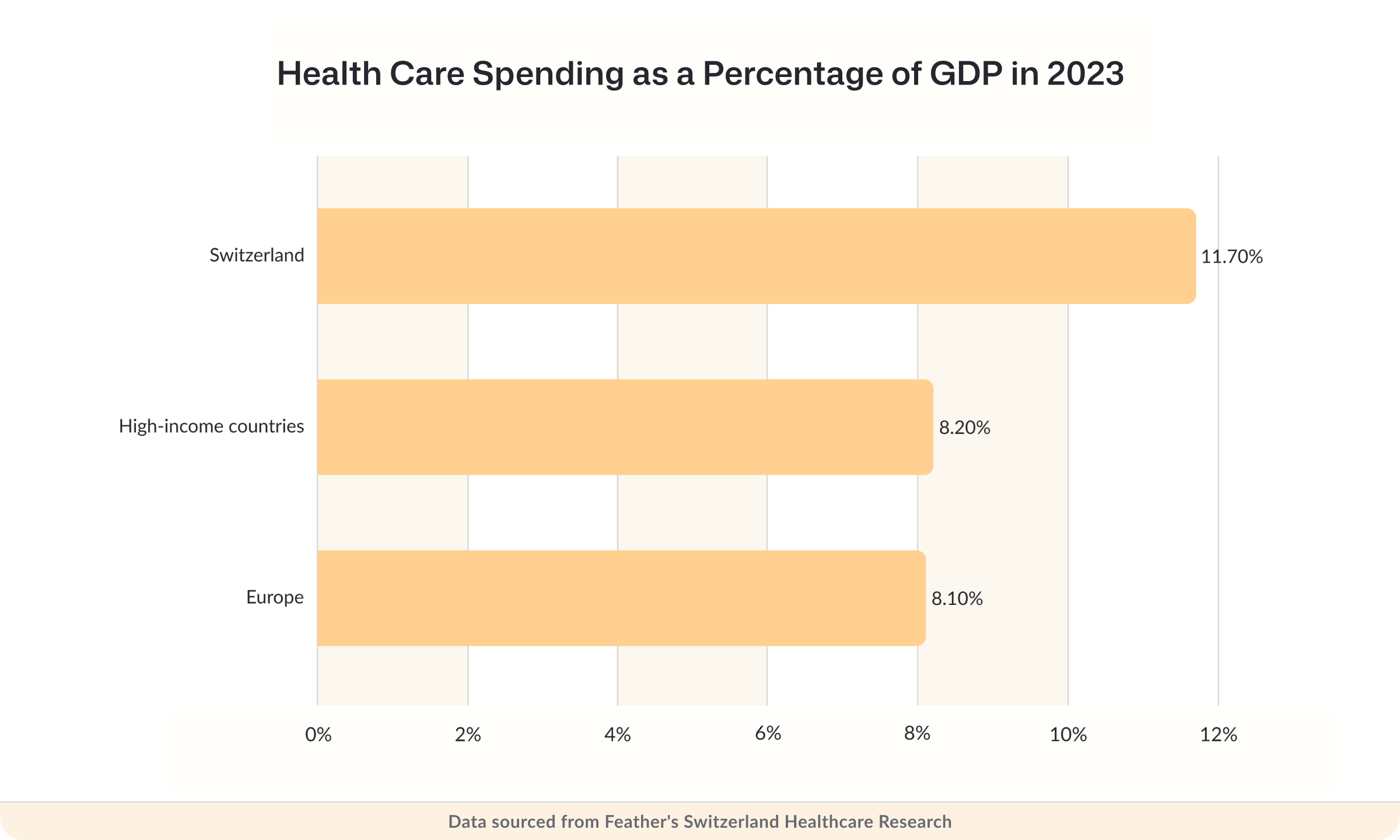
A lot. In 2023, Switzerland spent approximately 11.7% of its GDP on healthcare, above the average for both high-income countries (8.2%) and Europe (8.1%).
Per person, Switzerland spends US$9,963 on health, nearly US$4,000 more than the OECD average of $5,967.
Source: Commonwealth Fund, OECD
Where does Switzerland spend its healthcare budget?
Long-term care takes the biggest share. In 2021, it accounted for 20.94% of Switzerland's total health spending.
The five largest areas of health spending were:
- Long-term care (20.94%)
- Inpatient care (20.3%)
- Other health-related spending (19.81%)
- Medical goods (14.54%)
- Outpatient care (8.47%)
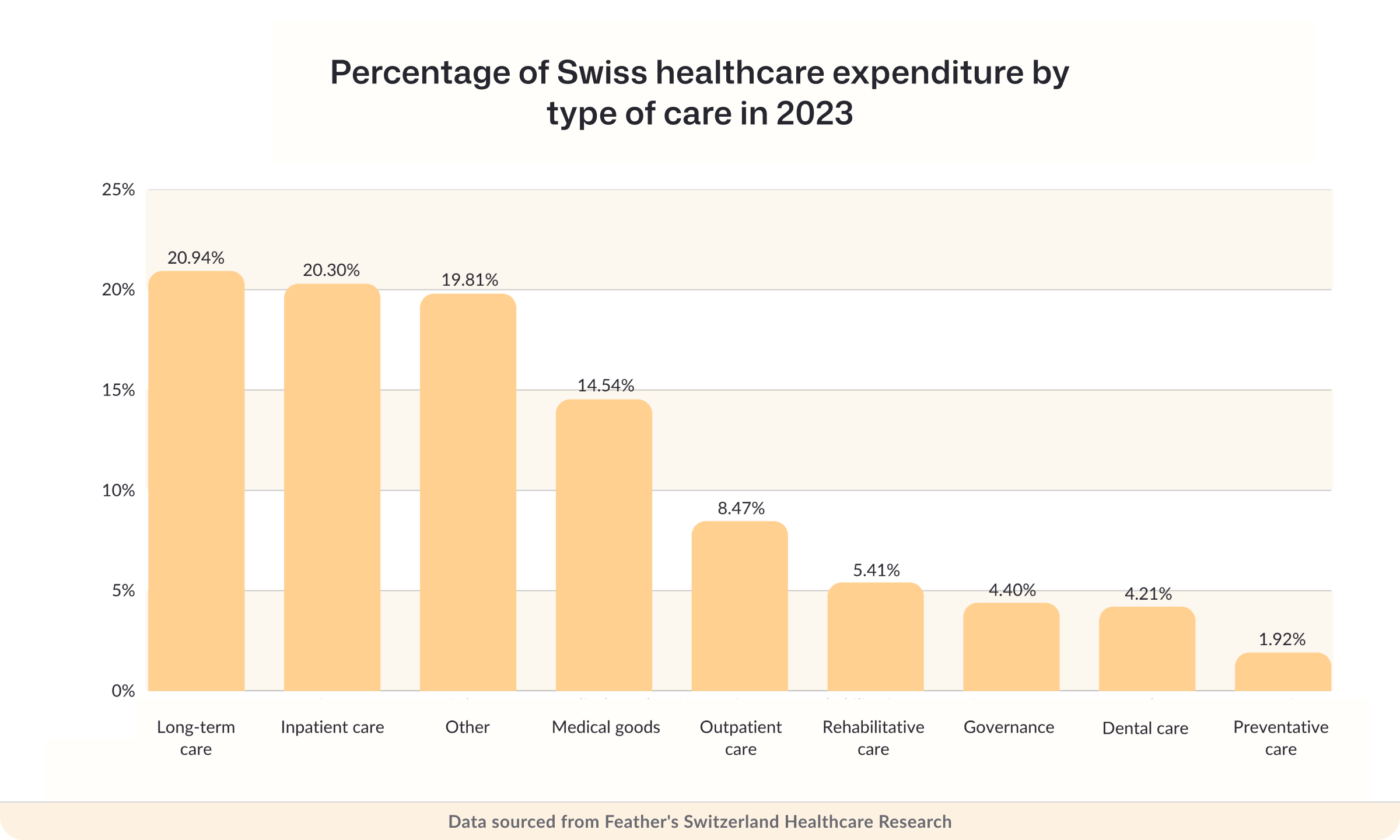
Prevention gets surprisingly little: just 1.92% of the budget, less than the OECD average of 3.4%.
That also puts Switzerland behind the EU average (4.2%), Italy (4.6%) and the Netherlands (5.2%).
Source: World Health Organization, OECD
How much does Switzerland spend on pharmaceuticals?
Pharmaceuticals accounted for 11.5% of Switzerland's total healthcare spending in 2021.
In 2023, the country spent US$1,061 per person on medicines, one of the three highest figures in the OECD.
Generics make up just 25% of the volume of Switzerland's pharmaceutical market, less than half the OECD average of 56%.
Source: Commonwealth Fund, OECD
Where does healthcare funding in Switzerland come from?
Mostly from households. Contributions to compulsory health insurance are the largest source of funding for Swiss healthcare.
In 2024, these premiums accounted for 32.5% of health funding. State payments for services made up 20.2%, and social security 11.2%.
Premiums for supplementary private insurance accounted for just 7.5% of health funding in 2024.
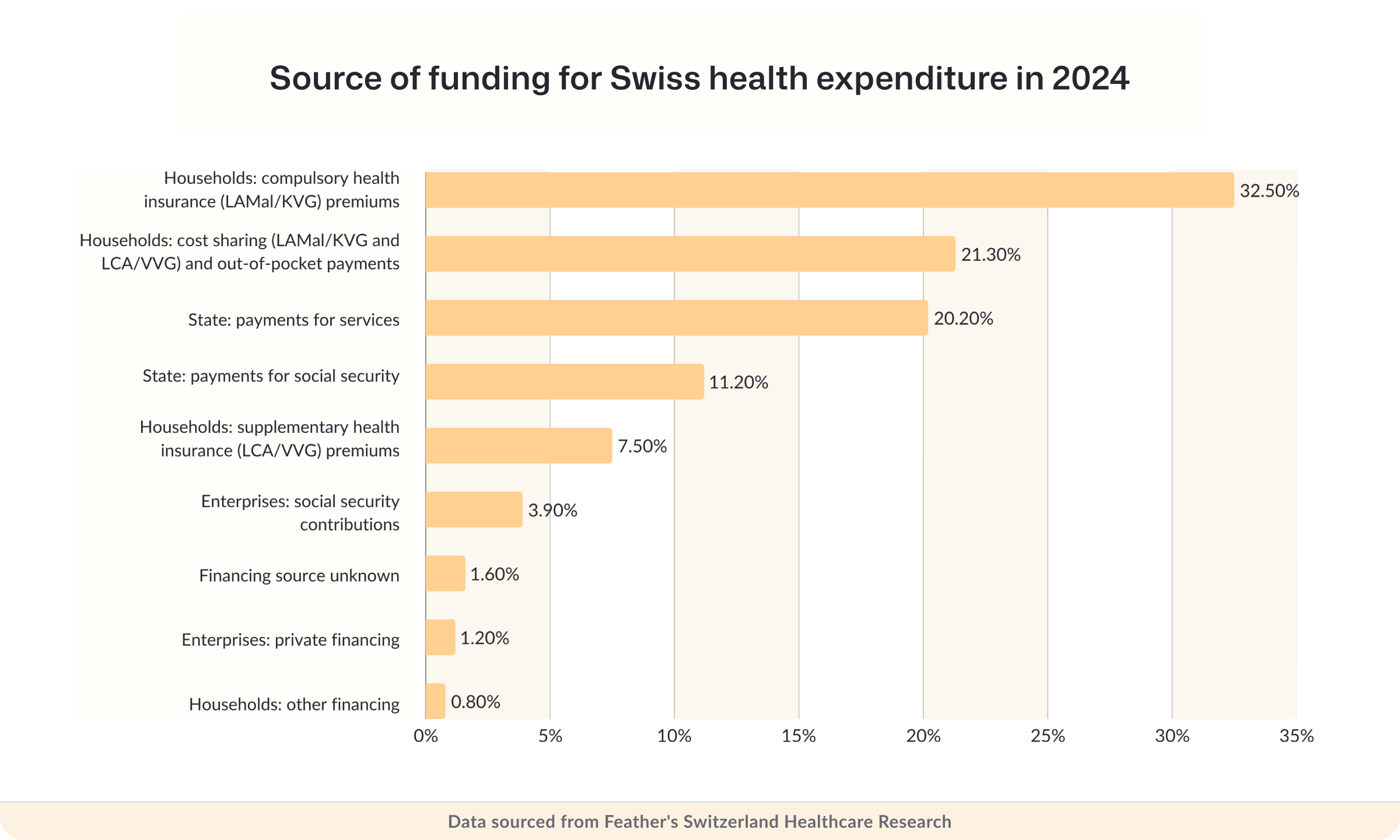
Out-of-pocket spending is the second largest source of funding in the Swiss system.
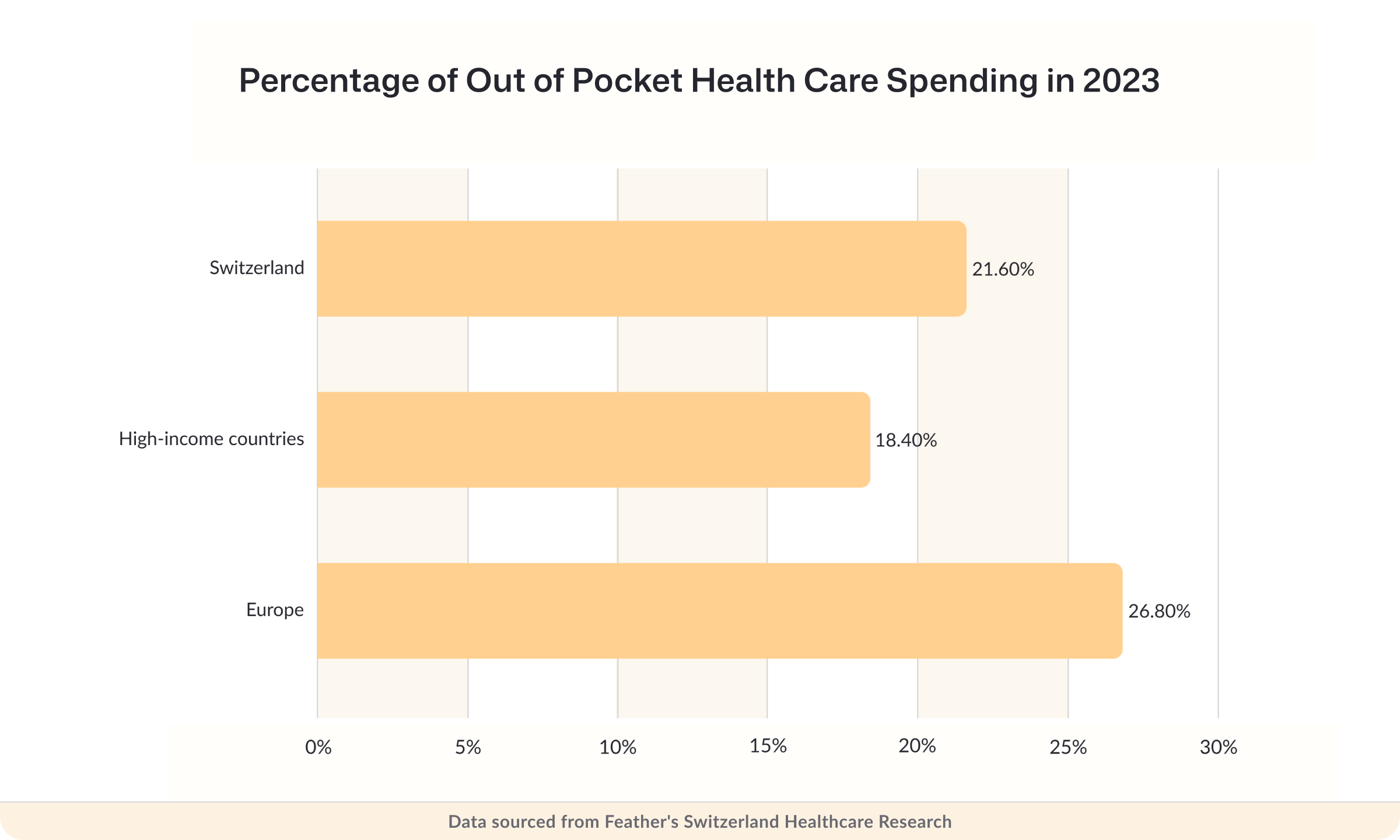
In 2024, 21.3% of all health funding came from out-of-pocket payments, down from 21.6% in 2023. (Think deductibles, co-payments and anything your policy doesn't cover.)
The 2023 figure puts Switzerland above the high-income country average (18.4%), but below the European average (26.8%).
Source: Commonwealth Fund, Federal Statistical Office
How satisfied are people in Switzerland with their healthcare?
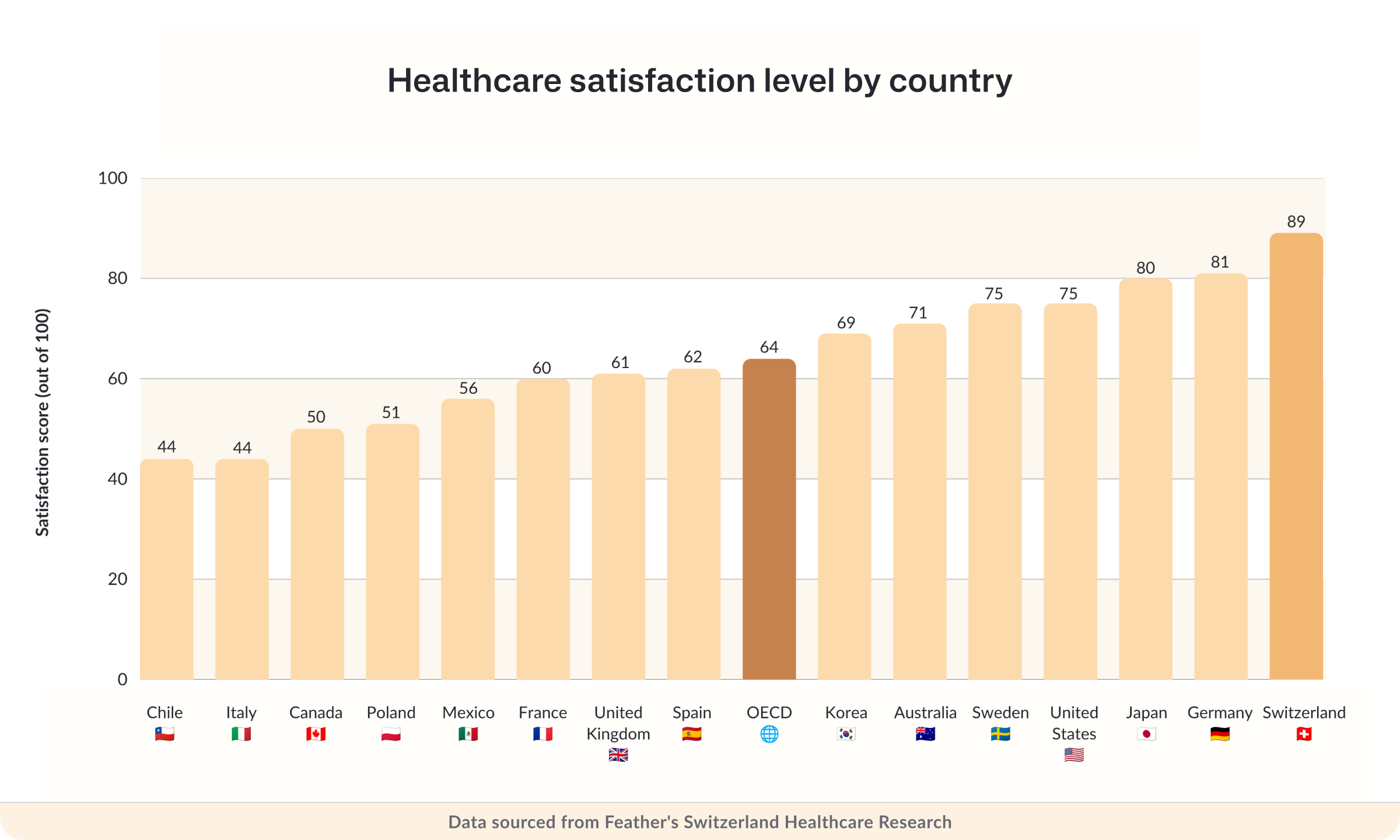
Very. Swiss healthcare satisfaction is among the highest in the world, and the highest in the OECD.
In 2025, 89% of Swiss adults were satisfied with the quality of healthcare in the country.
That's far above the OECD average of 64%, and ahead of Japan (80%) and Germany (81%) in second and third place.
Source: OECD
What percentage of the Swiss population has unmet medical needs?
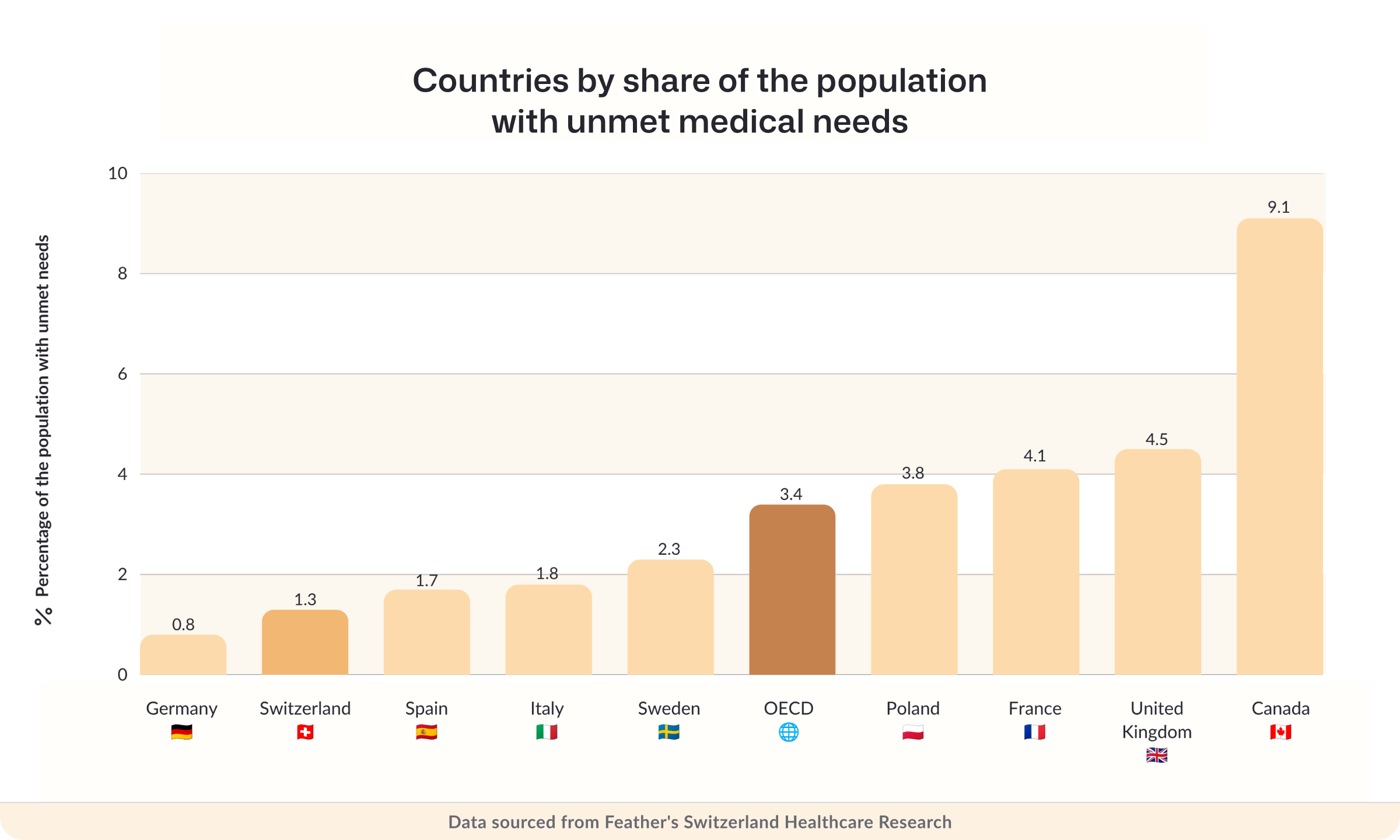
Very few people in Switzerland go without care. It's one of the lowest rates in the OECD.
Approximately 1.3% of Swiss residents report an unmet medical need, nearly three times fewer than the OECD average of 3.4%.
Source: OECD
How healthy are people in Switzerland?
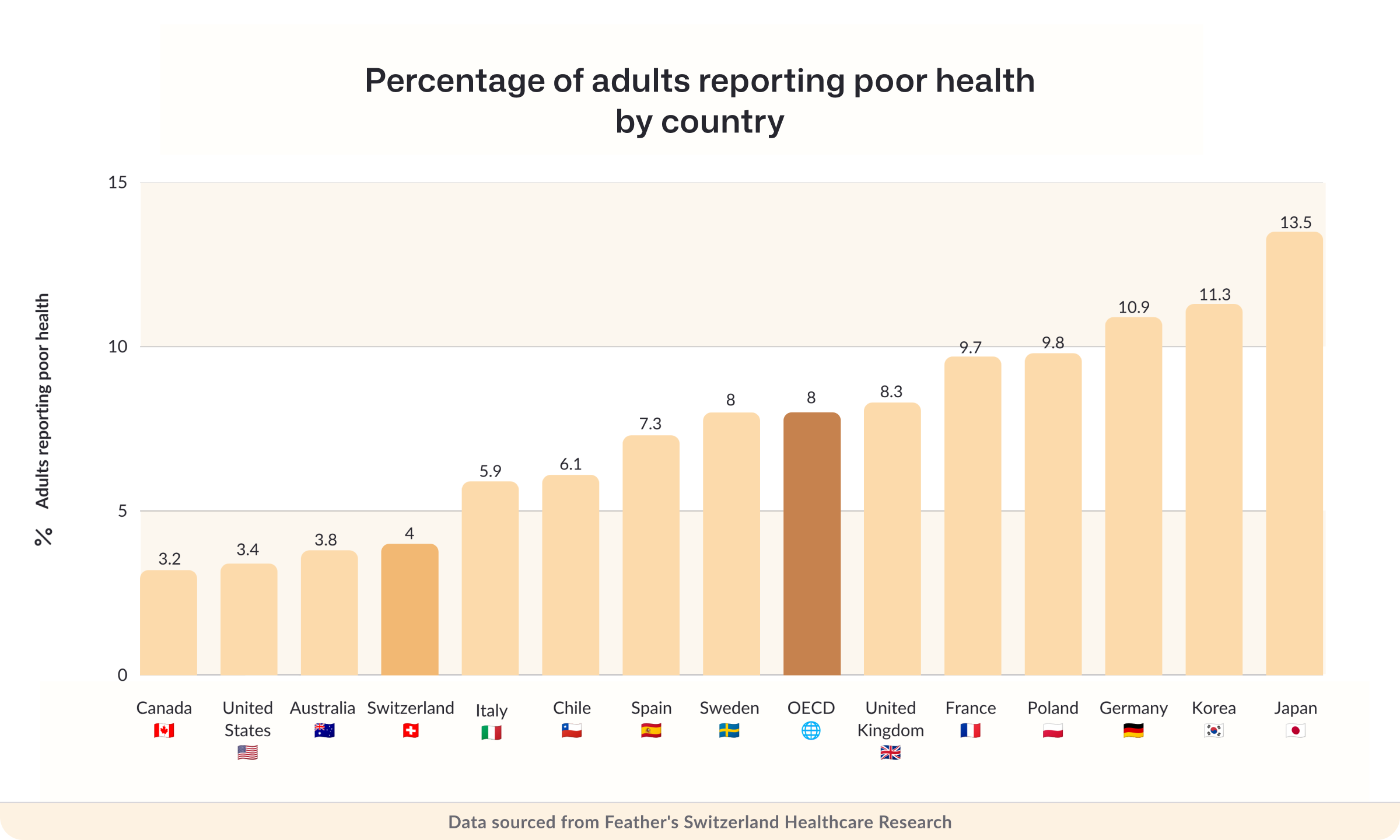
4% of Swiss adults rate their health as poor or very poor. That's one of the lowest rates in the OECD, and half the OECD average of 8%.
In 2022, 78.7% of Swiss men and 73.4% of Swiss women described themselves as physically active. In the same year, 75.8% of women said they paid close attention to their diet, compared to 65.6% of men.
Swiss adults drink an average of 8.0 liters of alcohol per person a year, slightly below the OECD average of 8.5 liters. Daily drinking is much more common among men (12.4%) than women (4.9%).
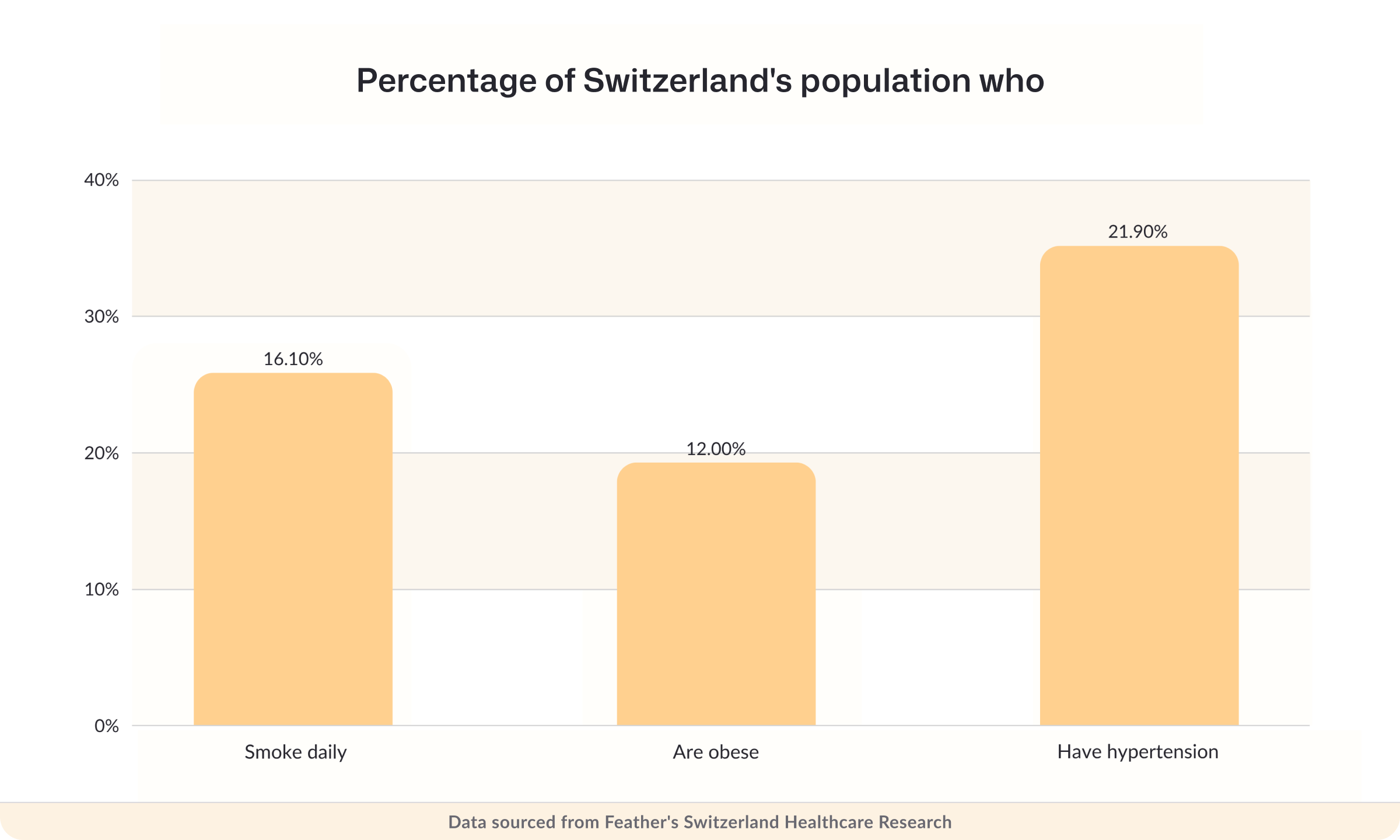
Approximately 16.1% of Swiss adults smoke daily, slightly above the OECD average of 14.8%.
12% of adults are obese, and 21.9% have hypertension. 22% of adults don't get enough physical activity.
Source: OECD, World Health Organization, Federal Statistical Office
Cause of death statistics in Switzerland
In 2021, 82.1% of deaths in Switzerland were due to noncommunicable diseases. Another 12.4% were attributed to communicable diseases and other conditions, and the remaining 5.5% to injuries.
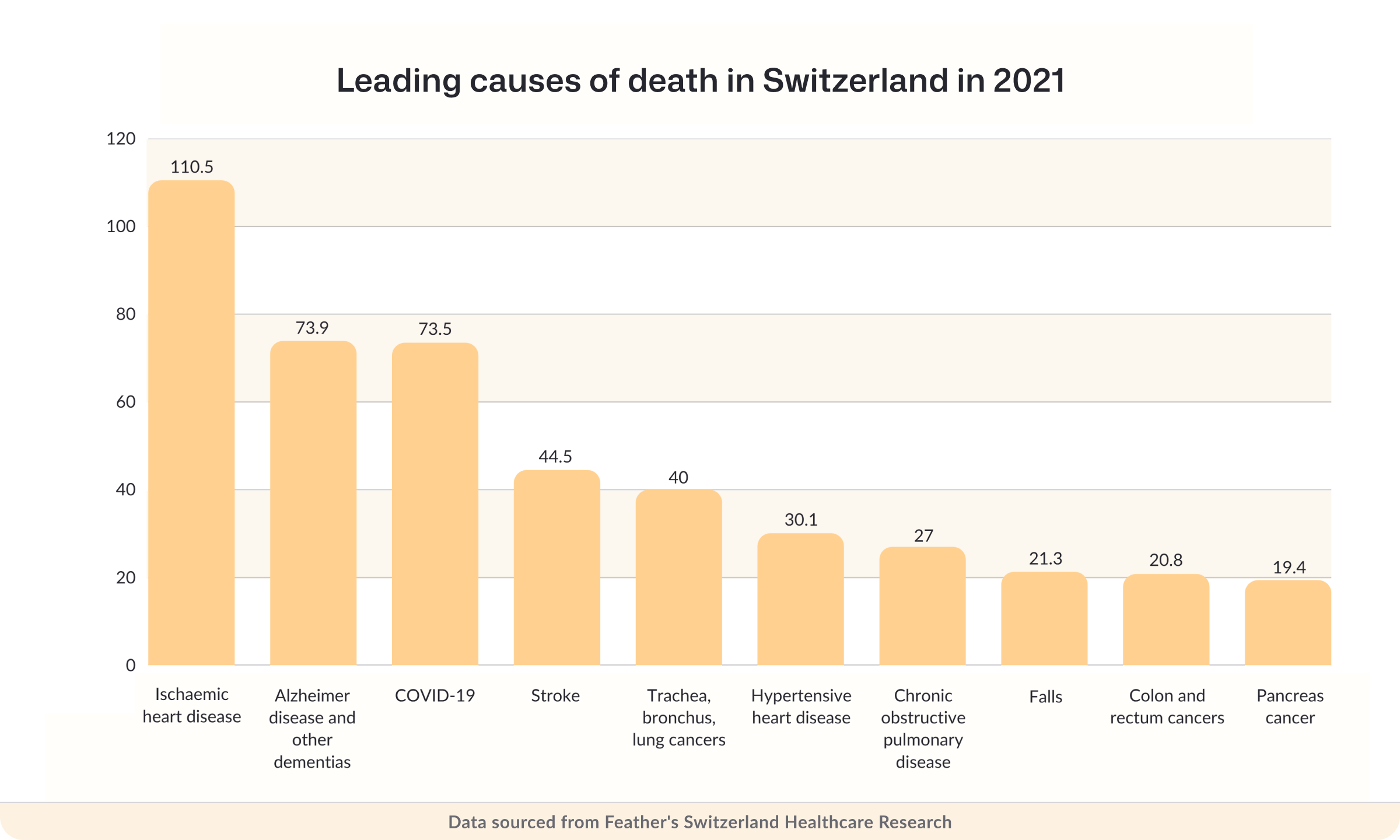
Switzerland's three leading causes of death in 2021 were:
- Ischemic heart disease, with 110.5 deaths per 100,000 people
- Alzheimer's disease and other dementias, with 73.9 deaths per 100,000 people
- COVID-19, with 73.5 deaths per 100,000 people
The table below shows the 10 leading causes of death per 100,000 people in Switzerland:
Source: World Health Organization
How many doctors and nurses are there in Switzerland?
In 2025, Switzerland had an average of 4.5 practicing physicians per 1000 people, 0.6 more than the OECD average of 3.9.
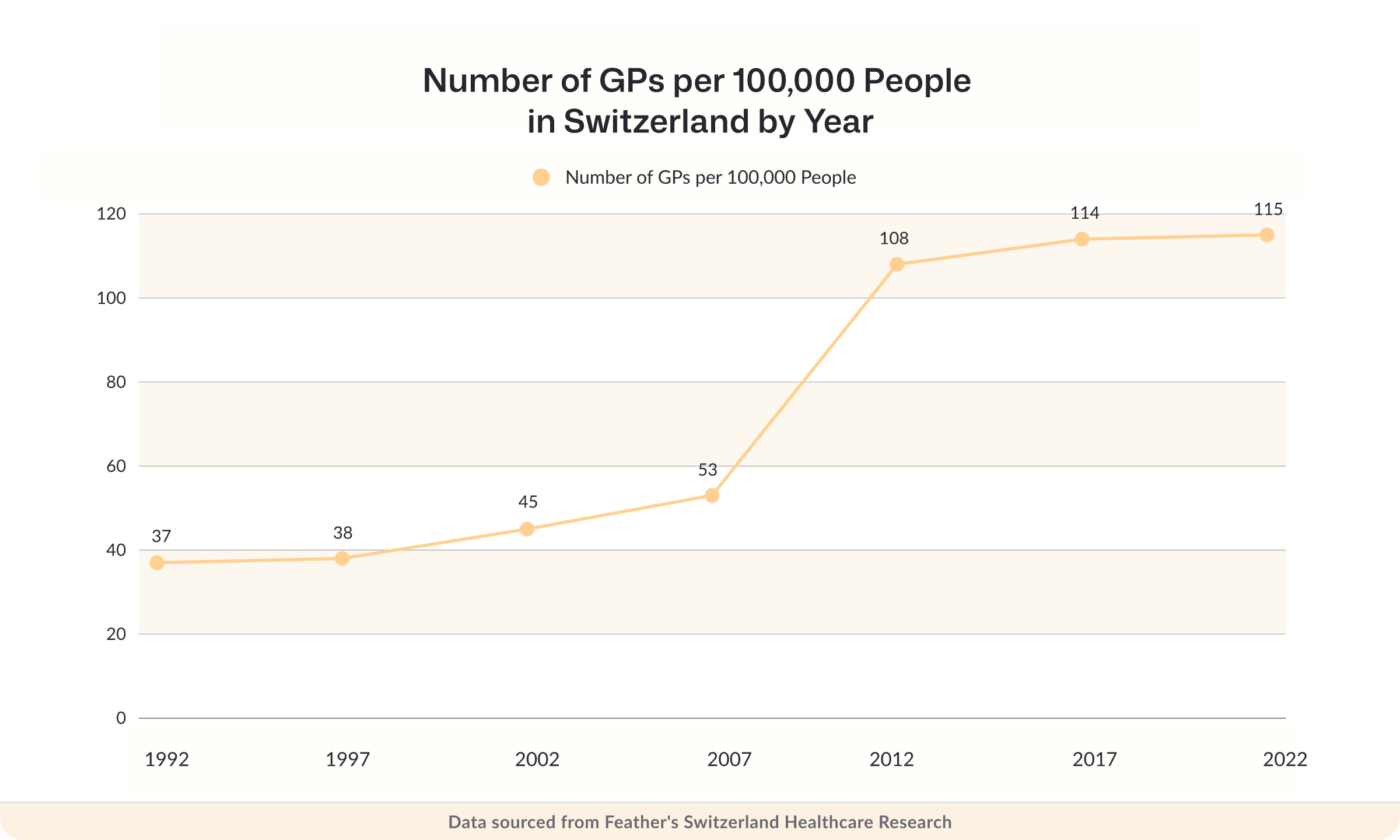
GP numbers have grown enormously. Between 1992 and 2022, GPs per 100,000 people in Switzerland more than tripled. In 1992, there were just 37 GPs per 100,000 Swiss residents. By 2007, that had risen modestly to 53 per 100,000.
By 2012, it had more than doubled to 108 per 100,000, before reaching 115 per 100,000 in 2022.
Switzerland has approximately 18.8 practicing nurses per 1000 people, more than double the OECD average of 9.2.
It also has 8.4 long-term care workers per 100 people aged 65 and over. That's above the OECD average of 5, and far above Canada's 3.7.
On equipment, Switzerland has 72 CT, MRI and PET scanners per million people. That's above the OECD average of 51 per million, and double Portugal's 32 per million.
Mental health is well staffed too. In 2023, there were 53 psychiatrists per 100,000 people, far above the high-income country average of 13 per 100,000.
Source: OECD, World Health Organization, Commonwealth Fund
How many hospital beds are there in Switzerland?
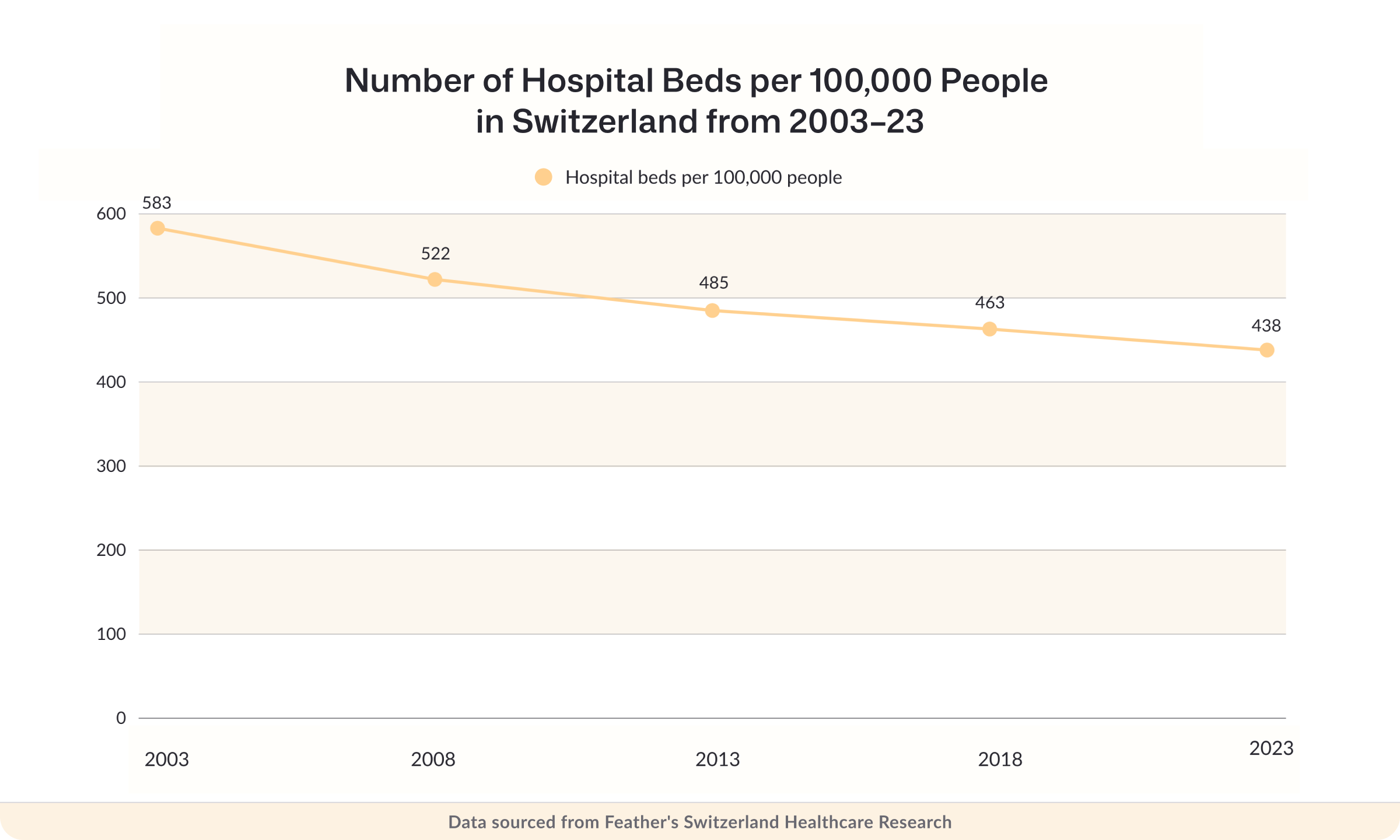
Hospital beds have been falling steadily. Between 2003 and 2023, the number in Switzerland declined year after year.
In 2023, the country had 438 hospital beds per 100,000 people, down from 583 per 100,000 in 2003.
That's roughly 4.38 hospital beds per thousand people, 0.38 more than the OECD average of four hospital beds per 1000 people.
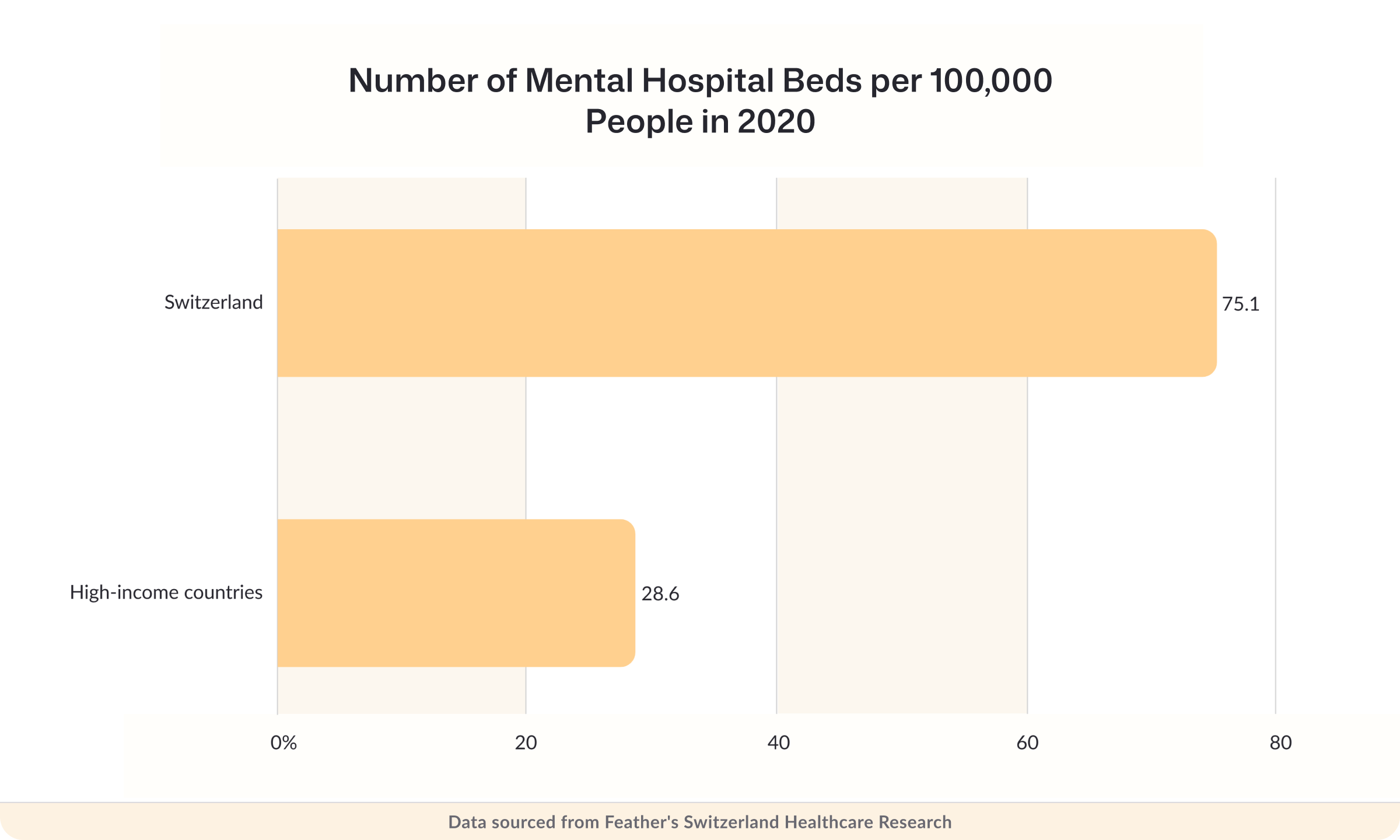
Mental health beds are where Switzerland really stands out.
In 2020, Switzerland had 75.1 mental hospital beds per 100,000 people, more than double the 28.6 per 100,000 average across high-income countries.
Source: World Bank, Commonwealth Fund, OECD
Vaccination and cancer screening coverage in Switzerland
96% of eligible Swiss children have had three doses of the DTP vaccine, 3 percentage points above the OECD average of 93%.
Breast cancer screening lags a little. 50% of women aged 50 to 69 have been screened, below the OECD average of 55–56%.
Source: OECD


