
Health & healthcare in Brazil: Statistics, trends & facts (2026)
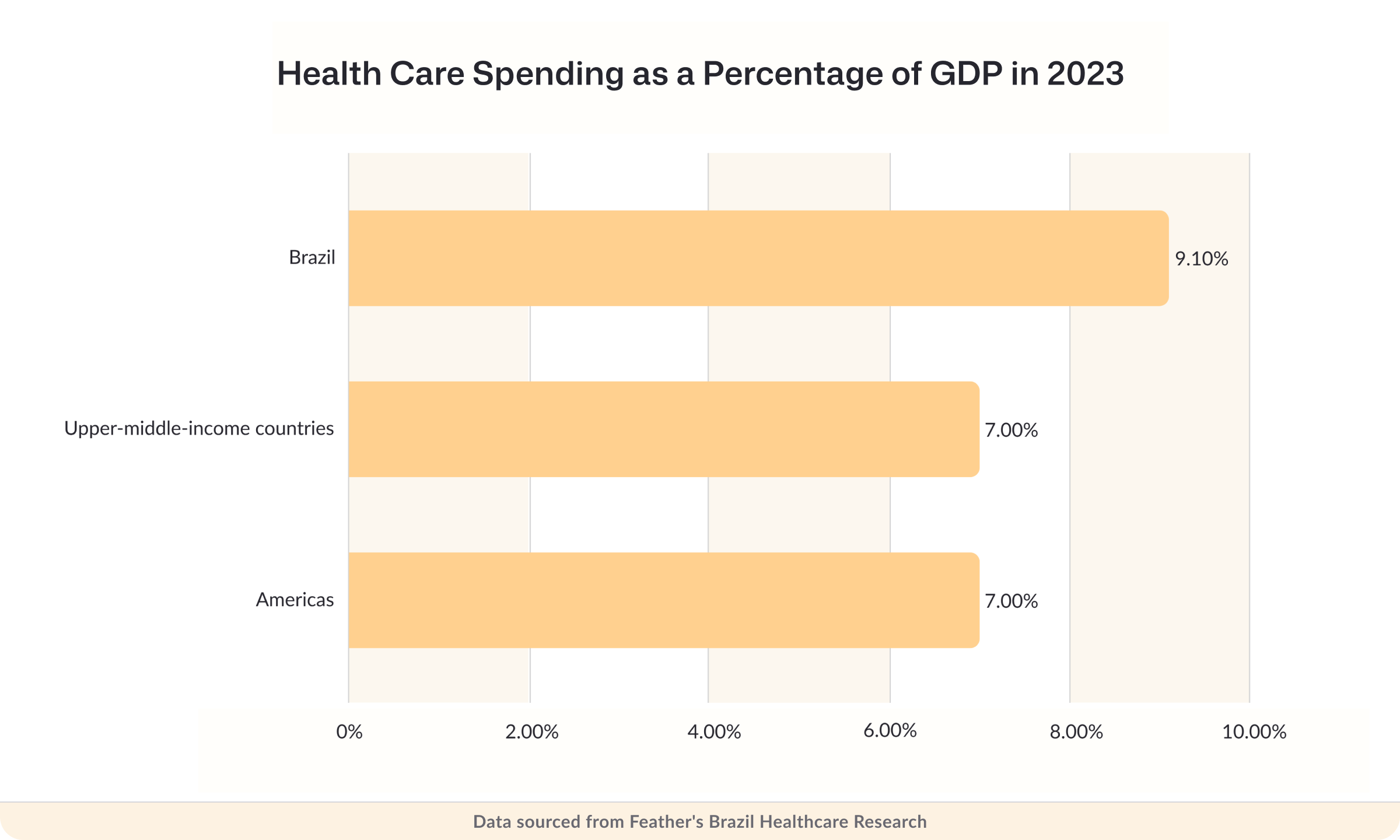
Brazil spends more of its GDP on healthcare (9.1%) than the average upper-middle-income country (7%). Yet health outcomes have improved only modestly since 2000. Between 2000 and 2021, average life expectancy in Brazil rose by less than a year.
So why isn't the spending translating into better health? If you're living in Brazil, or planning to, it's a question worth understanding before you decide how to cover yourself.
In this article, we'll cover:
- Who lives in Brazil, and how long (and how healthily) they can expect to live
- How much Brazil spends on healthcare, and where the money comes from
- How public and private coverage fit together, and how much people pay out of pocket
- How healthy Brazilians are, and what they're most likely to die from
- How many doctors, hospitals and hospital beds the country has
First, the headline numbers.
Key Brazilian healthcare statistics: our top picks
- In 2024, only 37% of Brazil's 7,309 hospitals were government owned and operated.
- Between 2000 and 2021, Brazil's average life expectancy rose by less than a year, from 71.5 years to 72.43 years.
- Brazil's 2022 per-person health spend of US$1,700 is less than one‑third of the OECD average of US$5,300.
- Out-of-pocket spending accounted for 27.4% of all healthcare spending in 2023.
- Brazil's 164 mental health professionals per 100,000 people is 10 times more than the average across upper-middle-income countries.
Brazil's population statistics
In 2025, Brazil had an estimated population of 213,421,037 people, up from 211,140,729 in 2023. By 2050, it's projected to grow by around 3%, to 217,480,299 people.
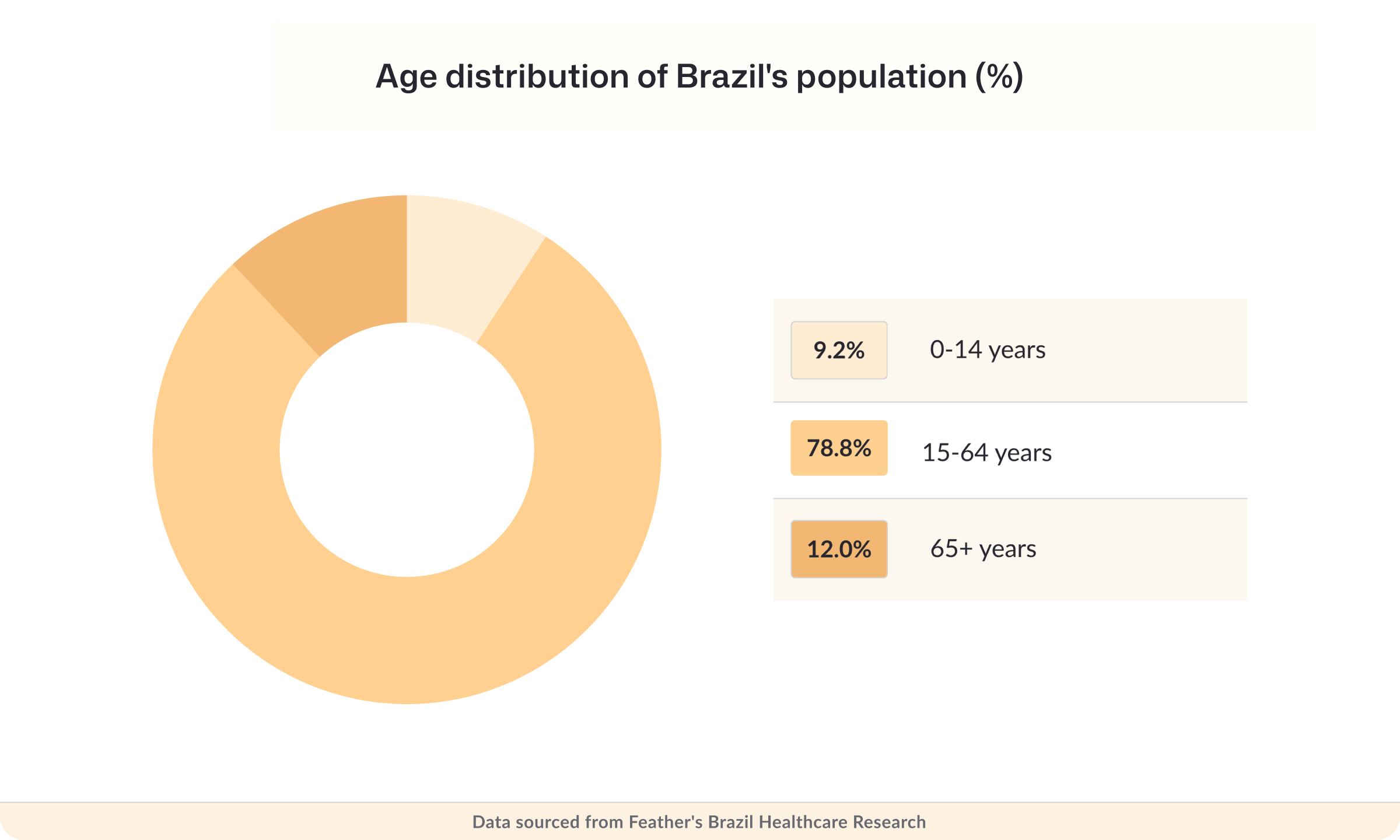
9.2% of Brazilian residents are under 14. The majority, 78.8%, are aged 15 to 64. The remaining 12% are over 65.
Source: World Health Organization, IBGE
What percentage of Brazil's population lives in urban areas?
88% of Brazil's population lived in urban areas in 2025, with the other 12% in rural areas.
That's a higher urban share than the European Union (75%), OECD members (81%) and upper-middle-income countries (68%).
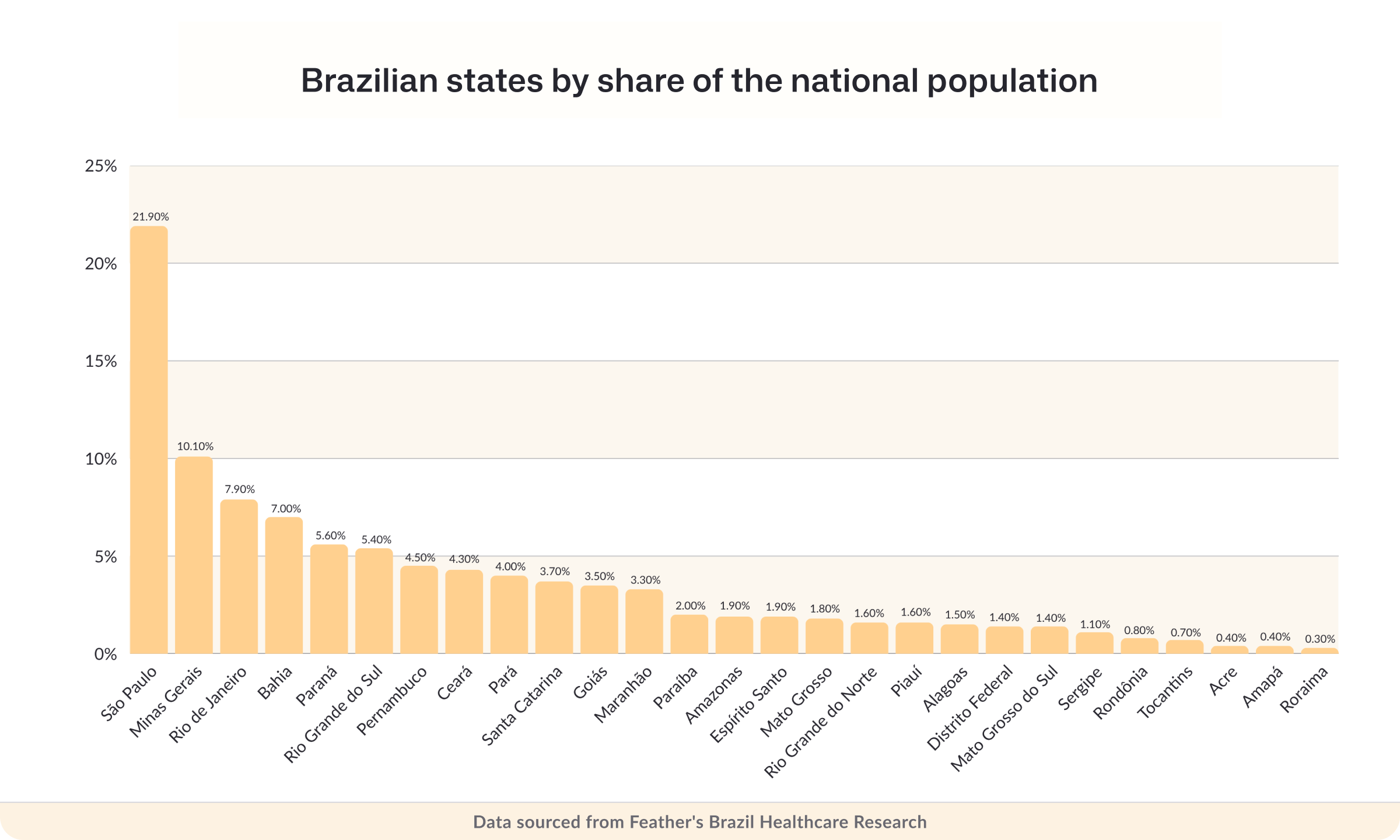
Among Brazil's 26 states and one federal district, São Paulo is by far the most populous.
In 2026, an estimated 46,179,008 people live in the state, or 21.9% of the country's total.
Minas Gerais comes next with 21,460,311 people (10.1%), followed by Rio de Janeiro with 17,225,410 people (7.9%).
Source: World Bank, IBGE
Life expectancy statistics in Brazil
In 2021, average life expectancy in Brazil was 72.4 years.
Between 2000 and 2021, it rose by less than a year, from 71.5 years to 72.43 years. Over the same period, life expectancy across Europe rose by 3.89 years, but by just 0.03 years across the Americas as a whole.
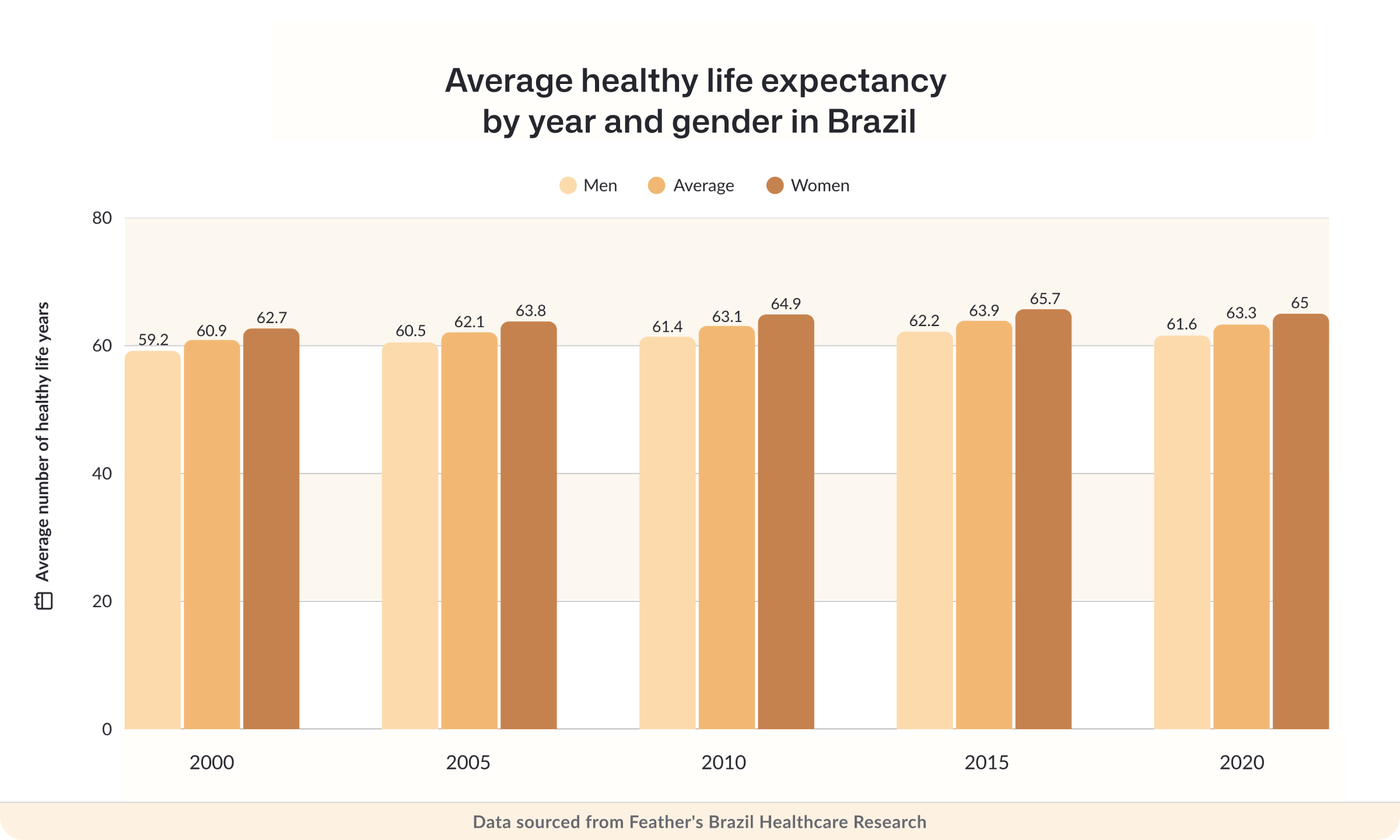
In 2021, the average Brazilian could expect 61.8 healthy life years, an increase of 0.91 years since 2000.
That's just below the global average of 61.9 healthy life years, and below the 63.2 average for the Americas.
Women do noticeably better than men. In 2020, approximately 3.4 years separated them: Brazilian men could expect 61.6 healthy life years, and women 65.
Source: World Health Organization
How much does Brazil spend on healthcare?
In 2025, Brazil spent approximately 9.1% of its GDP on healthcare. That's more than the average for upper-middle-income countries and for the Americas as a whole, both of which spend 7% of GDP.
As a share of GDP, that's generous. Per person, it's a different story.
In 2022, Brazil spent around US$1,700 per person on health, less than one‑third of the OECD average (US$5,300).
That's roughly in line with the OECD's Latin American members:
- Mexico: US$1,400 per person
- Colombia: US$1,630 per person
- Costa Rica: US$1,770 per person
At the other end of the scale sit the United States (US$12,740), Switzerland (US$8,910), Norway (US$8,640) and Germany (US$8,540). All of them spent at least five times more per person than Brazil.
Source: Commonwealth Fund, World Health Organization, OECD
Where does Brazil spend its healthcare budget?
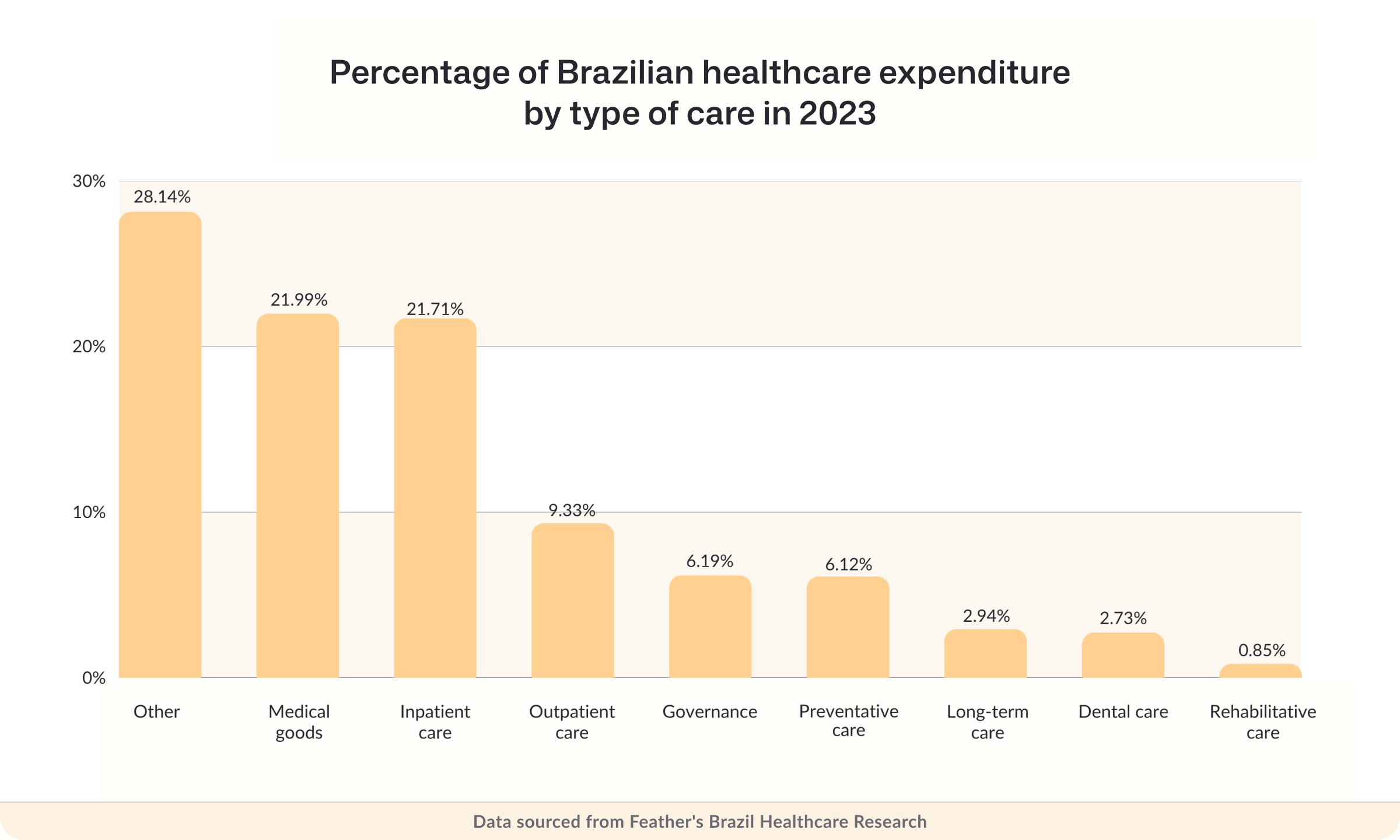
In 2021, "other and non-specified" health spending was the largest single category, at 28.14% of Brazil's total health spending.
The five largest areas of health spending were:
- Other health-related spending (28.14%)
- Medical goods (21.99%)
- Inpatient care (21.71%)
- Outpatient care (9.33%)
- Governance (6.19%)
Source: World Health Organization
How much does Brazil spend on pharmaceuticals?
In 2021, medicines accounted for 2.5% (US$ 2.3 billion) of government health spending. That's the most the government has spent on medicines since 2015, when it spent US$2 billion.
Households are spending far more. Household spending on medicines rose from US$11 billion in 2010 to US$ 31 billion in 2021.
Source: Commonwealth Fund
Where does healthcare funding in Brazil come from?
Everyone in Brazil is covered. All residents and visitors, including undocumented people, can access a core set of health services through the public system. That includes primary care, outpatient specialty care, mental healthcare, hospital care and prescription drugs.
About 80% of Brazil's citizens rely solely on public health services. Another 24% have additional private health insurance.
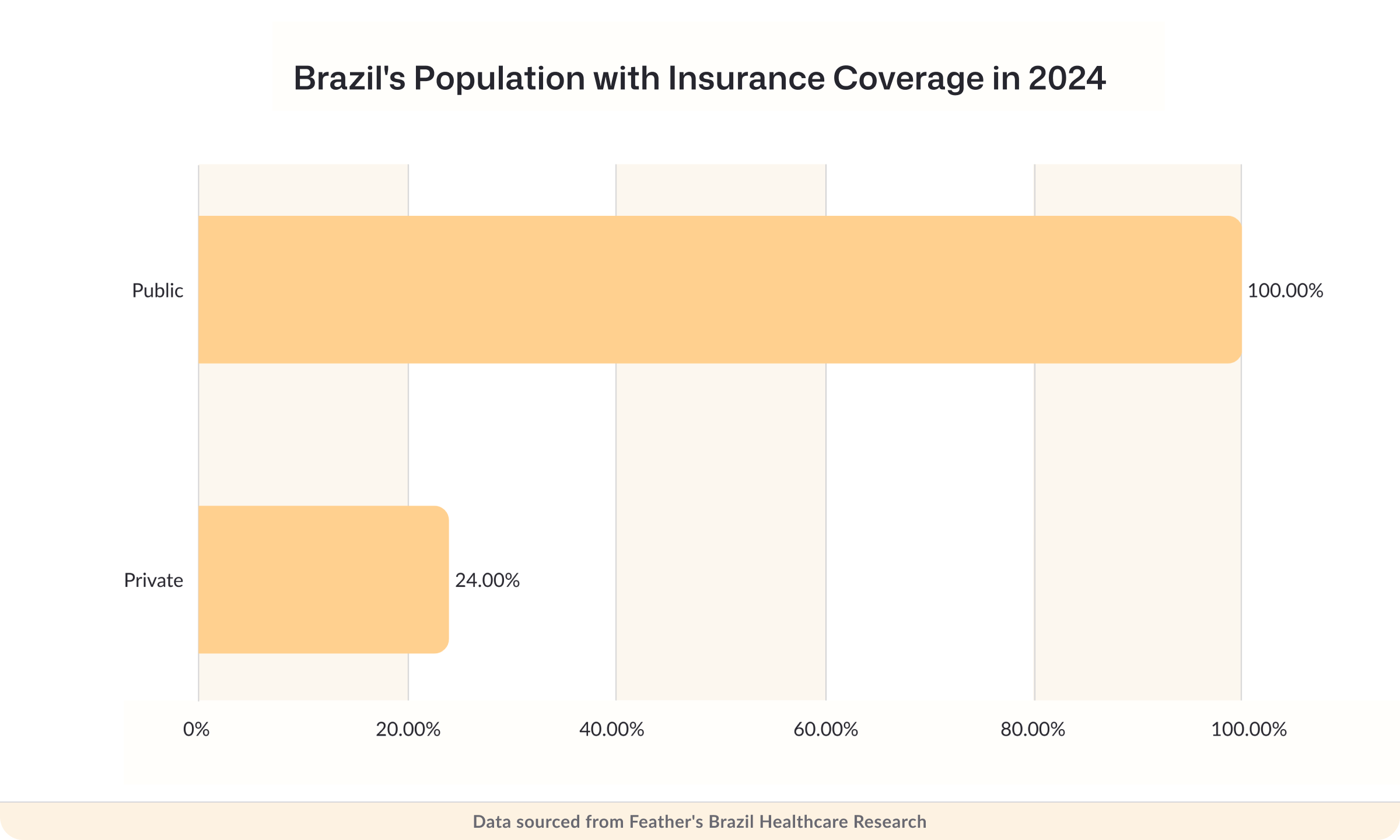
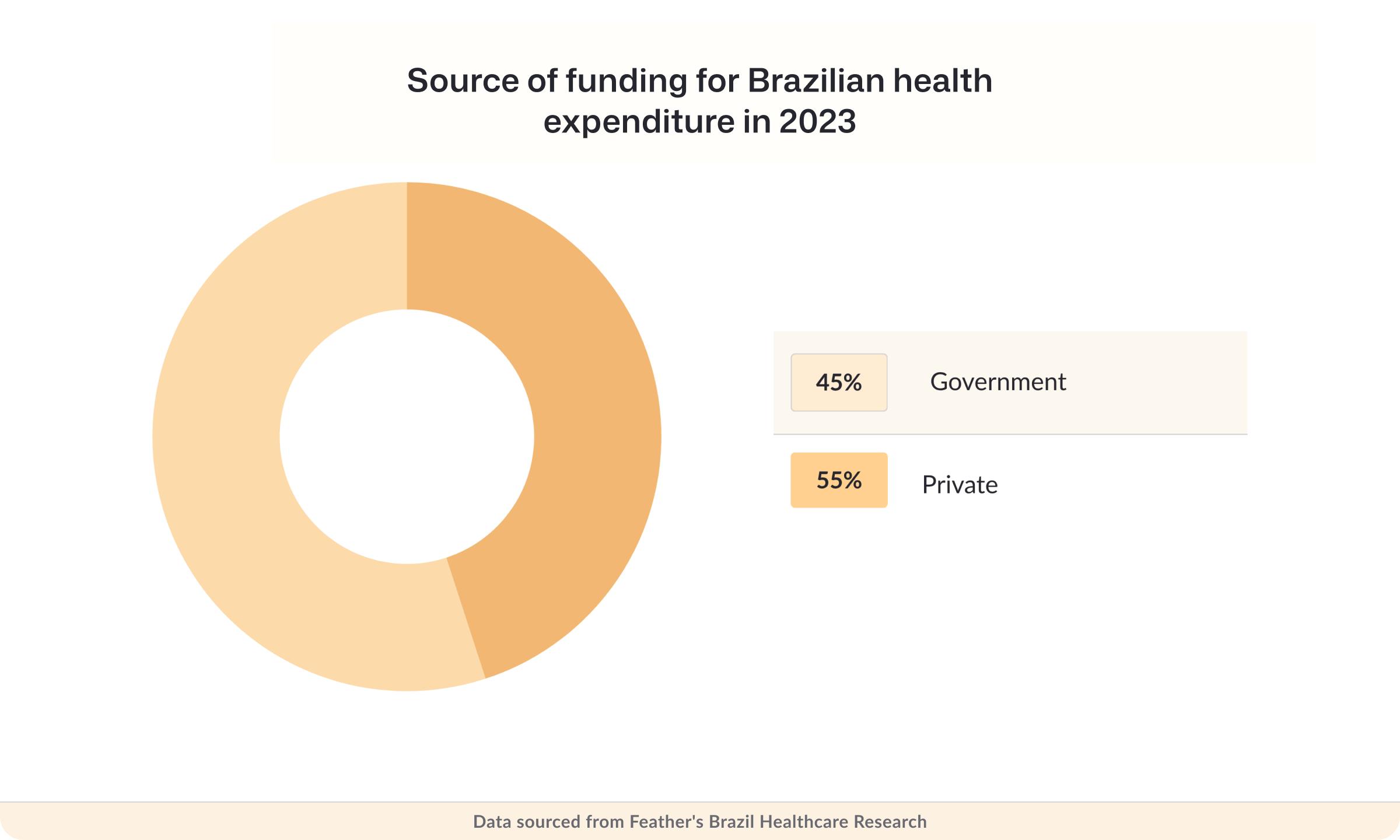
Even so, private money pays for most healthcare in Brazil. In 2023, 45% of all health funding came from the government. Private sources made up the majority, at 55%.
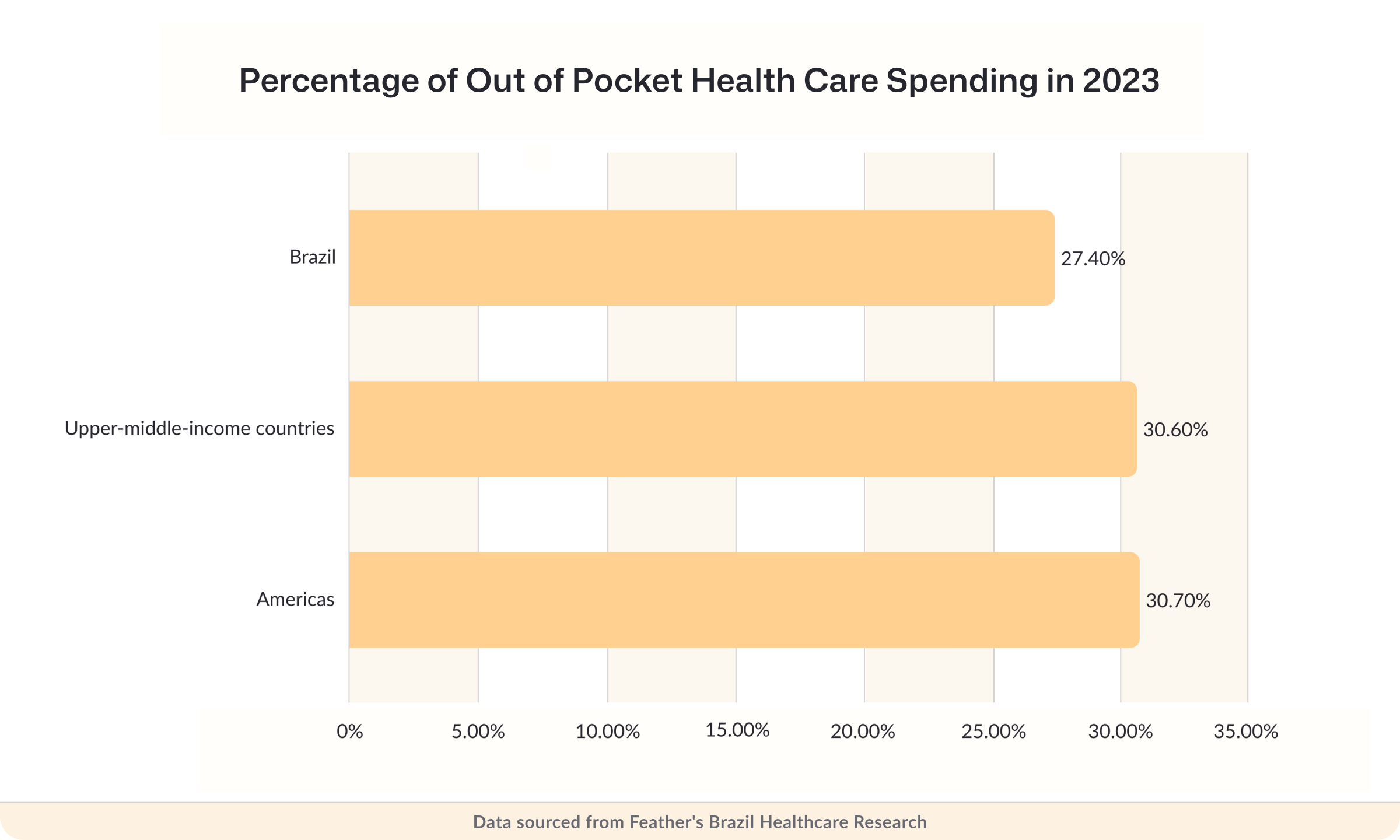
A big chunk of that is paid directly by patients. In 2023, out-of-pocket spending accounted for 27.4% of all healthcare spending in Brazil, down from 33% in 2007.
That's one of the largest sources of health funding in the country. It's still below the average for upper-middle-income countries (30.6%) and the Americas as a whole (30.7%).
Source: Commonwealth Fund, World Health Organization, World Health Organization
How healthy are people in Brazil?
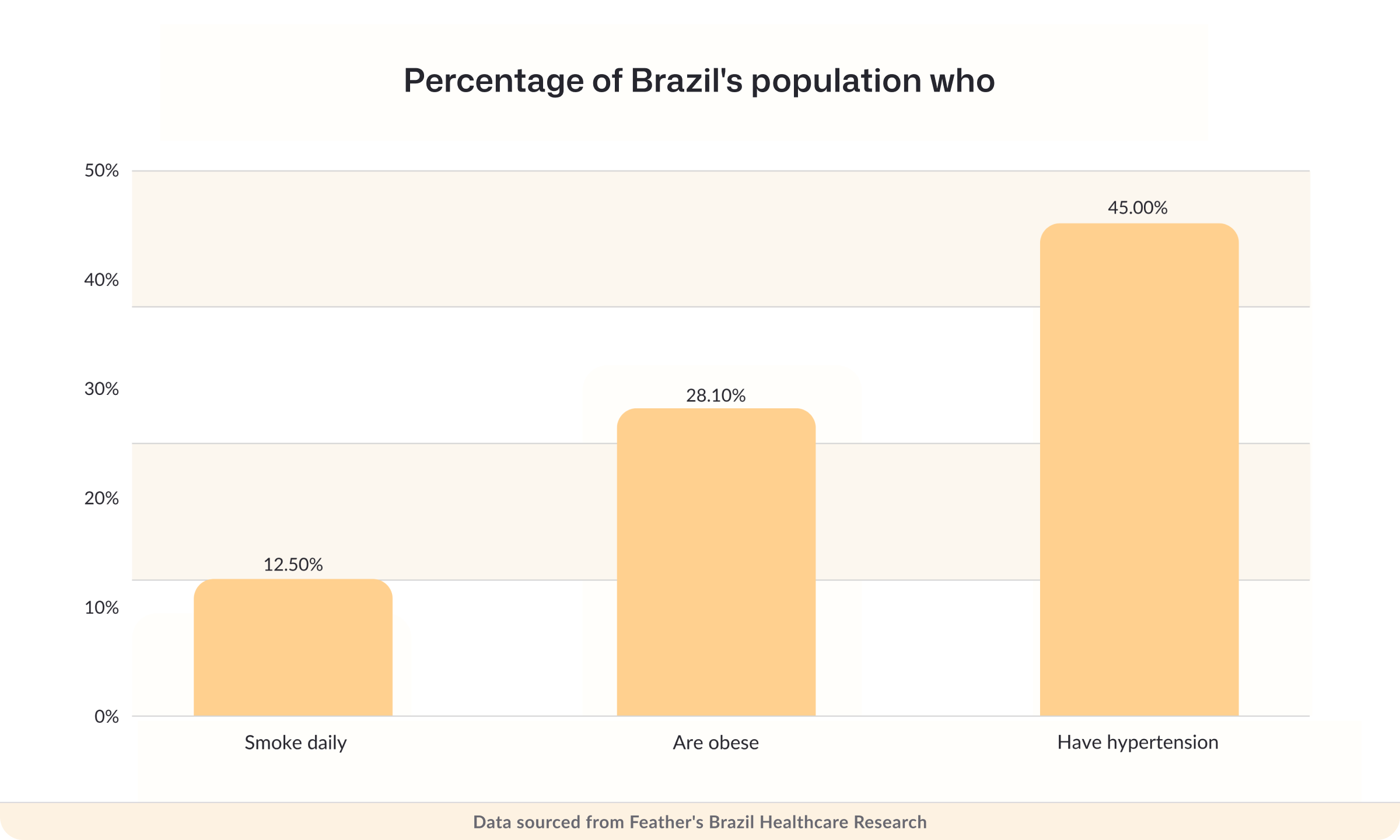
In 2022, approximately 12.5% of Brazilians aged 15 and older smoked daily. The average adult drank roughly 9.52 liters of alcohol a year.
Blood pressure is a major concern. 45% of Brazilian adults over 30 have been diagnosed with hypertension. And 28.1% of Brazilian adults are obese.
Among children and adolescents, 15.5% are obese.
Source: World Health Organization
Cause of death statistics in Brazil
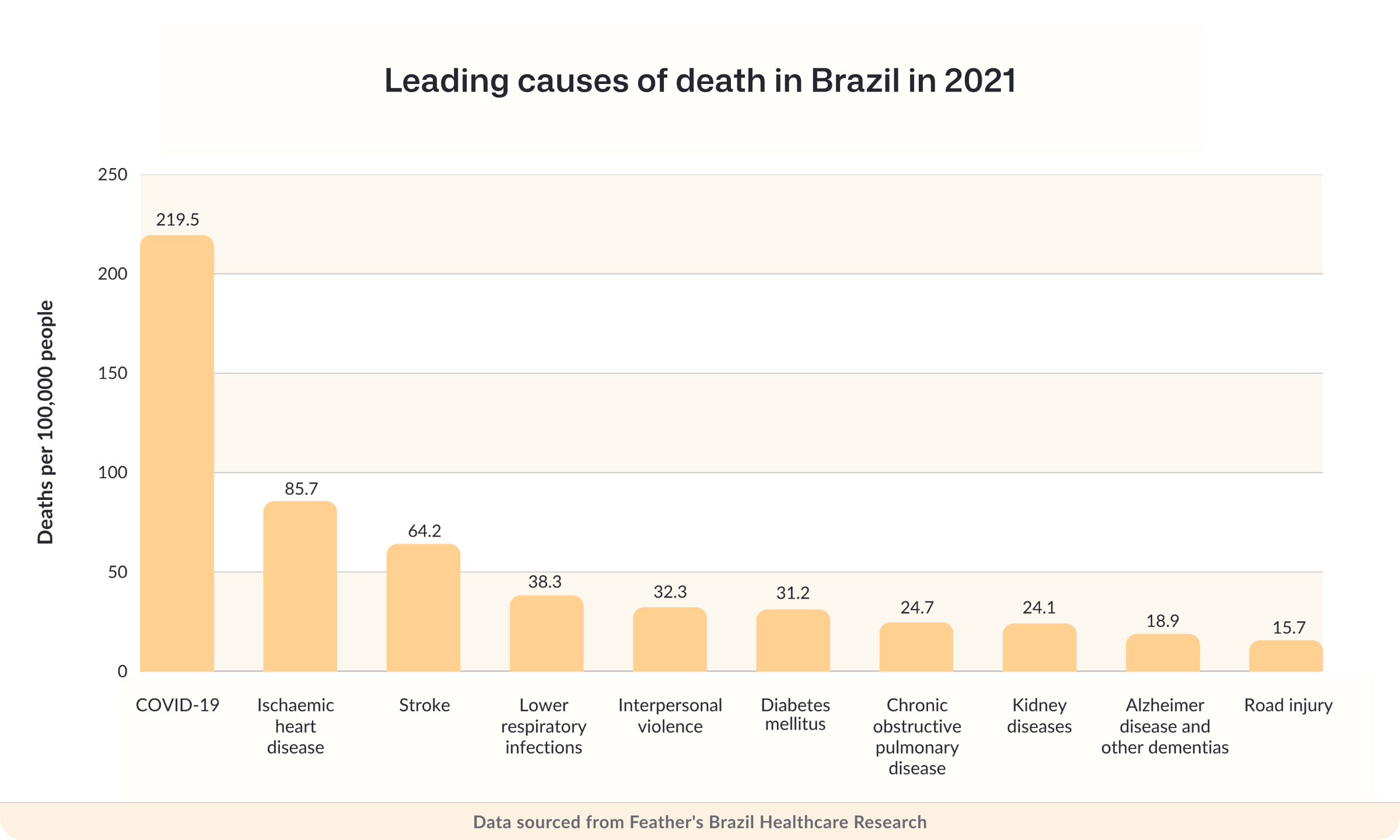
In 2021, Brazil's three leading causes of death were:
- COVID-19, with 219.5 deaths per 100,000 people
- Ischemic heart disease, with 85.7 deaths per 100,000 people
- Stroke, with 64.2 deaths per 100,000 people
The table below shows the 10 leading causes of death per 100,000 people in Brazil:
Injuries and violence account for a larger share of deaths in Brazil than in many upper-middle-income and high-income countries.
In 2021, interpersonal violence was the fifth leading cause of death, at 32.3 deaths per 100,000 people. Road injuries accounted for 15.7 deaths per 100,000 in the same year.
Guns and gun violence were responsible for 18 deaths per 100,000 in Brazil in 2023.
Source: World Health Organization, Commonwealth Fund
How many doctors are there in Brazil?
Brazil had 235.7 physicians for every 100,000 people in 2023, compared to an average of 280 per 100,000 across the Americas.
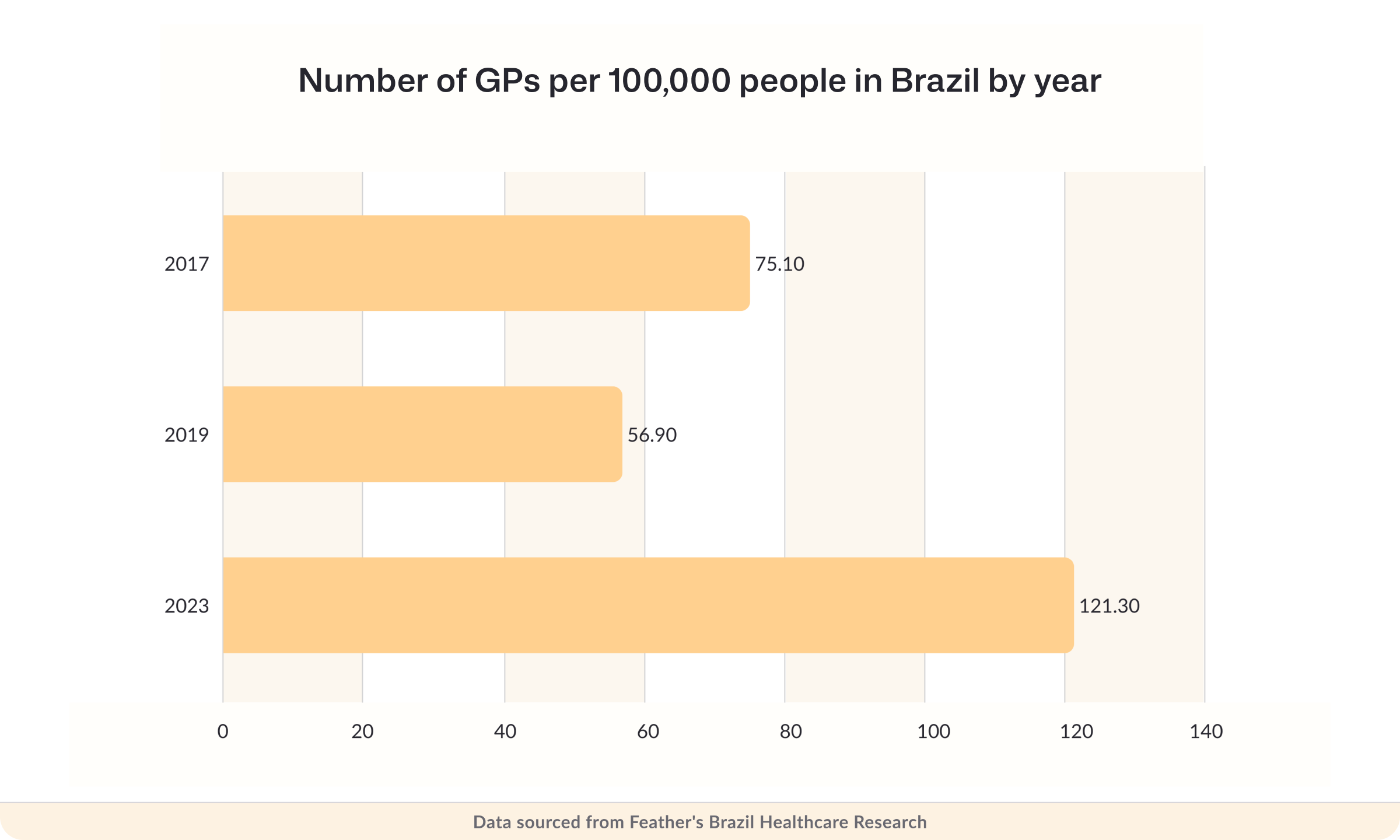
Primary care has grown fast. In 2023, there were 121.3 GPs for every 100,000 people, up from 75.1 per 100,000 in 2017. The country also had 57.9 specialist medical practitioners for every 100,000 people.
Mental health is a strength. Brazil had an average of four psychiatrists per 100,000 people in 2020, double the 2 per 100,000 average across upper-middle-income countries.
In the same year, Brazil had 164 mental health professionals per 100,000 people, more than ten times the 15 per 100,000 average for upper-middle-income countries.
In 2023, Brazil had approximately 550 nurses and midwives per 100,000 people, compared to an average of 671 per 100,000 across the Americas.
Source: Commonwealth Fund
How many hospitals are there in Brazil?
In 2024, the Brazilian Hospitals Federation and the National Confederation of Health, Hospitals, Establishments and Services estimated that Brazil had about 7,309 hospitals.
About 63% (4,599 hospitals) were private. Only 37% (2,710 hospitals) were government owned and operated.
Source: Commonwealth Fund
How many hospital beds are there in Brazil?
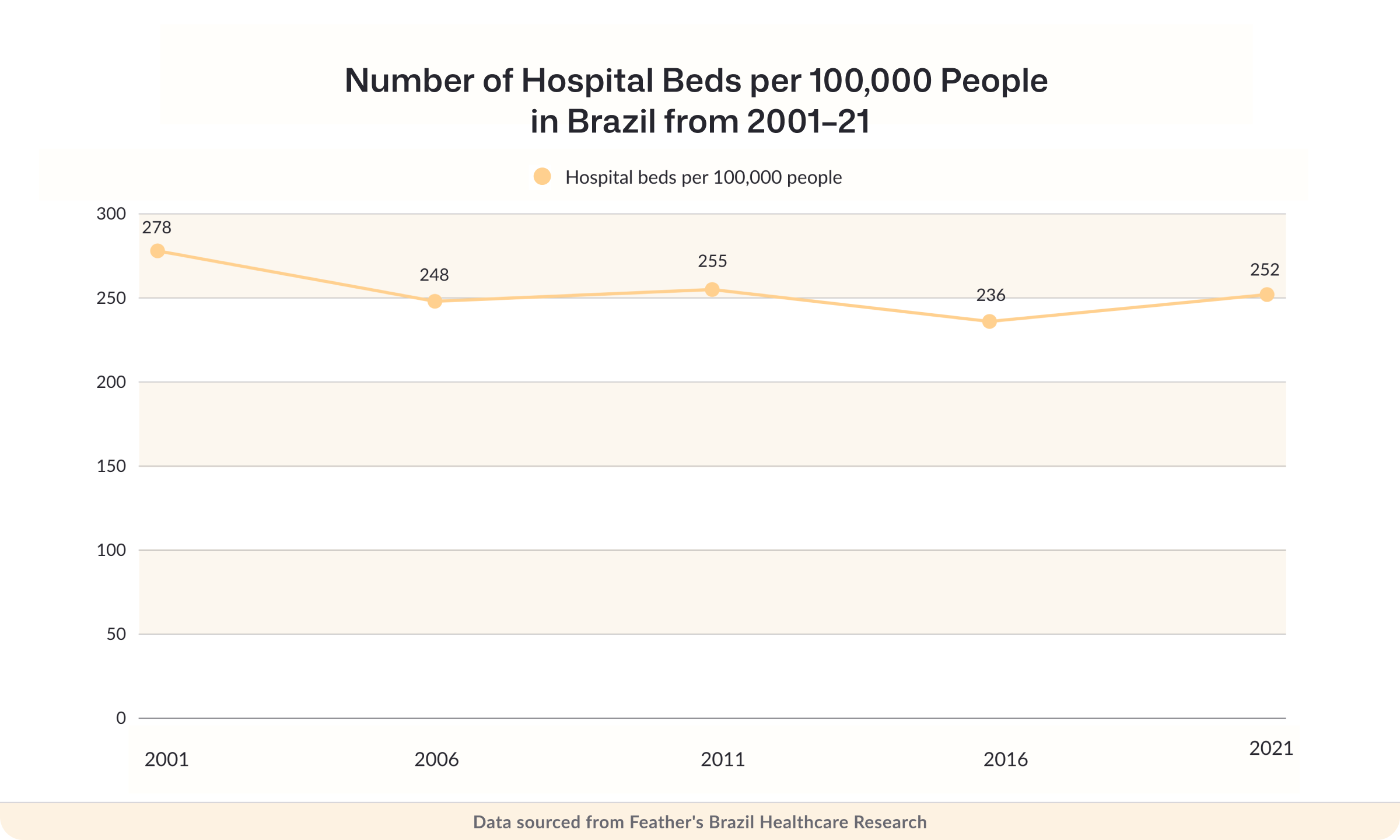
In 2021, Brazil had 252 hospital beds per 100,000 people, down from 278 per 100,000 in 2001.
That's 2.52 beds per 1,000 people, below the 4.2 per 1,000 average across upper-middle-income countries.
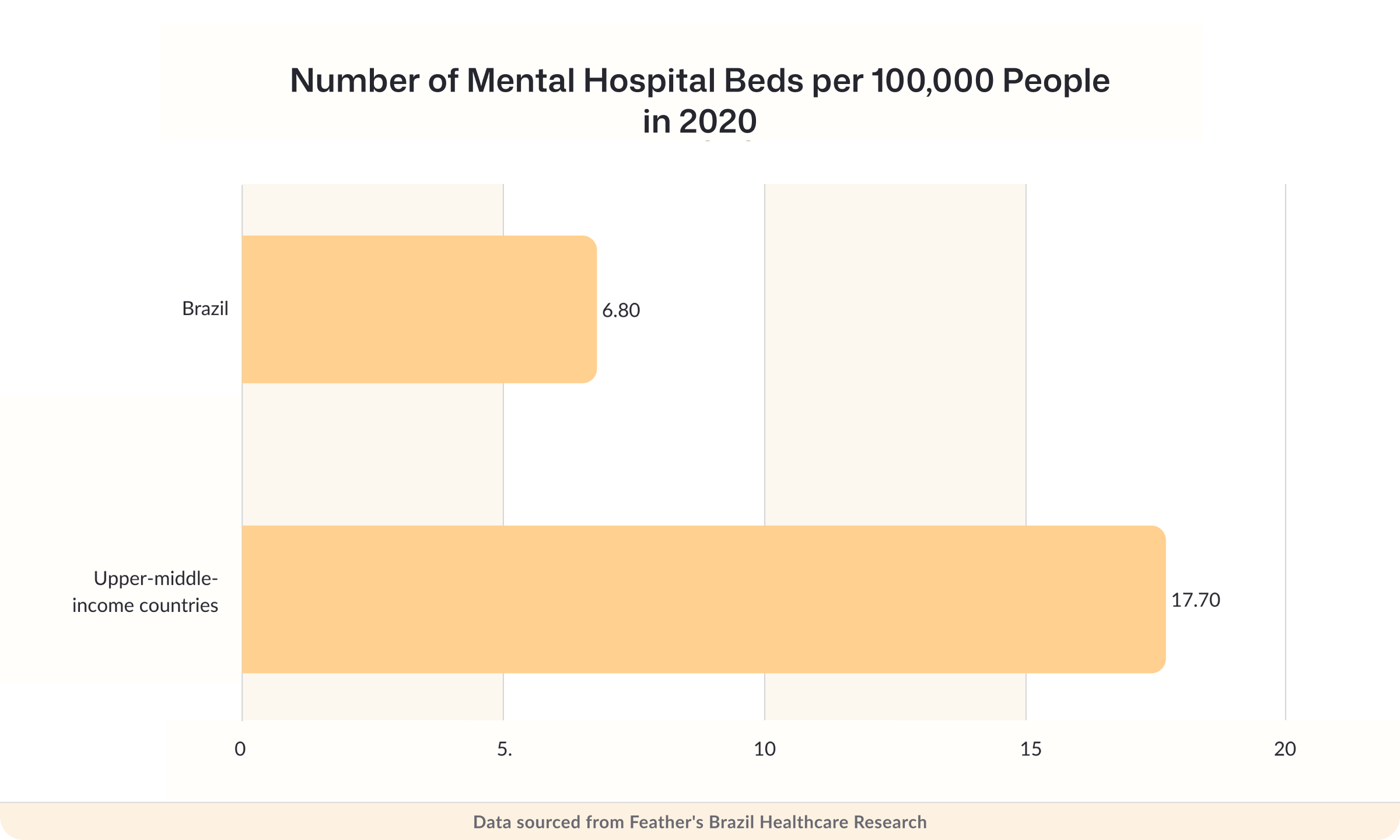
Mental health beds are scarce too, despite the strong workforce.
In 2020, Brazil had 6.8 mental hospital beds per 100,000 people. That's less than half the 17.7 per 100,000 average across upper-middle-income countries.
Source: Commonwealth Fund, World Bank


